
Florida sewage driller tests 100-foot nuclear reactor canister for Deep Fission
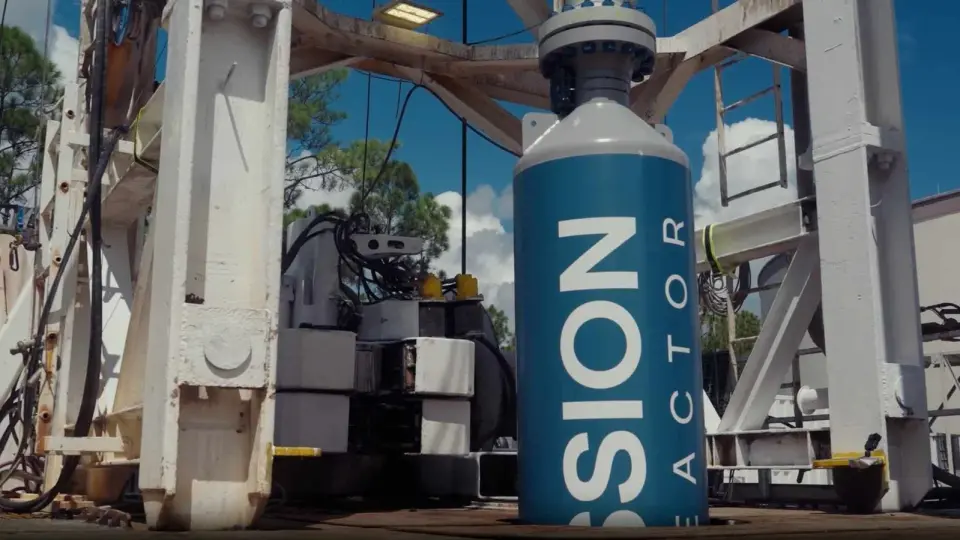
Deep Fission successfully lowered a 20-foot, 30-inch-wide prototype reactor canister 100 feet into a 34-inch borehole in Fort Myers, Florida, and retrieved it using commercial rigging. The test, conducted on September 3, validated the tight clearance and handling mechanics required for the company's plan to place pressurized water reactors one mile underground. The drilling was performed by Youngquist Brothers, a Florida contractor specializing in large-diameter sewage wells since 1971. This collaboration, announced on September 21, aims to adapt existing commercial drilling methods for deep nuclear deployment, with commercial operations targeted for 2027.
Key points
- Deep Fission lowered a full-size, 20-foot steel reactor canister 100 feet into a 34-inch borehole in Fort Myers, Florida, on September 3, achieving 2 inches of clearance per side.
- The test used commercial rigging and equipment from Youngquist Brothers, a contractor that has drilled large-diameter wells in Florida since 1971, rather than custom-built nuclear-specific machinery.
- The collaboration was formally announced on September 21, 18 days after the test, to address the engineering challenge of constructing and maintaining one-mile-deep boreholes for underground reactors.
- Deep Fission’s Gravity Nuclear Reactor uses standard low-enriched uranium fuel and pressurized water technology, relying on surrounding rock and water for containment and cooling instead of a concrete dome.
- The company is targeting commercial deployment as early as 2027 and is currently advancing its first project in Parsons, Kansas, under the U.S. Department of Energy’s Reactor Pilot Program.
Background
This development follows earlier coverage of Deep Fission’s progress in Parsons, Kansas, where the company received DOE approval for its safety design in July 2026. The Kansas site is undergoing state permitting for a larger proof-of-concept borehole. The current Florida test serves as a preliminary validation of handling mechanics at a shallow depth, distinct from the full-depth drilling required for the Kansas deployment. This approach contrasts with traditional nuclear construction, which relies on bespoke, high-cost infrastructure, by leveraging existing commercial drilling expertise.
How outlets are covering it
AutoNotion emphasizes the practicality of using off-the-shelf commercial equipment to reduce costs, noting that the test proved the critical step of retrieving a reactor canister from a borehole. Interesting Engineering highlights the strategic partnership between Deep Fission and Youngquist Brothers, focusing on the adaptation of large-diameter drilling methods for nuclear applications. Oklahoma Energy Today provides broader context on the regulatory milestones, noting that the DOE approved Deep Fission’s safety framework in July 2026, though it does not authorize operation. It also mentions local opposition in Kansas regarding waste storage, a concern not addressed in the Florida test reports. The sources agree on the technical specifications of the test but differ in emphasis: AutoNotion focuses on the mechanical success, Interesting Engineering on the industrial collaboration, and Oklahoma Energy Today on the regulatory and local political landscape.
Why it matters
The successful test demonstrates that deep borehole nuclear reactors can utilize existing commercial drilling infrastructure, potentially lowering the high capital costs associated with bespoke nuclear construction. By validating the retrieval of a full-size canister with minimal clearance, Deep Fission addresses a key engineering hurdle for its 2027 commercial deployment target. This approach could accelerate the deployment of small modular reactors by leveraging decades of experience in large-diameter well drilling, moving the concept from theoretical design to practical engineering application.
What to watch
Deep Fission and Youngquist Brothers will continue testing drilling and borehole construction methods to meet the requirements for one-mile-deep deployment. The next phase involves scaling up from the 100-foot test to the full depth required for the Gravity Nuclear Reactor. Deep Fission aims to achieve commercial deployment as early as 2027, while continuing to advance its first project in Parsons, Kansas, under the DOE’s Reactor Pilot Program. Further testing will focus on validating the handling and installation of the reactor in deeper, water-filled boreholes.
- A 20-foot steel canister built to hold a nuclear reactor went 100 feet down a 34-inch borehole in Florida and came back up on the rigging, with 2 inches of clearance per side, run by the company that has drilled the state's sewage wells since 1971 Autonocion.com
- US nuclear startup taps large-bore drilling firm to advance 1-mile underground reactor project Interesting Engineering
- Deep Fission and Youngquist Brothers Announce Collaboration on Deep, Large-Diameter Borehole Drilling for Underground Nuclear Reactor Deployment The Joplin Globe
- Deep Fission releases safety design agreement for Parsons nuclear pilot project cnhinews.com
- Underground nuclear reactor project in SE Kansas advances Oklahoma Energy Today
Want the full story? Read the original reporting
Read on Autonocion.com