
Vanguard 500 Index Fund Marks 50 Years: From Flop to $1.7 Trillion Giant
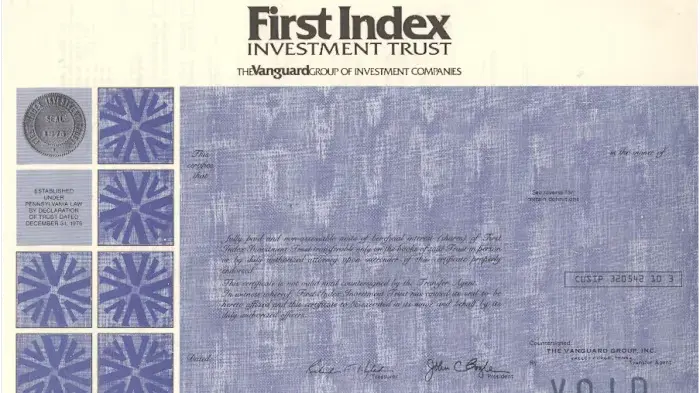
The Vanguard 500 Index Fund, originally launched as the First Index Investment Trust on August 31, 1976, has grown from a disastrous debut raising only $11.32 million to a massive asset manager holding $1.7 trillion. While early critics dismissed it as 'Bogle's Folly,' the fund's persistence and low-cost strategy have reshaped global investing, outperforming active managers and saving investors billions in fees over five decades.
Key points
- The First Index Investment Trust launched on August 31, 1976, with a failed initial offering that raised just $11.32 million against a target of $150 million, leading to its nickname 'Bogle's Folly.'
- Jack Bogle, who was previously ousted from Wellington Management, launched the fund partly to circumvent corporate restrictions and expand his influence, though he later championed passive investing as a mission.
- The fund did not reach $100 million in assets until 1981 and only surpassed Fidelity's Magellan fund to become the world's largest in April 2000.
- As of 2025, the fund's ETF share class recorded a record $137.7 billion in net new investment, and the total assets under management now exceed $1.7 trillion.
- A hypothetical $10,000 investment at the fund's inception in 1976 would have grown to approximately $2.0 million by March 2026, illustrating the power of low-cost compounding.
- The success of the fund is attributed to the Efficient Market Hypothesis and the 'Arithmetic of Active Management,' which suggests that after costs, active managers generally underperform passive index trackers.
Background
The rise of index funds has influenced broader financial policy, such as the recent Treasury guidance for 530A Trump Accounts, which emphasizes low-cost index funds like the S&P 500 to maximize long-term compound growth for children's accounts. This regulatory focus reflects the growing acceptance of passive strategies as a default for long-term investing.
How outlets are covering it
The Financial Times highlights the initial commercial failure and the political motivations behind Jack Bogle's decision to launch the fund, noting that it took decades for the strategy to gain traction. In contrast, Index Fund Advisors emphasizes the academic foundations of the fund, citing the work of Eugene Fama, Paul Samuelson, and William Sharpe to explain why passive investing outperforms active management after costs. The Investing News Network provides a more neutral, factual overview, confirming the fund's current status as the industry's first index fund for individual investors and its massive asset base, without delving into the historical controversies or academic theories.
Why it matters
The 50-year anniversary of the Vanguard 500 Index Fund underscores the fundamental shift in the asset management industry from active stock-picking to passive index tracking. It demonstrates how a concept initially dismissed as a 'cop-out' became the dominant strategy for millions of investors, driven by the undeniable math of lower fees and the efficiency of markets. This history serves as a cautionary tale for innovation in finance, showing that even superior ideas can face long periods of skepticism and failure before achieving widespread adoption and dominance.
What to watch
Investors and financial advisors will likely continue to debate the merits of active versus passive management, but the dominance of index funds is entrenched. The focus will remain on cost efficiency and tax advantages, with new products and strategies emerging to track various global benchmarks. The legacy of the Vanguard 500 will continue to influence how retirement and long-term savings are structured, reinforcing the principle that low costs and discipline are key to long-term wealth accumulation.
- Happy birthday to the First Index Investment Trust Financial Times
- The gospel of Jack Bogle The Economist
- Vanguard 500 Index Fund Turns 50: NYSE Content Update Investing News Network
- Fifty Years of "Bogle's Folly" Index Fund Advisors, Inc.
- Vanguard’s S&P 500 index fund changed how we invest — but there may be a smarter way to get a piece of the market MarketWatch
Want the full story? Read the original reporting
Read on Financial Times