As U.S. 10-year Treasury yields exceed 5%, top investors debate whether to buy bonds or hedge against a potential AI-driven market correction. While some view high yields as a historic opportunity, others warn of rising deficits and recommend gold or Bitcoin.
Q3 earnings season begins Tuesday with major banks reporting, amid concerns over soaring yields and a potential Federal Reserve rate hike. The September CPI report on Wednesday is critical for determining October monetary policy, while telecom stocks fell after SpaceX acquired spectrum licenses.
JPMorgan Asset Management is positioning high-quality fixed income as a 'generational opportunity' for investors seeking diversification away from concentrated AI equity exposure. Portfolio manager Priya Misra notes that investors can now access 6.5% yields in top-tier corporate debt without descending into lower credit tiers. This strategy offers a diversified return profile that contrasts with the volatility of the current tech-heavy market.
Major US banks are set to report third-quarter earnings next week, marking the start of a pivotal earnings season. While the sector enjoyed a historic first half driven by AI and dealmaking, surging long-term interest rates have caused bank stocks to shed $270 billion in market value. Investors are now focused on whether rising borrowing costs will erode the sector's momentum or if strong AI-related financing will sustain profits.
Palantir Technologies shares rose more than 5% on October 9, 2026, following a new 'buy' rating from Barclays and a recent upgrade from Goldman Sachs. Analysts cite growing demand for sovereign AI and custom software solutions as key drivers for the company's future growth.
A historic bond selloff has driven U.S. 10-year Treasury yields to 5.365% and 30-year yields to 5.732%, their highest levels in over two decades. Advisors to the ultra-wealthy view this as a 'generational opportunity' to lock in stock-market-like returns with lower risk, particularly through tax-exempt municipal bonds. While global fiscal deficits and AI-driven capital demand are driving yields higher, experts warn that political instability in Europe, especially France, poses contagion risks. U.S. mortgage rates have risen to 7.4%, reducing homebuyer affordability, but high-income investors are advised to enter the market now to secure income before potential further volatility.
Despite fears of an AI-driven bubble, Warren Buffett’s philosophy advocates staying invested through volatility rather than attempting to time market crashes. Recent data shows that even a 99% decline in Berkshire Hathaway would not erase its outperformance of the S&P 500 since 1965, highlighting the power of long-term compounding. While the S&P 500 has risen 118% since the 2022 bear market bottom, driven by AI enthusiasm, experts emphasize that diversified portfolios and patience are more reliable predictors of success than predicting short-term downturns.
Billionaire investor Bill Ackman advises retail investors to maintain cash reserves and buy high-quality stocks during market sell-offs, rather than trying to time the market. He views uncertainty as an opportunity to acquire assets at discounted valuations, a strategy his firm Pershing Square has used to purchase companies like Amazon during periods of heightened volatility.
SpaceX is planning to raise $40 billion in debt to buy Nvidia chips for AI infrastructure, following a recent $25 billion bond sale. This move highlights a broader trend where AI expansion is increasingly funded by massive corporate borrowing rather than just equity. As AI-related debt issuance surges, investors are watching whether credit markets can absorb this volume without raising borrowing costs, which could constrain the AI boom.
Pimco’s chief investment officer, Dan Ivascyn, warned that US 10-year Treasury yields could reach 6% for the first time since 2000. This potential spike is driven by forced liquidations from leveraged investors, persistent inflation, and concerns over US public debt. Current yields stand at 5.29%, with mortgage rates already hitting 7.4%.
CNBC’s eighth annual Financial Advisor 100 list ranks the top 100 firms in the US, which collectively manage $329.7 billion. The selection process narrowed 41,578 registered investment advisors to 1,015 finalists using data from AccuPoint Solutions. The report highlights the importance of fiduciary standards, fee structures, and the limitations of AI in personal financial planning.
Warren Buffett’s decades-old advice to invest in low-cost S&P 500 index funds continues to yield strong returns, with the index hitting a record 7,819 points. While the strategy avoids high fees and active management pitfalls, critics warn that extreme concentration in AI-heavy tech giants creates fragility. Buffett remains confident in the long-term US market, despite recent leadership transitions at Berkshire Hathaway.
Rising 10-year Treasury yields are making AI-related debt significantly more expensive, creating a credit crunch for data center developers and AI labs. OpenAI and Anthropic face a funding gap, needing at least $50 billion annually in debt once public, but their negative EBITDA and lack of assets likely limit them to junk-rated borrowing. Major lenders are becoming more selective, and Oracle’s financial strain highlights the fragility of the AI infrastructure boom.
JPMorgan CEO Jamie Dimon has issued a sharper warning regarding a potential tightening in corporate credit markets, stating that the market will demand more from borrowers. This caution comes amid a backdrop of narrow market rallies and rising bond yields, suggesting increased scrutiny for corporate debt issuers.
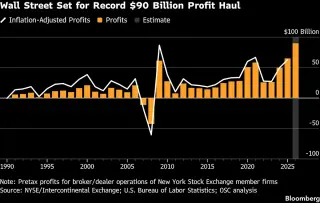
Wall Street is on track for a record-breaking year, with annual profits exceeding $90 billion. This surge is driven by massive AI investment, robust trading, and a boom in mergers and acquisitions. However, rising interest rates and geopolitical tensions pose risks to this momentum.