
Eight AI Giants Drive Half of S&P 500 Growth, but Recent Volatility Highlights Concentration Risks
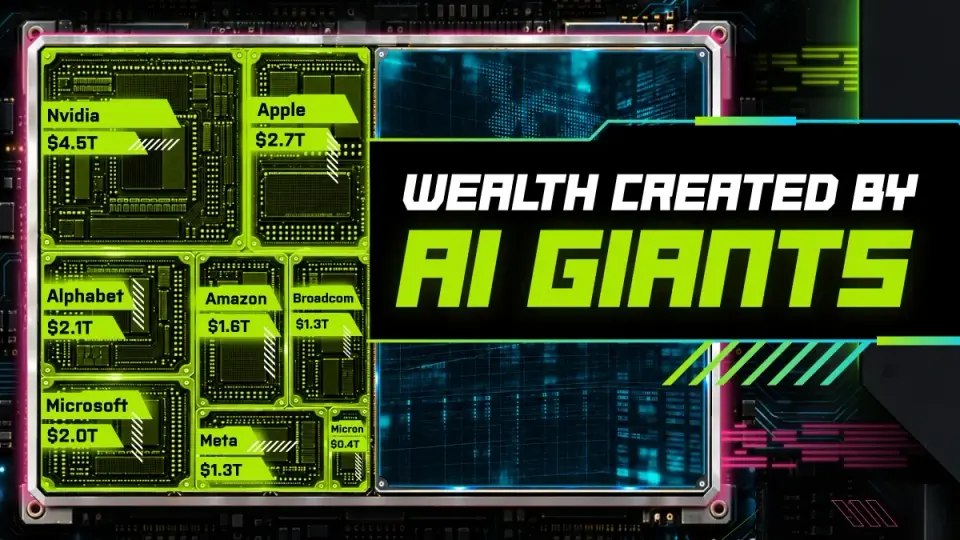
Eight artificial intelligence (AI) companies accounted for 47% of the S&P 500’s market cap growth from November 2022 to October 2026. While these firms added $15.8 trillion in value, a recent sharp market sell-off exposed the risks of this heavy concentration, prompting experts to urge broader diversification.
Key points
- Eight AI giants, including Nvidia, Apple, and Alphabet, added $15.8 trillion to the S&P 500’s market cap between November 30, 2022, and October 30, 2026.
- Nvidia led the group with a $4.51 trillion increase, followed by Apple at $2.68 trillion and Alphabet at $2.10 trillion.
- AI was mentioned in 67% of S&P 500 earnings calls for Q2 2026, indicating the technology’s broad reach beyond just the largest firms.
- A recent market rout wiped $2.5 trillion from the Nasdaq Composite, with the S&P 500 falling more than 4% in a single day.
- Semiconductor stocks plunged over 11% during the sell-off, while South Korean markets dropped nearly 14%.
- Investment advisors warn that the extreme concentration in AI stocks creates significant vulnerability for portfolios that lack diversification.
Background
Recent archive coverage noted that the S&P 500 was trading near record highs in October 2026, yet nearly half of its component stocks were in bear-market territory. This divergence highlighted a 'divided' market driven by a narrow group of AI leaders, a trend that intensified with the recent volatility.
How outlets are covering it
Visual Capitalist emphasizes the sheer scale of AI dominance, noting that eight companies drove nearly half of the index’s total market cap growth since the launch of ChatGPT. CNN frames the recent volatility as a 'wake-up call' for investors, arguing that the heavy reliance on a few blockbuster stocks necessitates a return to diversified portfolios involving bonds, health care, and commodities. Ben Carlson of A Wealth of Common Sense contextualizes the recent drawdown as a 'flesh wound' compared to historical averages, suggesting that while the pain is real, index funds remain the best strategy for capturing long-term winners despite short-term re-pricing speed. While Visual Capitalist highlights the positive momentum of AI adoption, CNN and Carlson focus on the defensive risks of such concentration.
Why it matters
The extreme concentration of market value in a handful of AI companies creates systemic risk for the broader economy and investor portfolios. When a small group of stocks drives the majority of index growth, any negative news regarding AI regulation, data center costs, or technological shifts can trigger outsized market-wide declines, as seen in the recent single-day sell-off. This dynamic underscores the importance of diversification to protect against volatility in the tech sector.
What to watch
Investors are expected to reassess their portfolio concentrations in the coming weeks, potentially shifting capital toward less correlated sectors like health care and consumer staples. Market participants will monitor whether the recent volatility marks the start of a broader correction or a temporary pause in the AI-driven bull market. Additionally, the performance of companies mentioning AI on earnings calls will be watched to see if the sector’s outperformance continues or if the recent volatility signals a shift in investor sentiment.
- The 8 AI Giants Behind Nearly Half of the S&P 500’s Growth Visual Capitalist
- AI nerves reinforce age-old investing lesson: Get diversified CNN
- AI Has Taken Over Every Corner of the Market Bloomberg.com
- Diversification & Drawdowns A Wealth of Common Sense
- Bulls vs. Bears on AI Stocks WSJ
Want the full story? Read the original reporting
Read on Visual Capitalist