
Nasdaq 100 Approaches Bear Market Threshold as Professional Investors Hesitate Amid Deep Tech Selloff
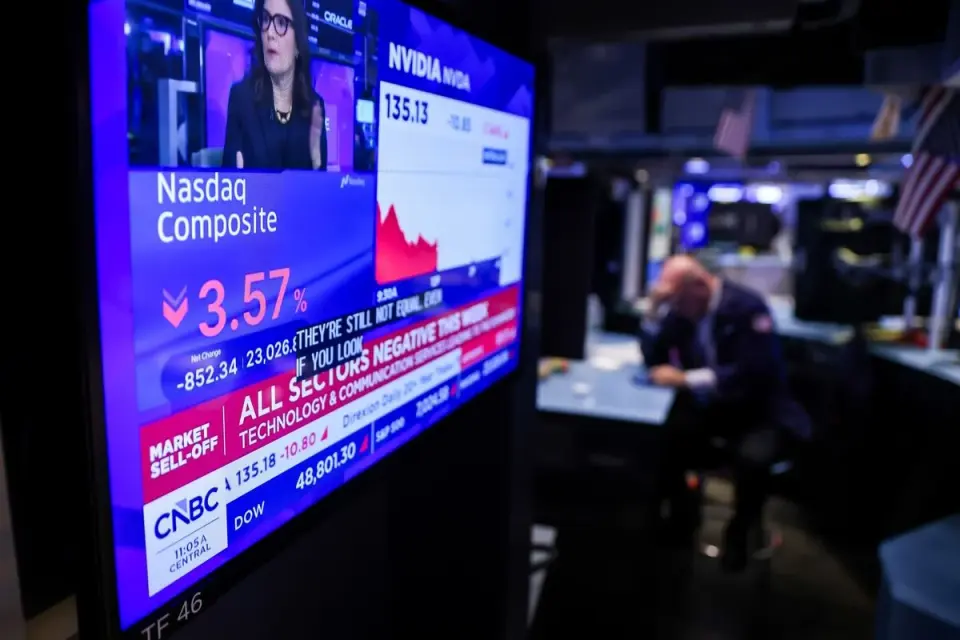
The Nasdaq 100 Index is nearing a 20% drawdown from its October 6 record, approaching bear market territory, while the S&P 500 and Dow Jones Industrial Average face potential corrections. Despite valuations appearing attractive, professional money managers are hesitant to buy the dip due to lingering uncertainties and a holiday-shortened trading week. The sell-off has been particularly severe for technology stocks, with Nvidia losing roughly a third of its value in three weeks following the sudden resignation of CEO Jensen Huang.
Key points
- The Nasdaq 100 Index has dropped 19.8% from its October 6 record, nearing the 20% threshold that defines a bear market.
- The S&P 500 has declined 12% from its highs, while the Dow Jones Industrial Average is down 9.7%, with the latter two indices approaching correction levels.
- Professional money managers are holding back from buying the dip despite attractive valuations, citing lingering questions and a holiday-shortened trading week.
- Nvidia has lost approximately 32.3% of its value in three weeks, accelerated by the sudden resignation of founder and CEO Jensen Huang after 33 years.
- The Nasdaq Composite closed at 23,879.20 on November 19, 13.5% below its all-time high of 27,722.75 set on October 6.
Background
This development follows a historic tech selloff in early November 2026, where retail investors abandoned their typical 'buy the dip' strategy, resulting in the largest single-day outflow since March 2020. That earlier event, characterized as a 'total capitulation' and 'buyers' strike,' saw the Nasdaq Composite drop 5.2% and the Dow plunge 1,800 points, signaling a rare retreat among both retail and institutional traders amid a massive tech sector drawdown.
How outlets are covering it
Bloomberg emphasizes that while fundamental outlooks did not change dramatically and valuations appear bargain-like, professional money managers lack confidence that the bottom has been set, leading to hesitation in buying the dip. In contrast, The Motley Fool highlights the speed and severity of the sell-off, noting that certain sectors like Nvidia have already experienced crash-like declines, and suggests that while some stocks like Nvidia may be weakened by leadership changes, other opportunities like ASML or growth ETFs may present clearer buying prospects. Both sources agree on the severity of the market decline but differ in their assessment of immediate buying opportunities versus the need for further clarity on market direction.
Why it matters
The approaching bear market threshold for the Nasdaq 100 signals significant risk for technology-heavy portfolios and could trigger further volatility across major indices. The hesitation among professional investors despite attractive valuations suggests deep uncertainty about market direction, potentially prolonging the downturn. The sudden resignation of Nvidia's long-time CEO adds a layer of corporate governance risk that may affect the broader AI and semiconductor sectors, influencing investor confidence and market stability in the near term.
What to watch
Investors will closely monitor whether the Nasdaq 100 falls to 22,178.20, which would mark a 20% decline and confirm bear market status. Market participants will watch for signs of stabilization or further declines in the holiday-shortened trading week, as well as developments regarding Nvidia's leadership transition and its impact on the AI sector. The behavior of professional money managers in the coming weeks will be a key indicator of whether the market has found a bottom or if further selling is likely.
- Dip Buyers Hesitate to Step In as Nasdaq 100 Nears a Bear Market Bloomberg.com
- Worried About Black Monday? What Wall Street Says Could Happen. Barron's
- The sudden reversal in the stock market, and what comes next The Washington Post
- The S&P 500 and Dow Jones Are Dangerously Close to Joining the Nasdaq in a Correction. Here’s the Level That Would Put the Nasdaq in a Bear Market, and What History Says Investors Should Do During a Stock Market Crash. Yahoo Finance
- The Stock Market Just Had Its Worst Week of 2026. Here's Why Long-Term Investors Shouldn't Flinch. The Motley Fool
Want the full story? Read the original reporting
Read on Bloomberg.com