
LandSpace Lands First Chinese Commercial Booster, Narrowing Gap with SpaceX
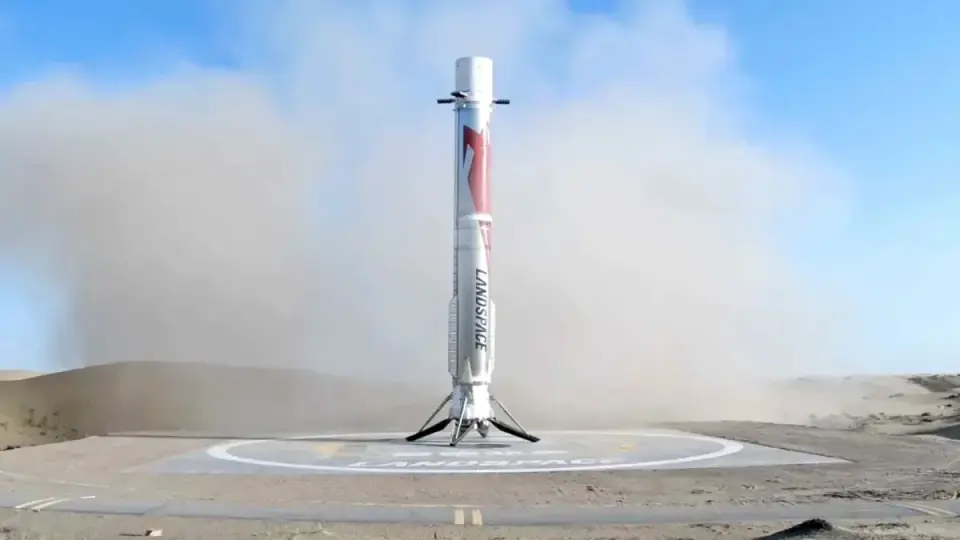
On August 19, 2026, Chinese firm LandSpace successfully recovered the first stage of its Zhuque-3 orbital rocket on land, marking the first successful land-based booster recovery for a Chinese commercial entity. This follows a July sea-based recovery by state-owned CASC. The milestone signals a rapid acceleration in China’s reusable launch capabilities, potentially reducing costs and increasing launch frequency for both commercial and military space operations.
Key points
- LandSpace’s Zhuque-3 Y2 mission launched at 07:35 CST from the Dongfeng Commercial Space Innovation Pilot Zone, delivering the Honghu 03 satellite to orbit.
- The first stage booster landed successfully at a site in Minqin County, Gansu Province, approximately eight minutes after liftoff, using landing legs.
- The Zhuque-3 is 76.6 meters tall, taller than SpaceX’s Falcon 9, and uses liquid methane propellant, a design choice aimed at reducing soot and improving reusability.
- This is the second launch for the Zhuque-3; the first attempt in December 2025 resulted in a booster explosion due to abnormal combustion during recovery.
- U.S. officials describe China’s space expansion as 'breathtakingly fast,' with satellite counts rising from under 100 in 2013 to approximately 1,900 today, including over 500 remote sensing satellites.
Background
China’s push for reusable launch technology has accelerated significantly since 2025. In July 2026, state-owned China Aerospace Science and Technology Corporation (CASC) achieved the country’s first orbital booster recovery using a sea-based net for the Long March 10B. Prior to that, China’s Long March 10A variant launched in February 2026 but did not recover its booster. LandSpace, founded in 2015, had previously demonstrated vertical takeoff and landing capabilities in 2024 and successfully launched its Zhuque-2 rocket eight times, six of which were successful. The current milestone follows a failed recovery attempt on the first Zhuque-3 flight in December 2025, where the booster exploded on the pad.
How outlets are covering it
The primary source, The War Zone, emphasizes the military implications of reusable launch technology, noting that lower costs and higher launch tempo could benefit China’s expanding space-based intelligence and national security capabilities. It cites U.S. Space Force General Stephen Whiting, who described China’s pace as 'breathtakingly fast,' and Lt. Gen. Gregory Gagnon, who highlighted the growth in Chinese remote sensing satellites designed to track U.S. naval forces. Spaceflight Now focuses on the technical and commercial aspects, noting that LandSpace’s Zhuque-3 incorporates design features from both SpaceX’s Falcon 9 and Starship, including stainless steel construction and liquid methane fuel. It also highlights that the booster experienced a post-landing fire, a detail not emphasized in the primary source. Yahoo Finance’s coverage, while largely obscured by technical errors, suggests market reactions to China’s progress, implying potential competitive pressure on SpaceX, though specific details are unavailable due to the source’s error state.
Why it matters
The successful land-based recovery of an orbital-class booster by a Chinese commercial firm marks a significant step in closing the gap with U.S. leaders like SpaceX. Reusable launch technology can drastically reduce costs and increase launch frequency, which is critical for deploying large satellite constellations and enhancing military space capabilities. For China, this milestone could accelerate its ability to compete in the global commercial launch market and support its expanding space-based intelligence and defense infrastructure. For the U.S., it underscores the need to maintain technological superiority and potentially develop countermeasures against growing Chinese space capabilities.
What to watch
LandSpace plans to transition the Zhuque-3 from the technological demonstration phase to the engineering application phase, with future flights aimed at validating booster reuse and supporting large-scale constellation deployment. CASC is expected to conduct its first Long March 10B booster reuse test by the end of 2026. The U.S. military is reportedly calling for new anti-satellite weapons to counter China’s growing presence in orbit. Other U.S. and global companies, including Blue Origin, Firefly Aerospace, and Relativity Space, are also pursuing reusable launch technologies, with several aiming for inaugural flights within the next year.
- China’s Reusable Space Launch Booster Recoveries Have Major Military Implications TWZ
- SpaceX stock falls after China rocket milestone, share unlock ahead Yahoo Finance
- LandSpace becomes first commercial Chinese company to land an orbital-class booster Spaceflight Now
- China's LandSpace lands rocket booster; joins SpaceX, Blue Origin with reusable tech Reuters
- China Lands Rocket Back on Earth in Push to Catch Up With SpaceX Bloomberg.com
Want the full story? Read the original reporting
Read on TWZ