
China Achieves First Land-Based Rocket Booster Recovery
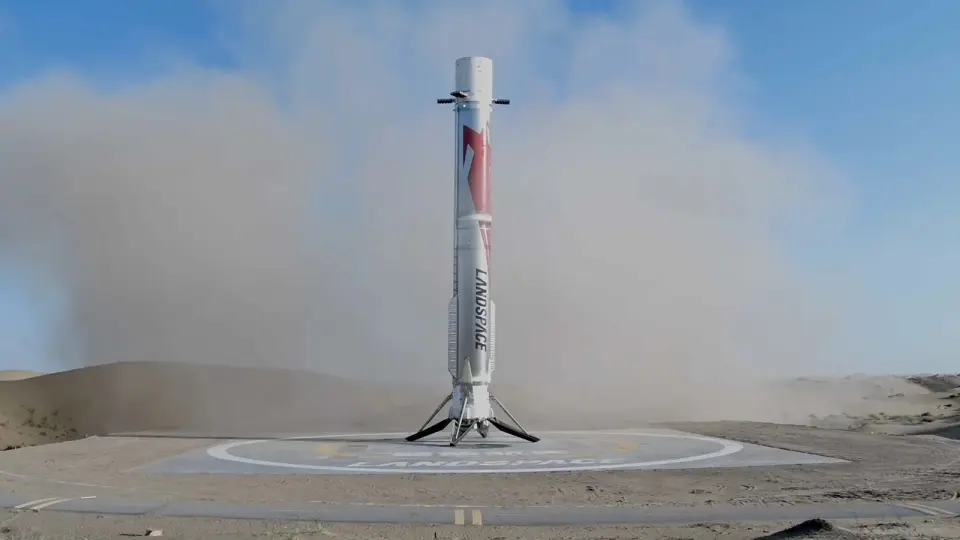
On August 18, 2026, the Beijing-based startup LandSpace successfully landed the first stage of its Zhuque-3 rocket on a terrestrial pad. This marks China's first-ever land-based recovery of an orbital-class booster, utilizing deployable landing legs. While the state-owned CASC achieved a sea-based recovery in July, this new milestone demonstrates a different approach to reusability, mirroring SpaceX's Falcon 9 methodology.
Key points
- LandSpace successfully recovered the Zhuque-3 first stage on land on August 18, 2026.
- This is the first time China has used landing legs for an orbital-class booster recovery.
- The Zhuque-3 is a 66-meter methane-oxygen rocket capable of lifting 18,300 kg to low Earth orbit.
- The mission follows the July 10 sea-based recovery of the Long March 10B by state-owned CASC.
- LandSpace described the flight as a transition from technology verification to engineering application.
Background
China has been accelerating its reusable rocket efforts to compete with SpaceX and Blue Origin. In July 2026, the state-owned China Aerospace Science and Technology Corporation (CASC) achieved the country's first controlled recovery of an orbital booster, the Long March 10B, using a net-capture system on a ship at sea. Prior to the August 18 success, LandSpace had attempted a Zhuque-3 recovery in 2025, which ended in an explosion during descent. A static-fire test in June 2026 validated the vehicle ahead of this successful orbital flight.
How outlets are covering it
Space.com emphasizes the technological parallel between LandSpace's Zhuque-3 and SpaceX's Falcon 9, noting that the use of landing legs on solid ground is a distinct achievement from the sea-based net recovery performed by CASC in July. NBC News, citing Xinhua, highlights the broader national significance, labeling the event a 'major breakthrough' in reusable rocket technology and framing it within China's state-driven push to advance its space program. While Space.com focuses on the private sector milestone, NBC News contextualizes it alongside recent Japanese test flights, suggesting a global race to reduce launch costs through reusability.
Why it matters
Successful land-based recovery is a critical step toward routine reusability, which significantly lowers the cost of access to space. By achieving this, China now has two distinct methods for booster recovery (sea and land), increasing its operational flexibility and potentially accelerating the deployment of satellite constellations similar to Starlink.
What to watch
LandSpace plans to transition the Zhuque-3 from the verification phase to engineering application, implying future flights will focus on routine reuse rather than just testing. The success of this mission may also prompt further investment in private Chinese space ventures and intensify competition with state-owned entities like CASC.
- Touchdown! Private Chinese rocket aces landing on 2nd-ever flight Space
- China’s LandSpace beats SpaceX with steel-booster recovery after orbital launch South China Morning Post
- China recovers rocket stage on land for first time, after earlier recovery at sea NBC News
- China's LandSpace lands rocket booster; joins SpaceX, Blue Origin with reusable tech Reuters
- China Lands Rocket Back on Earth in Push to Catch Up With SpaceX Bloomberg.com
Want the full story? Read the original reporting
Read on Space