
Virgin Galactic's Apeiron Completes First Flight to New Mexico
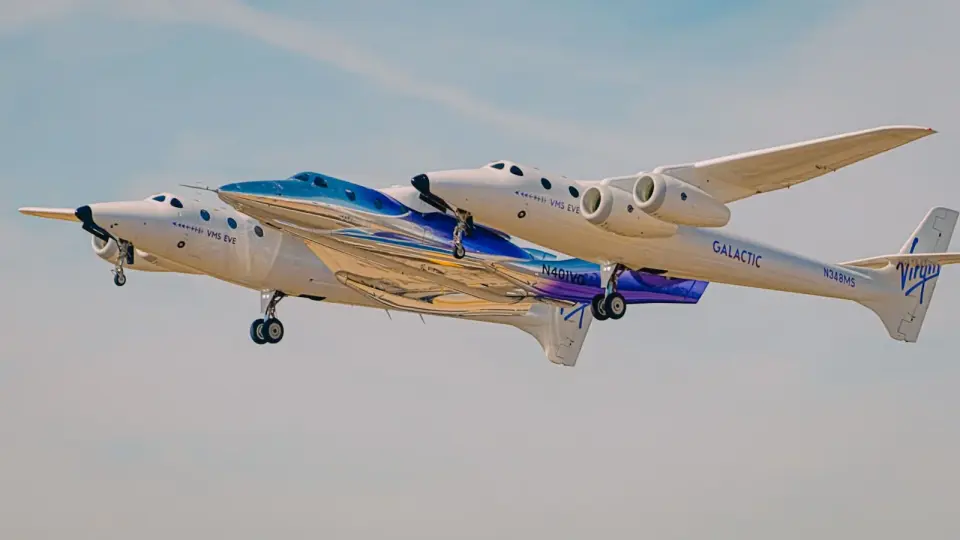
Virgin Galactic’s first Delta-class spaceplane, Apeiron, completed its maiden flight on October 28, 2026, ferrying from its Arizona manufacturing site to Spaceport America in New Mexico. The vehicle, named after the Greek word for 'boundless,' was carried by the carrier aircraft VMS Eve. This transfer marks the start of a test campaign ahead of commercial flights expected in early 2027. The new fleet is designed for higher frequency and longer lifespans than its predecessor, VSS Unity.
Key points
- Apeiron flew from Mesa, Arizona, to Spaceport America in New Mexico on October 28, 2026, as a captive-carry flight beneath VMS Eve.
- The name 'Apeiron' was selected via a public vote involving participants from 83 countries.
- Commercial service is scheduled to begin in the second quarter of 2027, with a second Delta-class ship following in late 2027.
- The Delta-class vehicles are designed for a flight cadence of twice per week and a lifetime of over 500 missions, compared to VSS Unity’s seven commercial flights.
- Virgin Galactic faces financial challenges, having lost $56 million in the second quarter of 2026, but has a backlog of nearly 700 ticket holders.
Background
Virgin Galactic previously operated the VSS Unity, which conducted seven commercial suborbital missions between June 2023 and June 2024. The company had delayed the return of commercial flights to 2027. This development follows the naming of Apeiron in late October 2026 and precedes the planned avionics software integration and validation at Spaceport America.
How outlets are covering it
Space.com and KOB 4 emphasize the successful transfer and the upcoming test phase, highlighting CEO Michael Colglazier’s statement that the 'Spaceship has arrived.' New Atlas provides a critical perspective, noting Virgin Galactic’s financial struggles, including a $56 million loss in Q2 2026, and the competitive landscape, noting that Blue Origin has paused its New Shepard flights to focus on lunar missions, leaving Virgin Galactic as the sole operator for suborbital tourism. New Atlas also details the supply chain, mentioning Bell and Qarbon Aerospace as key suppliers for the Delta-class fleet.
Why it matters
The successful transfer of Apeiron is a critical milestone for Virgin Galactic’s return to commercial spaceflight. It demonstrates the company’s ability to manufacture and transport its next-generation fleet, which is designed for higher operational frequency. This could solidify Virgin Galactic’s position in the suborbital tourism market, especially with its main competitor, Blue Origin, currently grounded. However, the company must overcome significant financial hurdles and successfully complete its test program to realize its commercial goals.
What to watch
Virgin Galactic will conduct avionics software integration and validation at Spaceport America. Following this, Apeiron will undergo glide and rocket-powered test flights. Commercial flights are expected to begin in the second quarter of 2027. The company plans to share more details about the flight test program during its third-quarter earnings call in November 2026.
- Watch Virgin Galactic's new 'Delta-class' space plane take to the skies for the 1st time (video) Space
- Meet Apeiron, Virgin Galactic's 1st 'Delta-class' space plane Space
- New Virgin Galactic spaceship arrives at Spaceport America KOB 4
- Virgin Galactic's new rocket plane revives its bid for a space airline New Atlas
- Virgin Galactic rolls out new suborbital spaceplane SpaceNews
Want the full story? Read the original reporting
Read on Space