
AI Impersonation of Down Syndrome Athlete Highlights Social Media Detection Gaps
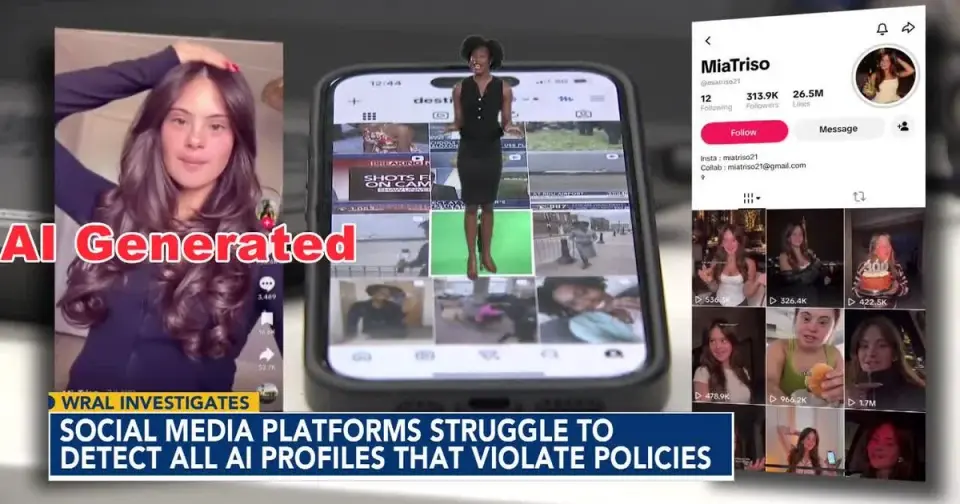
Valeriia Litvinova Cunningham, a North Carolina State University student and Ukrainian refugee, shares how her sister Anya’s strength training journey inspired a community for people with Down Syndrome. However, the family faces AI-generated impostor accounts that mimic Anya’s face on other creators’ bodies. WRAL Investigates found that platforms like TikTok and Meta struggle to detect these fakes, often rejecting user reports. While TikTok cites C2PA technology for tracking content origins, Meta did not respond to inquiries. The incident underscores the difficulty of distinguishing real human creators from AI fabrications in current moderation systems.
Key points
- Valeriia Litvinova Cunningham and her sister Anya, who has Down Syndrome, built a social media following by sharing strength training sessions, leading to the creation of 'Strength Without Labels' workout classes through GiGi’s Playhouse.
- An account named @MiaTriso21 appeared on TikTok and Instagram, using AI to place Anya’s face onto other creators’ bodies, which Cunningham described as a violation of their audience trust and a new form of harassment.
- Laeeq Khan, director of the social media analytics research lab at Ohio University, noted that platforms rely heavily on victim reporting to catch AI-generated content, meaning unreported fakes often remain active.
- Cunningham reported that some platform responses denied the AI nature of the content, forcing her to spend significant time disputing the classifications.
- TikTok stated it uses C2PA Content Credentials to track digital content origins and tests detection systems for AI spam, while Meta did not respond to WRAL’s repeated inquiries regarding their detection methods.
- Although @MiaTriso21 was removed after WRAL Investigates contacted the platforms, similar accounts have already resurfaced, indicating that takedowns do not permanently eliminate the threat.
Background
Recent months have seen increased public scrutiny of AI-generated content on social media. In late October 2026, the Atlanta Falcons faced backlash for a retro profile picture that users compared to Nazi iconography, highlighting how visual elements on social platforms can trigger intense public debate. Additionally, Amazon’s 'About You' feature sparked viral outrage earlier this month after users shared screenshots of the platform’s invasive and often incorrect AI-generated profiles based on purchase history. These events illustrate a growing tension between AI-driven personalization or content creation and user trust, privacy, and accurate representation. The current story extends this trend into the realm of identity theft, where AI is used to mimic real individuals rather than just analyzing their data.
Why it matters
This case demonstrates the inadequacy of current social media moderation tools in protecting vulnerable creators from AI impersonation. As platforms struggle to detect and label AI-generated content, individuals risk having their identities exploited for monetization without effective recourse. The failure of reporting mechanisms and the rapid resurfacing of removed accounts suggest that existing policies are insufficient to maintain trust in digital spaces, particularly for marginalized communities.
What to watch
Social media platforms may need to develop more proactive detection systems beyond relying on user reports. There could be increased pressure on companies like Meta to disclose their AI detection methodologies. Creators may continue to face challenges in proving their authenticity, potentially leading to new advocacy efforts for stronger digital identity protections.
Want the full story? Read the original reporting
Read on WRAL