
Anthropic’s Subscription Value Surges 5x as OpenAI Cuts Limits and Introduces $500 Tier
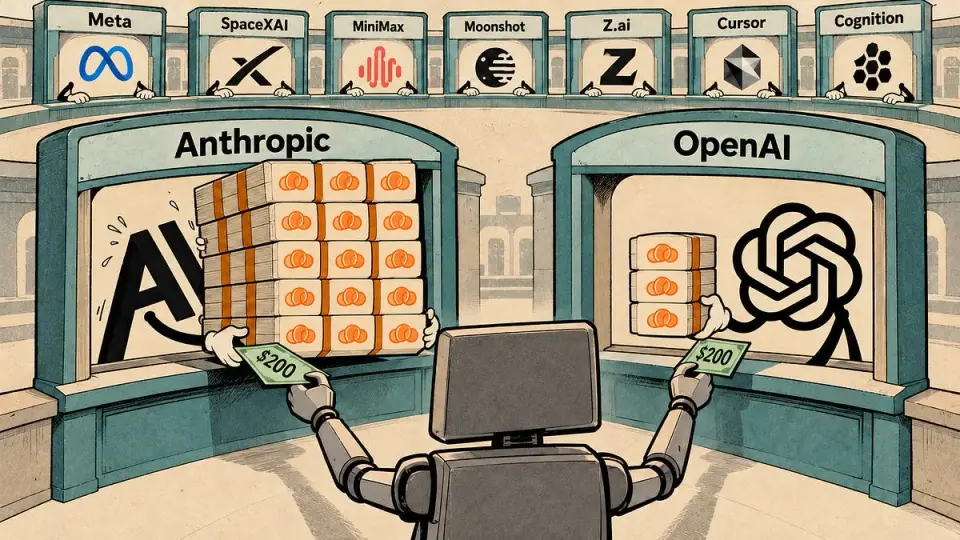
SemiAnalysis reports that Anthropic’s AI subscriptions now offer five times the API-equivalent value of OpenAI’s plans, driven by OpenAI’s recent 50% limit cuts and a new $500 tier. While OpenAI’s move aims to improve margins, it has reversed its previous advantage in generous usage limits. Meanwhile, industry observers note that unpredictable usage-based billing is causing enterprise churn, prompting vendors to experiment with caps, smoothing, and outcomes-based pricing to stabilize revenue and customer trust.
Key points
- SemiAnalysis found Anthropic’s $200 plan offers roughly 5x the API-equivalent value of OpenAI’s equivalent tier for mid-tier models like Opus 5.5 and GPT 6.1 Sol.
- OpenAI recently halved the usage limits for its $200 plan and introduced a new $500 tier, which offers only 21% more usage than the old $200 plan but includes ultrafast 300 TPS features.
- OpenAI’s limit cuts were implemented to improve gross margins, as subscription plans are heavily subsidized and consume over 40% of inference compute despite being a small portion of total revenue.
- Anthropic maintains consistent per-dollar value across all its subscription tiers, whereas OpenAI’s recent changes have flattened the value difference between its Plus, Pro, and new Ultra plans.
- Enterprise buyers are increasingly wary of usage-based AI pricing due to unpredictable spikes, leading to quiet churn; vendors like Cursor and Anthropic use hard caps to prevent surprise bills, while others explore outcomes-based pricing.
Background
This shift in subscription economics follows a period of intense price competition between Anthropic and OpenAI, where both released cost-efficient models like Opus 5.5 and GPT-6 Sol to address enterprise cost concerns. Anthropic is currently navigating an IPO process with a valuation between $1.5 trillion and $4 trillion, while facing scrutiny over its revenue sustainability and competition from open-weight rivals. The current pricing adjustments occur amid broader debates about AI bubble risks and the long-term viability of subsidized consumer AI markets.
How outlets are covering it
SemiAnalysis emphasizes the quantitative disparity in value, highlighting that Anthropic’s strategy of gradually reducing API-equivalent value for premium models is more subtle and margin-friendly than OpenAI’s abrupt limit cuts. Startup Fortune focuses on the customer experience, arguing that OpenAI’s and Anthropic’s use of usage caps is a necessary safeguard against 'surprise bills' that drive enterprise churn, noting that OpenAI’s previous generosity was a key differentiator for indie developers. TechTarget offers a broader enterprise view, suggesting that while usage-based pricing is common, many CIOs are skeptical of unpredictable costs and are pushing for outcomes-based pricing models, though they face procurement hurdles due to a lack of standardized metrics. The outlets agree that subscription economics are under pressure but differ on whether the solution lies in technical caps, financial smoothing, or fundamental pricing model shifts.
Why it matters
The shift in AI subscription pricing signals a maturing market where labs are prioritizing margin sustainability over aggressive customer acquisition. For enterprises, the volatility in usage-based pricing is creating friction in procurement and renewal processes, potentially slowing adoption. For investors, the divergence in pricing strategies between Anthropic and OpenAI may impact their respective revenue trajectories and gross margins, influencing the valuation of both companies as they navigate public markets and intense competition.
What to watch
SemiAnalysis plans to publish results on the limits of OpenAI’s new 300 TPS Ultrafast feature and third-party app integrations. OpenAI may face continued pressure to adjust its pricing structure if the current limit cuts do not sufficiently improve margins or if public backlash emerges. Enterprise vendors may continue to experiment with hybrid pricing models, including spend smoothing and rollover credits, to mitigate the risks of usage spikes. The standardization of outcomes-based pricing metrics remains a key challenge for the industry in the coming months.
- Anthropic Subscriptions Offer 5x+ More Value Than OpenAI newsletter.semianalysis.com
- How to Price an AI Agent So Usage Spikes Don't Trigger Churn Startup Fortune
- Outcomes-based AI pricing works in theory -- but in practice? TechTarget
- Sam Altman Said They Were Losing Money on a $200 Subscription. DataDrivenInvestor
- How to Price a Freemium AI Agent Without Giving Away Your Margin Startup Fortune
Want the full story? Read the original reporting
Read on newsletter.semianalysis.com