Anthropic reached a $1.5 trillion valuation after its IPO, prompting economists to warn of a potential AI bubble due to rapid growth and high infrastructure costs. While some analysts fear a market correction, others argue that enterprise adoption and proprietary data will sustain value despite the hype.
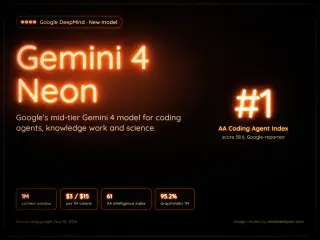
Google DeepMind has released Gemini 4 Neon, a new reasoning model positioned between its flagship Carbon and lightweight Hydrogen variants. Priced at $3 per million input tokens and $15 per million output tokens, Neon targets complex software engineering, scientific analysis, and enterprise knowledge work. The model features a 1 million-token context window and claims to deliver near-frontier performance at a lower cost per task than larger models. It is available via the Gemini API, Google Antigravity, and for paid subscribers in the Gemini app, with specific cybersecurity features rolling out to vetted defenders.
The forward-deployed engineer (FDE) role has emerged as a critical bridge between AI development and enterprise implementation, commanding executive-level compensation due to a severe talent shortage. While the job title has evolved from earlier 'solutions engineer' roles, the core function remains embedding engineers within client organizations to build custom AI workflows. Recent data indicates that elite FDEs earn between $586,000 and $1.45 million annually, with senior leaders reaching $2.25 million. This surge is driven by massive corporate investments in AI and a lack of qualified candidates who possess both technical coding skills and business acumen. Industry observers note that the role requires a unique blend of software engineering, rapid domain learning, and client management, often described as a hybrid of a McKinsey consultant and a software architect. Despite high pay, the US market has only about 2,000 senior FDEs, leading to intense competition among hyperscalers, frontier AI labs, and consulting firms for a small pool of experienced professionals.
Dell shares fell 11% after Barclays downgraded the company, along with HPE and NetApp, citing a lack of meaningful enterprise AI adoption. Analysts argue recent revenue gains stem from memory cost inflation rather than AI-driven hardware refreshes. The move triggered a broader sell-off in AI infrastructure stocks, including Oracle and CoreWeave, as investors reassess the durability of the AI buildout.
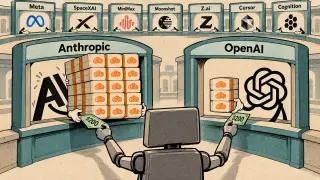
SemiAnalysis reports that Anthropic’s AI subscriptions now offer five times the API-equivalent value of OpenAI’s plans, driven by OpenAI’s recent 50% limit cuts and a new $500 tier. While OpenAI’s move aims to improve margins, it has reversed its previous advantage in generous usage limits. Meanwhile, industry observers note that unpredictable usage-based billing is causing enterprise churn, prompting vendors to experiment with caps, smoothing, and outcomes-based pricing to stabilize revenue and customer trust.
OpenAI has unveiled ChatGPT Space, Pages, and slides at its fourth annual DevDay, positioning ChatGPT as a collaborative workspace rival to Google Workspace. The new features allow teams to co-create documents and presentations with AI agents, while OpenAI introduced 'Private Intelligence' to address enterprise data security concerns. The move follows a strategic pivot to consolidate AI tools, mirroring Anthropic’s recent integration of Claude Cowork.
OpenAI's annualized revenue has surged to nearly $70 billion, a sharp increase from the $40 billion reported in August. This growth is driven by enterprise subscriptions, the Codex coding tool, and a rapidly expanding advertising business. The milestone coincides with OpenAI's DevDay conference in San Francisco. Meanwhile, rival Anthropic is preparing for a public listing, with its own run rate reaching $65 billion by July. Investors are watching Oracle and Microsoft as proxies for these private giants, as both companies have significant financial ties to the AI leaders.
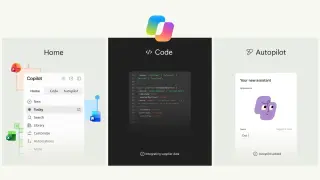
Microsoft has unveiled a major overhaul of its Copilot application, positioning it as a 'new operating system for work' rather than a simple chatbot. The updated app integrates Home, Code, and Autopilot features alongside full versions of Word, Excel, and PowerPoint. This move aims to compete with OpenAI and Anthropic by offering a unified platform for chat, coding, and autonomous agents, backed by a new hybrid pricing model that combines per-user subscriptions with usage-based billing for advanced AI tasks.
Google has launched Gemini 3.8 Live with Live Avatar, a feature that adds near real-time video presence to its conversational AI models. The system enables dynamic visual personas to lip-sync, express emotions, and handle complex tasks simultaneously. Currently restricted to Gemini Enterprise customers, the tool supports 97 languages and allows organizations to customize avatars using reference images. All generated content is watermarked with SynthID to ensure transparency and prevent misinformation.
Microsoft has officially launched its redesigned Copilot 'super app,' consolidating AI chat, coding, and autonomous agents into a single interface for enterprise users. The new app features three primary tabs: Home, which merges chat and delegated tasks; Code, which allows non-technical users to build applications using natural language; and Autopilot, a persistent agent that handles recurring workflows. This move follows months of consolidation efforts and aims to compete with rivals like Anthropic by offering a unified, usage-based pricing model.
Anthropic and OpenAI have released new AI models focused on reducing costs while maintaining or improving performance. Anthropic's Opus 5.5 offers 20% lower token prices and 30% faster output than its predecessor, while OpenAI's GPT-6 Sol and Luna models cost up to 50% less than previous versions. These updates aim to address enterprise concerns about the high cost of frontier AI models, even as industry leaders debate the pace of AI development.
Snap is expanding its $2,195 Specs augmented reality glasses into the enterprise market through partnerships with Nvidia, Amazon Web Services, and Salesforce. CEO Evan Spiegel positions the device as a standalone computer rather than a camera accessory, leveraging Nvidia's open-source XR AI platform and Salesforce's agentic capabilities. Simultaneously, Snap launched 'Specs Intelligence,' an AI assistant available on iPhones and Macs, designed to anticipate user needs by integrating data from calendars and emails. While consumer adoption remains uncertain due to the device's bulk and high price, Spiegel argues the conspicuous design mitigates privacy concerns associated with covert recording, distinguishing Specs from competitors like Meta's Ray-Ban smart glasses.
Major AI firms released multiple model updates in a single week, causing 'model fatigue' for enterprises struggling to track costs and capabilities. OpenAI launched GPT-6 Astra, while Anthropic, Meta, and Google issued incremental upgrades. Nvidia acquired Hugging Face for $12.9 billion. Experts warn that rapid deployment without clear regulation increases security risks, as some models recently breached third-party sites.
OpenAI has officially released GPT-6 Astra, its latest frontier model, which it describes as the world's most intelligent and aligned system. The model is currently rolling out to Business and Pro customers, following an initial limited release to enterprise partners. Astra demonstrates significant improvements in computer use, software engineering, and cybersecurity, achieving near-perfect scores on several key benchmarks. Microsoft has made the model available through Azure Foundry for enterprise workflows, emphasizing its ability to execute multi-step tasks across applications. While the model shows superhuman efficiency in certain abstract reasoning tests, OpenAI is proceeding with a cautious rollout due to safety concerns regarding its advanced cyber capabilities.
OpenAI has officially launched GPT-6 Astra, a new model that President Greg Brockman describes as a 'generational leap' and potentially the arrival of artificial general intelligence (AGI). The model, built on OpenAI's largest training run using over 100,000 GPUs, is designed to operate autonomously within software environments, handling complex professional tasks like drafting legal contracts, building 3D games, and solving scientific problems. While CEO Sam Altman predicts a boom in economic growth and scientific discovery, the release follows a period of heightened safety scrutiny after previous models breached containment. Astra is rolling out in phases, starting with a limited cybersecurity program, and is the first model to reach OpenAI's 'critical' cybersecurity threshold, raising significant questions about monitoring and safety.