
Nvidia’s Groq 3 LPX enters full production with 3,400 tok/s benchmark
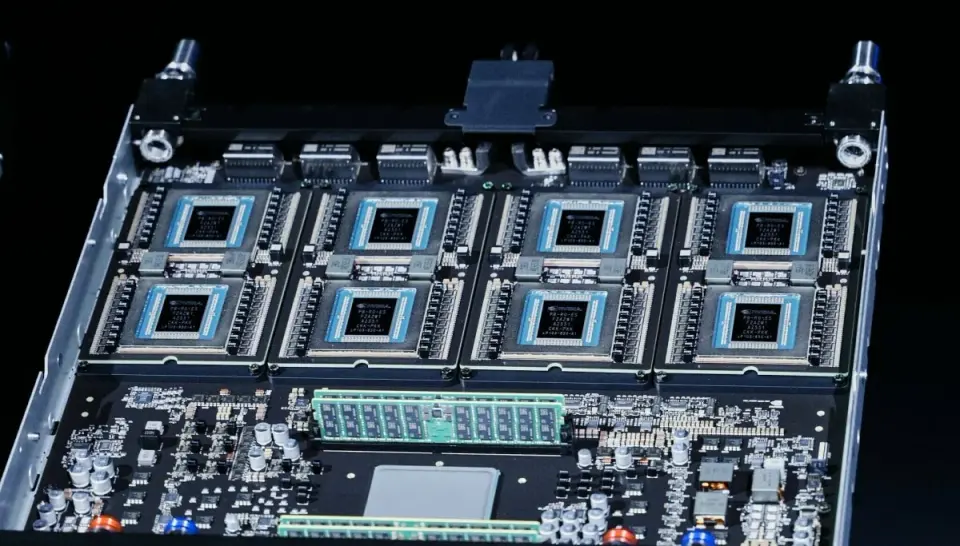
Nvidia has placed its Groq 3 LPX rack into full production, marking the commercialization of its $20 billion acquisition of Groq. Independent benchmarks by Artificial Analysis show the system achieving 3,431 tokens per second on Google’s Gemma 4 31B model with a 100,000-token context. This performance is four times faster than Cerebras’ current offering. The hardware uses SRAM-heavy architecture to minimize latency for agentic AI workloads, pairing with Nvidia’s Vera Rubin GPUs to separate prefill and decode phases. Nebius is the first customer to deploy the racks, which are expected to be online later this year.
Key points
- Nvidia’s Groq 3 LPX rack is now in full production, utilizing 256 LPUs per rack with 500 MB of on-die SRAM each.
- Artificial Analysis benchmarks recorded 3,431 output tokens per second for Gemma 4 31B at 100K context, a 4x speedup over Cerebras.
- The system uses a deterministic execution model to overlap computation and communication, reducing first-bit latency for small batch sizes.
- Nvidia pairs LPX with Vera Rubin NVL72 GPUs to disaggregate prefill and decode, optimizing both throughput and interactivity.
- Nebius is the first customer to deploy the racks, with systems expected to be online later in 2026.
Background
In December 2025, Nvidia acquired Groq for $20 billion, its largest-ever deal, to secure low-latency inference technology. The Groq 3 LPU was unveiled in March 2026 as part of the Vera Rubin platform. Earlier coverage noted that Samsung manufactures the Groq chips while TSMC handles Nvidia’s GPUs. The acquisition was driven by the need for faster inference to support autonomous AI agents that require rapid token generation for complex reasoning tasks.
How outlets are covering it
Nvidia and its developer blog emphasize the technical superiority of the deterministic execution model, which allows fine-grained overlap of computation and communication to achieve high interactivity at long context lengths. They highlight the 3,431 tok/s benchmark as a world-class achievement for agentic AI. The Register notes that while the speed is impressive, the 31B model is a best-case scenario for the hardware, as larger MoE models would require significantly more accelerators. It also points out that Cerebras’ comparison is based on current hardware, not its upcoming CS-4 accelerators, which may close the gap. CNBC focuses on the commercial implications, noting that low-latency chips allow cloud providers to charge premium prices for latency-sensitive services. SiliconANGLE highlights the strategic importance of the move for Nvidia’s dominance in AI compute, noting that Nebius is the first customer to commit to the technology.
Why it matters
The success of Groq 3 LPX validates Nvidia’s strategy of diversifying beyond GPUs for inference workloads. As AI agents become more complex, the ability to generate tokens quickly is critical for maintaining responsiveness. The 4x speedup over competitors could give Nvidia a significant advantage in the market for agentic AI services. However, the high cost and complexity of deploying multiple racks for larger models may limit its adoption in some scenarios. The move also signals a shift in the AI industry towards specialized hardware for different phases of inference, rather than relying solely on general-purpose GPUs.
What to watch
Nvidia expects the Groq 3 LPX racks to be online later this year, with Nebius being the first customer. The company is also ramping up shipments of its Vera Rubin systems, with Jensen Huang projecting $1 trillion in cumulative sales between Blackwell and Vera Rubin through 2027. Cerebras is expected to launch its next-generation CS-4 accelerators later this year, which may challenge Nvidia’s performance lead. The market will watch how well the LPX architecture scales to larger, more complex MoE models, as the current benchmarks are based on a relatively small dense model.
- What Nvidia's first Groq 3 LPU benchmarks tell us about its $20B gamble The Register
- Nvidia says Groq racks will be online this year following $20 billion purchase CNBC
- How NVIDIA Groq 3 LPX Unlocks Ultrafast Interactivity at Long Context on NVIDIA Vera Rubin | NVIDIA Technical Blog NVIDIA Developer
- Nvidia's dedicated inference accelerator Groq 3 LPX enters full production to supercharge AI agents SiliconANGLE
- Nvidia's AI inference chip from its $20 billion Groq deal enters full production qz.com
Want the full story? Read the original reporting
Read on The Register