
SpaceX Achieves Historic Starship Catch, Despite Booster Failure
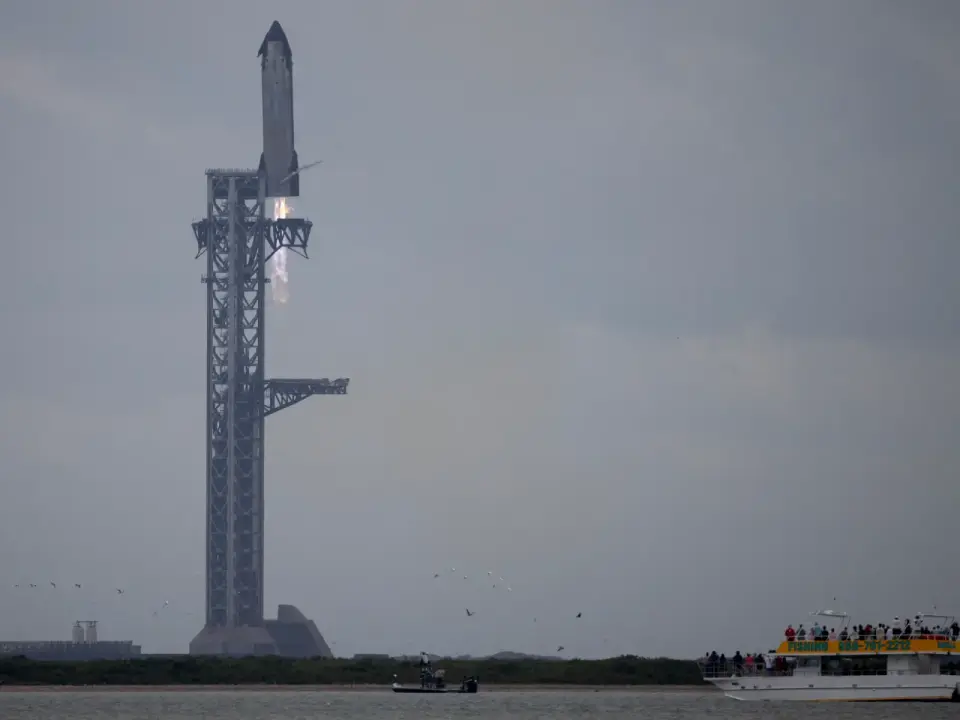
SpaceX successfully captured its Starship upper stage with mechanical arms at its Texas facility on November 14, 2026, marking the first time the vehicle was recovered from orbit. Although the Super Heavy booster failed to land and exploded in the Gulf of Mexico, the upper stage completed 14 orbits, deployed 26 Starlink satellites, and returned safely to the launch pad, demonstrating key reusability milestones for future lunar missions.
Key points
- SpaceX’s Starship upper stage was caught by the 'Mechazilla' arms at Starbase, Texas, on November 14, 2026, 22 hours after launch.
- The Super Heavy booster failed to land, exploding in the Gulf of Mexico after its engines shut down prematurely during descent.
- The upper stage completed 14 orbits around Earth, deployed 26 Starlink V3 satellites, and returned safely to the launch pad.
- NASA Administrator Jared Isaacman praised the achievement as 'almost magic,' highlighting its importance for the Artemis program.
- SpaceX expects to begin launching Starships from Florida’s Kennedy Space Center within the next few months.
Background
This is the 15th test flight of a full-scale Starship since 2023 and the second orbital flight. Previous attempts, including the September 2026 flight, focused on suborbital trajectories or failed to reach orbit due to engine issues. The successful catch validates SpaceX’s goal of full reusability, crucial for reducing launch costs and supporting NASA’s Artemis III moon landing mission, targeted for 2028.
How outlets are covering it
Al Jazeera and NPR emphasized the historic nature of the upper stage catch, noting it demonstrated full reusability despite the booster failure. CNN highlighted the risks of orbital reentry and SpaceX’s decision to proceed with the mission despite an engine shutdown during the previous flight. Fox Business focused on the broader implications for humanity and SpaceX’s role in lunar and Mars exploration, quoting Walter Isaacson and Pete Hegseth. All sources agreed on the success of the upper stage catch but noted the booster failure as a setback.
Why it matters
The successful catch of Starship from orbit is a critical milestone for SpaceX’s goal of fully reusable rockets, which could drastically reduce launch costs and enable frequent missions to the Moon and Mars. It also supports NASA’s Artemis program, which relies on Starship for lunar landings and future lunar base construction. The achievement validates SpaceX’s technology and positions it as a leader in space exploration.
What to watch
SpaceX will investigate the cause of the booster failure and continue testing reusability. The company expects to begin launching Starships from Florida’s Kennedy Space Center within the next few months, ahead of NASA’s Artemis III mission, which aims to dock with Starship and Blue Origin’s Blue Moon in lunar orbit. SpaceX also plans to test in-orbit cryogenic propellant transfers in early 2027, a key step for lunar missions.
- SpaceX’s Starship captured by launchpad arms in dramatic first Al Jazeera
- Live updates: SpaceX Starship soars in orbit, still aiming for ship catch in unprecedented test flight CNN
- SpaceX makes history as Starship spacecraft caught by launch tower for first time Fox Business
- SpaceX successfully catches Starship and makes history NPR
- With Starship catch, SpaceX still shows it can dazzle the world Ars Technica
Want the full story? Read the original reporting
Read on Al Jazeera