
Malicious Microsoft Agent Framework Packages Steal Azure and CI Credentials
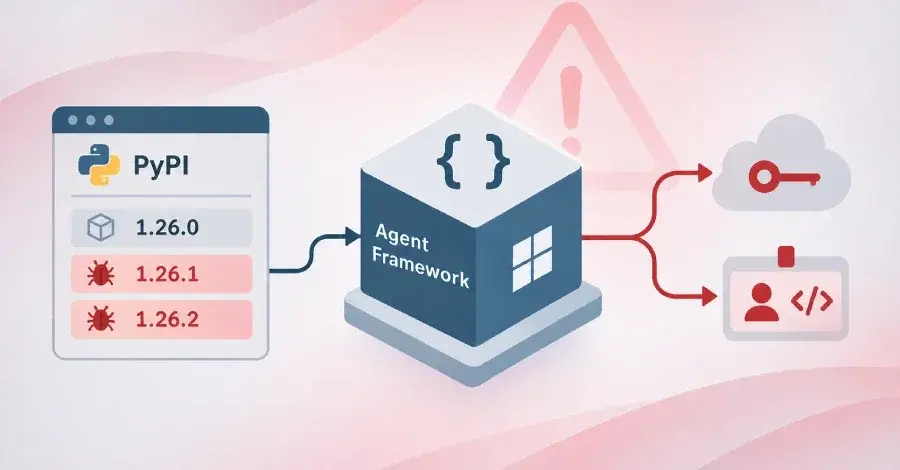
Attackers published two malicious versions of Microsoft's agent-framework Python package on November 17, 2026, to steal cloud credentials and environment data. The compromised releases, 1.26.1 and 1.26.2, were quarantined on PyPI after security firms detected them. The malware uses .pth files to execute a stealer on every Python startup, harvesting Azure tokens, GitHub Actions secrets, and local credential files. It exfiltrates data to a specific webhook endpoint. Users are advised to isolate affected hosts, pin to version 1.26.0, and rotate exposed credentials. This is the second major Microsoft-related PyPI compromise this year, following a similar attack on the durabletask package in May.
Key points
- Malicious versions 1.26.1 and 1.26.2 of the agent-framework package were published 33 minutes apart on November 17, 2026, and subsequently quarantined on PyPI.
- The malware installs .pth files in site-packages, ensuring the credential stealer runs on every Python interpreter start, even if the package is not explicitly imported.
- The stealer targets Azure CLI credentials, .npmrc, .git-credentials, and environment variables, while also requesting new federated tokens from Azure DevOps and managed identity endpoints.
- Exfiltrated data is compressed, Base64-encoded, and sent via HTTPS POST to a hard-coded webhook.site endpoint.
- Version 1.26.2 adds a new module to collect GitHub Actions OIDC tokens and expands environment variable search patterns.
- The package receives approximately 190,000 downloads monthly, prompting recommendations to isolate affected hosts and audit Azure identities and GitHub Actions workflows.
Background
This incident follows a pattern of supply chain attacks targeting AI and developer tooling in 2026. In October, attackers compromised LiteLLM's release pipeline to distribute a credential stealer via PyPI and Docker, exploiting leaked GitHub CLI tokens. Earlier in the year, the durabletask package, Microsoft's client for the Durable Task framework, was also compromised to distribute the Mini Shai-Hulud worm. These events highlight increasing risks to the Python package ecosystem and CI/CD pipelines, particularly those integrated with cloud identity systems.
Why it matters
The compromise of a widely used Microsoft package underscores the vulnerability of open-source AI frameworks to supply chain attacks. The malware's ability to run on every Python start, regardless of explicit import, poses a significant risk to developers and CI/CD pipelines. The theft of Azure and GitHub Actions credentials could lead to unauthorized access to cloud resources and code repositories, potentially impacting enterprise security and data integrity.
What to watch
Security teams should immediately isolate any hosts or runners that installed versions 1.26.1 or 1.26.2 between 8:35 and 9:20 p.m. UTC on November 17, 2026. Organizations must pin the agent-framework package to version 1.26.0, restore environments from clean sources, and rotate all exposed credentials. Additionally, auditing Azure sign-in logs and GitHub Actions workflows is critical to detect any unauthorized activity. Microsoft and security firms are likely to investigate how the attacker obtained publishing access to prevent future compromises.
Want the full story? Read the original reporting
Read on The Hacker News