
Bayeux Tapestry’s ‘Aelfgyva’ Scene May Expose a Royal Scandal That Undermined William’s Claim
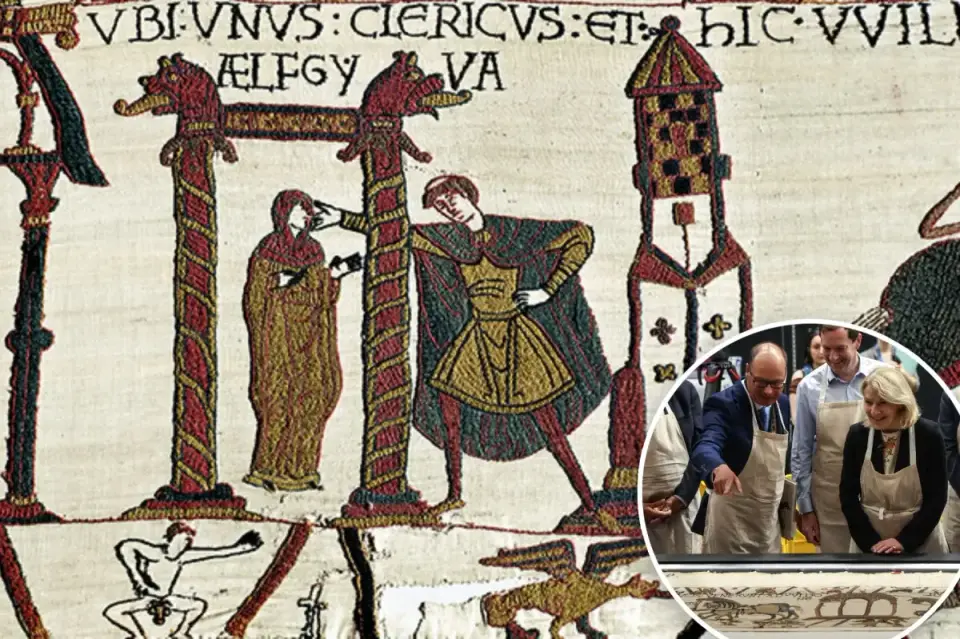
A controversial scene in the Bayeux Tapestry, recently returned to the UK for display at the British Museum, may depict a sexual scandal involving Emma of Normandy that could have challenged William the Conqueror’s legitimacy. The tapestry, which chronicles the 1066 Norman Conquest, includes 93-94 phallus motifs and a vignette showing a clergyman caressing a woman named Aelfgyva while a naked man looks on. British Museum curator Michael Lewis suggests this scene alludes to rumors that Emma, William’s great-aunt, had an affair with Bishop Alfwin of Winchester, thereby questioning the family ties William used to justify his claim to the English throne. The identity of the woman remains debated, with some historians proposing she could be Aelfgyva of York or Northampton. The tapestry’s return to the UK after nearly 1,000 years has sparked renewed interest in its subversive details and historical implications.
Key points
- The Bayeux Tapestry, depicting 58 events leading to the 1066 Norman Conquest, has returned to the UK for the first time since its creation.
- The tapestry contains 93-94 phallus motifs, which experts interpret as either graffiti or subversive commentary.
- A specific scene shows a clergyman caressing a woman named Aelfgyva while a naked man looks on, which British Museum curator Michael Lewis believes alludes to a scandal involving Emma of Normandy.
- Lewis argues that this scene could undermine William the Conqueror’s legitimacy, as he used his family connection to Emma to claim the English throne after Edward the Confessor died without an heir.
- The identity of the woman in the scene is debated, with some historians suggesting she could be Aelfgyva of York or Northampton, while Lewis believes she is Emma of Normandy.
- The tapestry’s return to the UK has sparked renewed interest in its historical and subversive details, including its potential to rewrite understanding of the Norman Conquest.
Background
The Bayeux Tapestry, an 11th-century embroidered cloth, has been a subject of historical debate for centuries. It was created in the aftermath of the 1066 Norman Conquest and is believed to have been commissioned by Bishop Odo, William the Conqueror’s half-brother. The tapestry’s return to the UK for display at the British Museum has prompted renewed scholarly interest in its content, particularly its subversive elements. Previous coverage has highlighted the tapestry’s treatment of virility as power and its gender dynamics, with scholars noting that women often serve as emotional punctuation in the narrative. The 1885 Reading Museum replica, stitched by women, has also contributed to debates about the tapestry’s creators and the gendered nature of its production. The current discussion adds a new layer to these debates by focusing on a potential scandal that could have challenged the legitimacy of the Norman Conquest itself.
How outlets are covering it
The New York Post emphasizes the scandalous nature of the tapestry’s content, framing the Aelfgyva scene as a potential 'hit piece' against Emma of Normandy that could undermine William the Conqueror’s legitimacy. The Independent focuses on the tapestry’s 'smuttiest bits,' highlighting the phallus motifs and the sexual scandal as key points of interest. The Observer provides a human-interest angle, profiling Mia Hansson, a woman who has spent 10 years creating a replica of the tapestry, and her belief that the original was made under duress. The Telegraph’s access issue prevents a direct comparison, but its absence does not affect the synthesis of the other sources. The outlets differ in their emphasis: the Post and Independent focus on the scandal and its historical implications, while the Observer highlights the craft and personal story behind a modern replica. All sources agree on the tapestry’s return to the UK and its significance, but they interpret its content through different lenses—historical, sexual, and artistic.
Why it matters
The Bayeux Tapestry is a primary source for understanding the Norman Conquest, one of the most pivotal events in English history. If the Aelfgyva scene indeed depicts a scandal involving Emma of Normandy, it could challenge the narrative of William the Conqueror’s legitimate claim to the throne. This would have significant implications for how historians interpret the transition of power in 11th-century England and the role of family ties in legitimizing rulers. The tapestry’s return to the UK has made these debates more accessible to the public, potentially reshaping popular understanding of medieval history and the power dynamics of the era. Additionally, the discussion of the tapestry’s subversive elements, including its phallus motifs and potential scandals, highlights the complexity of medieval art and its ability to convey hidden messages about power and legitimacy.
What to watch
The British Museum exhibition of the Bayeux Tapestry will likely draw significant public and scholarly attention, with ongoing debates about the Aelfgyva scene and its historical implications. Mia Hansson’s replica, which she hopes to complete by autumn 2027, may also attract interest as a modern interpretation of the medieval work. Further scholarly analysis of the tapestry’s content, particularly the Aelfgyva scene, could lead to new interpretations of the Norman Conquest and the role of scandal in medieval politics. The tapestry’s return to the UK may also prompt renewed discussions about its creation, including the gendered nature of its production and the conditions under which it was made.
- Medieval tapestry featuring countless penises hides a sex scandal that could rewrite European history New York Post
- The Bayeux Tapestry’s greatest hits will be its smuttiest bits The Independent
- The woman stitching a replica Bayeux tapestry The Observer
- Secret sex scandal stitched into Bayeux Tapestry, says curator The Telegraph
- ‘They were stitching for their lives’: why the Bayeux tapestry is a testament to terror The Observer
Want the full story? Read the original reporting
Read on New York Post