
Study Links Van Gogh’s 'Starry Night' to July 1889 Dawn Sky
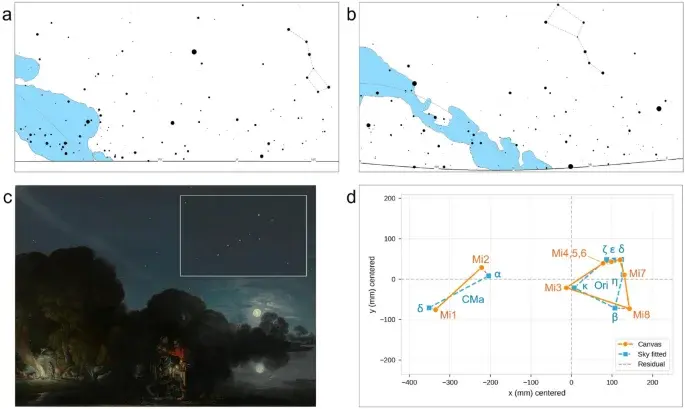
A new study in Scientific Reports argues that Vincent van Gogh’s 'The Starry Night' depicts the pre-dawn sky of July 22, 1889, rather than the traditionally accepted June date. Researchers used geometric analysis to match the painting’s central star cluster to the Hyades in Taurus, challenging long-standing art historical timelines.
Key points
- The study identifies the central asterism in 'The Starry Night' as the Hyades cluster, matching it to the sky on July 22, 1889.
- Researchers used Procrustes fitting to quantitatively compare the painting’s star patterns with real celestial coordinates, finding a strong statistical match.
- The traditional June 1889 dating is challenged by discrepancies in lunar phase and the visibility of the Hyades cluster during that period.
- Van Gogh’s letters and weather records from late July 1889 support the possibility that he observed the sky during that time.
- The Van Gogh Museum and some experts remain skeptical, arguing that the painting’s celestial positions do not reliably indicate a specific date.
Background
Previous analyses of 'The Starry Night' had reached conflicting conclusions about its astronomical basis, with some suggesting it depicted the Aries constellation in June 1889. This new study builds on earlier forensic astronomy efforts, such as those by Albert Boime and Charles Whitney, but introduces a more rigorous quantitative method. Additionally, recent research has highlighted van Gogh’s intuitive grasp of natural patterns, such as turbulence, in his work.
How outlets are covering it
The primary source, published in Scientific Reports, presents a detailed multidisciplinary analysis combining astronomical, meteorological, and epistolary evidence to support the July 22, 1889 date. The Guardian and Space.com highlight the study’s findings but note that the researchers acknowledge the results are not conclusive. The Van Gogh Museum and Donald Olson, a professor of physics and astronomy, express skepticism, arguing that van Gogh’s celestial depictions are not reliable for dating and that the painting’s wide field of view contradicts the narrow frame assumed by the researchers. Scientific American emphasizes the shift in the burden of proof, noting that the study challenges the traditional June dating but does not definitively resolve the debate.
Why it matters
This study challenges a century-old assumption about one of the most famous paintings in Western art, potentially reshaping our understanding of van Gogh’s creative process. It also demonstrates the application of modern astronomical and statistical methods to historical art, offering a new framework for analyzing other night-sky paintings.
What to watch
Further research in art history and conservation science may provide additional evidence to support or refute the July 1889 dating. The study’s methodology could be applied to other historical night-sky paintings, potentially revealing new insights into their astronomical accuracy.
- The actual sky of Van Gogh’s Starry Night: a multidisciplinary reconstruction | Scientific Reports Nature
- Astronomers challenge dating of Van Gogh’s Starry Night The Guardian
- Van Gogh's 'The Starry Night' depicts the sky on July 22, 1889, researchers find Space
- Was van Gogh’s ‘The Starry Night’ a flight of fancy or a real sky? Science News
- Astronomers unlock a mystery hidden in van Gogh’s The Starry Night Scientific American
Want the full story? Read the original reporting
Read on Nature