
Focusing on pain may reduce inflammation, new study suggests
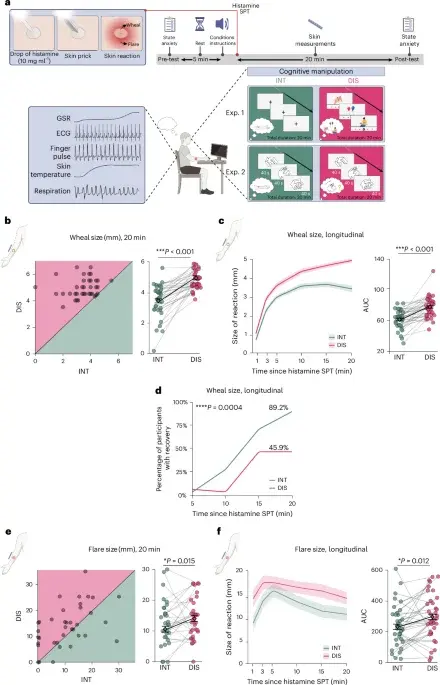
A study in Nature Human Behaviour finds that directing attention to bodily sensations, rather than distracting oneself, leads to smaller and faster-resolving acute inflammatory responses in humans. The research suggests attention acts as a biological control mechanism, not just a perceptual filter.
Key points
- Three pre-registered experiments involving 57 healthy volunteers used histamine skin prick tests to induce acute inflammation.
- Participants who focused on sensations at the test site showed inflammatory responses approximately 1.5 times smaller than those who were distracted.
- The effect was consistent, with about 90% of participants showing reduced inflammation when attending to their body.
- Two mechanisms were identified: a sensory-dependent route and a top-down route involving parasympathetic vagal activity.
- The findings challenge the idea that inflammation is purely autonomous, suggesting cognitive processes can regulate immune responses.
Background
Previous research has established that attention modulates the perception of pain and itch, but its impact on downstream biological processes like immune regulation was largely unexplored. While rodent studies suggested neural pathways influence immune dysregulation, direct human evidence linking voluntary attention to acute inflammation was lacking. This study builds on predictive and allostatic models of brain-body control, which propose that the brain anticipates and regulates internal states through autonomic and immune activity.
How outlets are covering it
The primary source, Nature Human Behaviour, emphasizes the dual mechanism of sensory modulation and top-down vagal control, highlighting the consistency of the effect across cohorts. Secondary sources, such as Euronews and Bioengineer.org, focus on the surprising nature of the finding, noting that while distraction is commonly advised for pain, focusing on the sensation may actually improve physiological regulation. All sources agree that the study does not imply attention can treat chronic diseases but rather reveals a new dimension of brain-body interaction. The primary source provides detailed statistical evidence, while secondary outlets frame the discovery as a shift in understanding perception as biologically consequential.
Why it matters
This research redefines the role of attention in physiology, suggesting that subjective experience is not merely a byproduct but an active component of immune regulation. It may inform future behavioral interventions for pain and inflammation, though further studies are needed to determine applicability to chronic conditions and specific neural pathways.
What to watch
Researchers plan to investigate the specific brain circuits and autonomic pathways involved, using neuroimaging and more direct autonomic assessments. Future studies will explore whether similar effects occur in chronic inflammation, wound healing, and other physiological contexts, potentially leading to new attention-based therapeutic approaches.
- Voluntary attention regulates acute immune responses in humans Nature
- Feel the burn: 90% of people heal faster by focusing on their pain — Israeli study The Times of Israel
- Focusing on bodily sensations may dampen acute inflammation, human experiments suggest Medical Xpress
- Your attention can influence your immune response, research finds Euronews.com
- Bar-Ilan Study Finds Attention Can Regulate Acute Inflammation in Humans Bioengineer.org
Want the full story? Read the original reporting
Read on Nature