
Penn Medicine’s new AI platform enables real-time two-way communication between patients and epilepsy devices
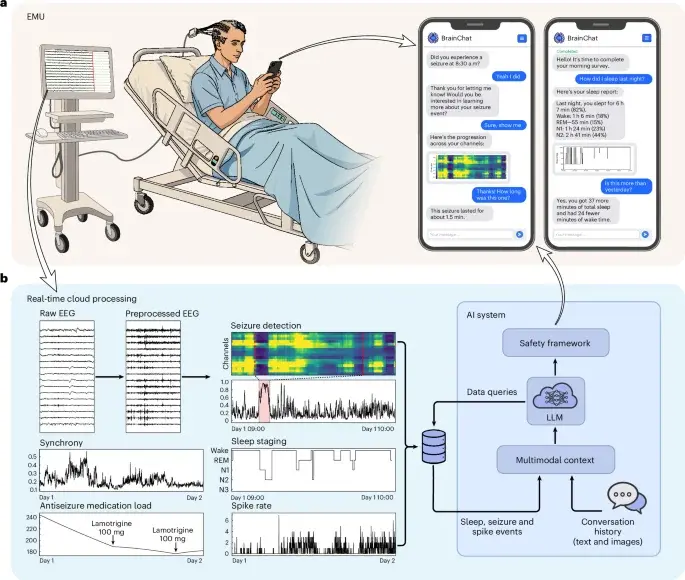
Researchers at the University of Pennsylvania have developed a prototype platform that allows patients with epilepsy to communicate bidirectionally with their medical devices in real time. By integrating EEG data with a large language model, the system alerts patients to clinical events and uses their feedback to improve seizure detection algorithms. A pilot study with 13 inpatients demonstrated that patient feedback significantly reduced false alarms, suggesting a future where medical devices actively collaborate with patients rather than passively monitoring them.
Key points
- The platform links scalp or intracranial EEG data to a HIPAA-compliant AI via a smartphone app, enabling real-time alerts and conversations.
- In a study of 13 patients, the system processed 1,307 messages, with patients providing feedback that helped retrain seizure detectors.
- Patient feedback alone reduced false alarm rates by 77.8% and improved F1 scores by 115.4% without expert intervention.
- The system uses GPT-4o-mini for general chat and a specialized 'data agent' for querying clinical metrics like sleep and seizure probability.
- Researchers plan to expand the platform to Parkinson’s disease deep brain stimulation and other conditions like diabetes and cardiac care.
Background
This development follows a broader trend in medical AI moving from passive monitoring to active, interactive support. Previous discussions in our archive highlighted the need for AI systems to be judged by real-world patient outcomes rather than just algorithmic accuracy. While earlier AI applications in epilepsy focused on detection algorithms or diagnostic screening from electronic health records, this new platform emphasizes the human-device relationship, allowing patients to learn how their behaviors affect their health in real time.
How outlets are covering it
The University of Pennsylvania team emphasizes the transformative potential of bidirectional communication, arguing that current devices miss opportunities to teach patients about their health. They highlight the success of using patient feedback to retrain algorithms, noting that even imperfect labels significantly improved detection accuracy. In contrast, secondary coverage from News-Medical focuses on a different AI application, 'EpiScreen,' which uses large language models to distinguish epilepsy from functional seizures using clinical notes. While both utilize AI for epilepsy, the Penn study focuses on real-time device interaction and patient education, whereas the EpiScreen study focuses on diagnostic accuracy and reducing wait times for confirmatory testing. The Penn team also notes that while the current study was limited to an inpatient setting, the platform is designed for future outpatient use, whereas the EpiScreen study remains retrospective and focused on pre-diagnosis screening.
Why it matters
This research represents a shift from medical devices as passive data collectors to active partners in care. By enabling real-time feedback and adaptive learning, the platform could help patients manage their conditions more effectively, potentially reducing seizure frequency and improving quality of life. The ability to reduce false alarms through patient interaction could make implantable devices more practical and less burdensome for daily use. Furthermore, the platform's design suggests a scalable model for other chronic conditions, potentially democratizing access to personalized, AI-driven medical management.
What to watch
The research team is preparing a trial to apply the platform to deep brain stimulation devices for Parkinson’s disease, aiming to optimize therapy through two-way communication. They also plan to expand testing into outpatient settings using minimally invasive EEG and wearable technologies. Future studies will evaluate whether the platform can reduce emergency department visits and lower healthcare utilization. Additionally, the team is incorporating wearables for applications in insomnia and other neuropsychiatric disorders, while addressing ethical considerations regarding AI reliability and clinical responsibility in long-term deployment.
- Human–artificial intelligence collaboration for comanaging epilepsy in real time Nature
- AI searches for a better, lightweight network to predict epileptic seizures EurekAlert!
- Patients engage with epilepsy monitor in real time, improving seizure detection Medical Xpress
- AI platform allows real-time conversation between patients and their medical devices Penn Medicine
- AI helps neurologists distinguish epilepsy from functional seizures News-Medical
Want the full story? Read the original reporting
Read on Nature