
Brain Surgery Patient Experiences Rare Facial Feature Transfers
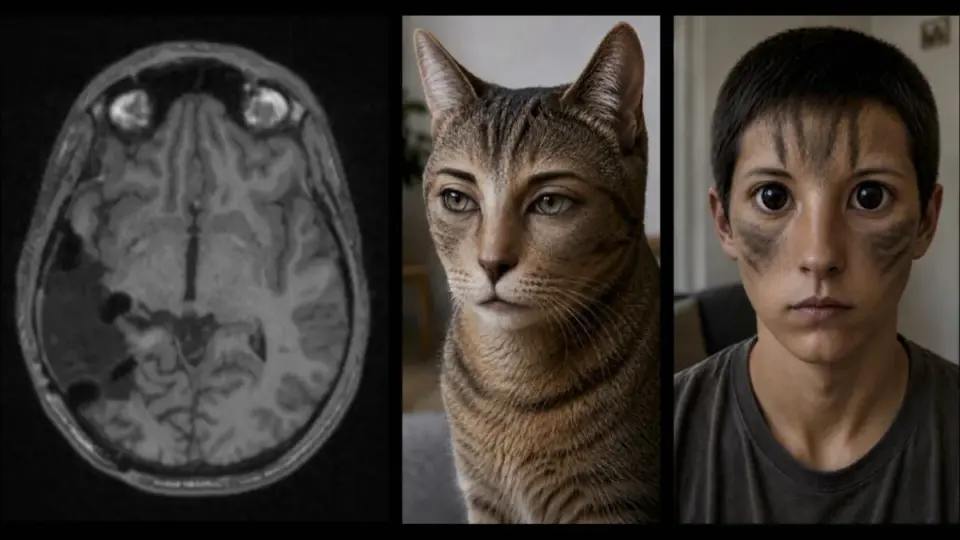
A 28-year-old man named Karl sees his cat’s eyes on human faces after brain surgery. Researchers at Dartmouth College and Brigham and Women’s Hospital published a case study in the journal Cortex. The condition, prosopometamorphopsia, stems from a partial removal of his right temporal lobe. It illustrates how the brain processes facial features and memory.
Key points
- Karl, 28, developed palinopsia after surgery for an arteriovenous malformation removed part of his right temporal lobe.
- He sees his cat Luna’s features, such as eyes and stripes, on human faces, especially if he sees the cat first in the morning.
- The condition is a rare form of prosopometamorphopsia, with only about 75 cases recorded in medical literature.
- Researchers used AI to create photorealistic images of Karl’s visual distortions, refining them with his feedback.
- The case highlights how the right temporal lobe processes facial features and matches them against stored memory.
Background
Prosopometamorphopsia (PMO) is a rare visual condition where faces appear distorted. It has been documented in about 75 cases in medical literature. Duchaine’s lab has contacted over 250 people with PMO. Some patients were misdiagnosed with psychiatric issues and prescribed antipsychotics, despite having visual processing problems. A similar case was reported in 1986, where a woman saw a poodle’s face on bus passengers after a stroke.
How outlets are covering it
Gizmodo emphasizes the rarity of Karl’s condition and the use of AI to visualize his experience. Popular Science highlights the nickname 'demon face syndrome' for PMO and the misdiagnosis of patients as psychiatric cases. Health and Me focuses on the definition of PMO and the specific features Karl sees. Bioengineer.org notes the collaboration between Karl and researchers to refine AI-generated images. All sources agree on the cause being the removal of part of the right temporal lobe and the role of memory in facial perception.
Why it matters
This case study provides insight into the neural circuitry of facial perception and the role of the right temporal lobe. It also demonstrates the potential of AI to help researchers and patients understand and communicate visual distortions. The findings could lead to better diagnosis and treatment for PMO, reducing misdiagnosis as psychiatric disorders.
What to watch
Duchaine’s team plans to continue working with Karl to monitor changes in his condition over time. They will use AI tools to further analyze his visual experiences. The researchers hope to develop better methods for understanding and potentially controlling PMO.
- Rare Condition Makes Man See His Cat's Eyes on Human Faces Gizmodo
- Man with ‘demon face syndrome’ sees cat’s eyes in human faces Popular Science
- After brain surgery, man sees cat's eyes in human faces Medical Xpress
- 28-Year-Old US Man Sees Cat’s Features On Human Faces After Brain Surgery: What Is Prosopometamorphopsia? Health and Me
- Man sees cat features in human faces after brain surgery Bioengineer.org
Want the full story? Read the original reporting
Read on Gizmodo