
AI 'Tissue Clocks' Map Organ-Specific Aging and Predict Disease via Blood Biomarkers
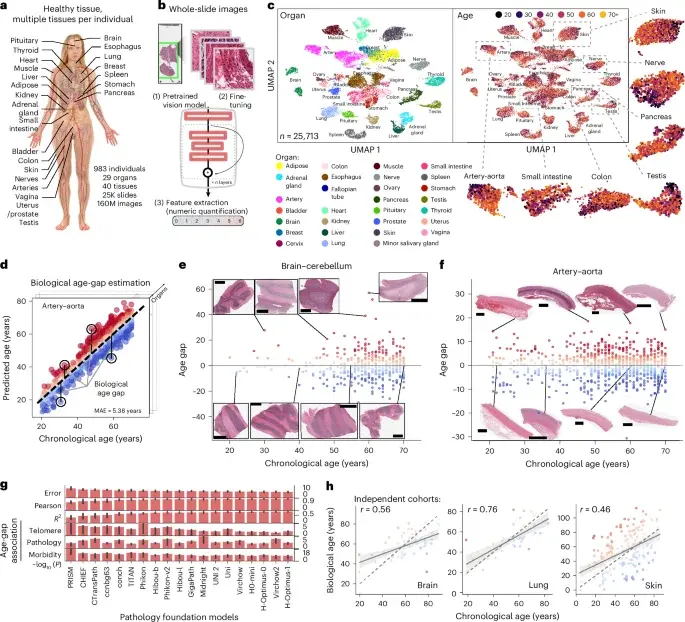
Researchers developed AI-driven 'tissue clocks' that estimate the biological age of individual organs by analyzing microscopic tissue structures. Using 25,712 histological images from 983 donors, the models predict organ age with a mean error of 4.9 years, revealing that organs age at different rates. These clocks correlate with telomere shortening and disease risk, and can potentially be inferred from blood gene expression to detect conditions like Alzheimer's and stroke before clinical symptoms appear.
Key points
- The study analyzed 25,712 whole-slide histopathological images from 40 tissue types across 983 individuals in the Genotype-Tissue Expression (GTEx) cohort.
- Deep learning models identified 'tissue clocks' that predict biological age with a mean absolute error of 4.88 years, outperforming standard DNA methylation clocks in predicting comorbidity burden.
- Aging is not uniform across the body; organs like the lung, kidney, and pancreas show accelerated structural changes between ages 20 and 40, while the uterus shows shifts around menopause.
- Researchers developed a method to predict tissue-specific age gaps from blood gene expression, identifying disease-relevant aging patterns for eight prevalent conditions, including Alzheimer's, stroke, and Crohn's disease.
- Histological age gaps correlate with telomere attrition and subclinical pathologies, such as artery calcification and muscle atrophy, offering a structural basis for monitoring physiological decline.
Background
This research builds on prior findings that biological aging varies by tissue type. Recent studies have highlighted tissue-specific responses to diet, such as ketogenic diets affecting intestinal cancer risk differently than colon cancer, and the link between visceral fat distribution and brain aging. Additionally, earlier work on tissue-resident memory T cells in the lungs demonstrated that human immune cells persist differently than in animal models, underscoring the need for human-specific aging metrics. The current study addresses the limitation of chronological age by providing organ-specific biological age estimates, complementing existing molecular clocks that often fail to capture structural tissue integrity.
How outlets are covering it
Nature Medicine presents the technical framework, emphasizing the superiority of histological clocks over DNA methylation for predicting comorbidity burden in the colon and lung. Bioengineer.org highlights the translational potential, focusing on how blood-based predictors could enable minimally invasive monitoring of diseases like Alzheimer's and Crohn's. The Times of India offers a patient-centric perspective, arguing that organ-specific aging clocks could detect risks like coronary artery disease years before standard blood tests, citing a case where a high calcium score was missed by normal lipid panels. While Nature and Bioengineer focus on the scientific validation and mechanism, The Times of India emphasizes the clinical utility and the gap between current diagnostic protocols and biological reality. All sources agree that aging is heterogeneous across organs, but they differ in emphasis: Nature stresses the methodological rigor, Bioengineer the non-invasive application, and The Times of India the preventive healthcare impact.
Why it matters
This research provides a scalable framework for monitoring organ-specific aging, moving beyond single-metric biological age assessments. By linking tissue architecture to blood biomarkers, it offers a potential pathway for early detection of chronic diseases through routine blood tests. Understanding that organs age at different rates allows for personalized medical interventions, targeting the 'weakest link' in an individual's physiology. This could shift healthcare from reactive treatment to proactive monitoring of physiological decline, potentially identifying at-risk individuals before clinical symptoms manifest.
What to watch
The next steps involve validating these tissue clocks in larger, more diverse populations to ensure generalizability. Researchers will need to determine if tissue-age gaps predict future illness and respond to lifestyle changes or therapies. Additionally, the development of commercial blood tests based on these predictors is anticipated, potentially becoming routine within a few years. Further studies will focus on distinguishing normal variation from clinically meaningful pathology and assessing the impact of sustained lifestyle interventions on organ-specific aging trajectories.
- Histological aging signatures for monitoring tissue-specific aging and disease Nature
- Organs age at different speeds: A blood test might soon tell which ones medicalxpress.com
- AI ‘Tissue Clocks’ Reveal the Age of Individual Organs Inside Precision Medicine
- Blood test could soon reveal which organs are aging fastest Bioengineer.org
- #78: Medicine is treating your age, not your body – How organ-aging clocks could predict trouble years befor The Times of India
Want the full story? Read the original reporting
Read on Nature