
Kazakhstan's Drowned Forest: A Century-Old Geological Accident Preserved by Cold Water
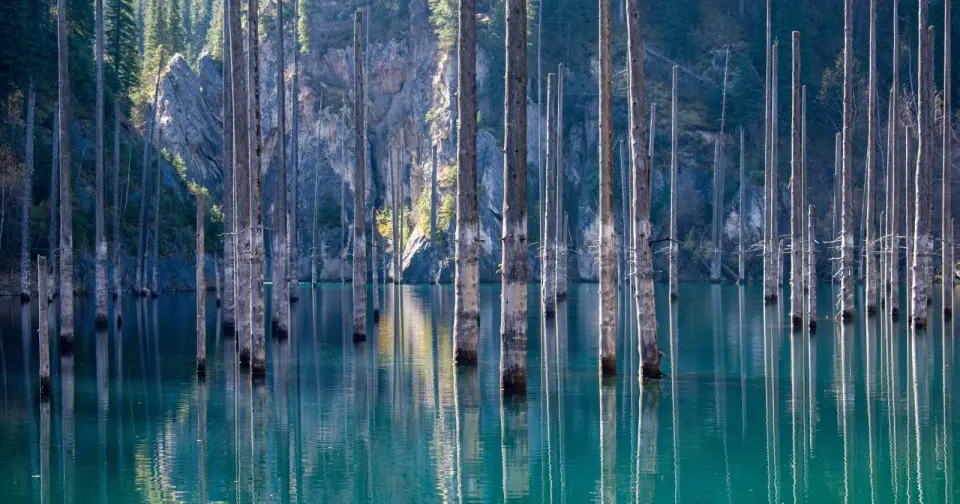
A 1911 earthquake in Kazakhstan’s Tian Shan mountains created a natural dam, submerging a spruce forest in near-freezing water. The cold and limestone-rich water halted decomposition, leaving hundreds of upright trunks visible today. While the trees appear preserved, the underground fungal networks that defined the forest likely died immediately upon submersion.
Key points
- In 1911, a massive earthquake dislodged limestone rubble in the Tian Shan mountains, sealing a valley and creating Lake Kaindy near Almaty, Kazakhstan.
- The resulting lake submerged a stand of spruce trees; the water’s near-freezing temperature and dissolved limestone prevented bacterial and fungal decomposition, preserving the trunks for over a century.
- The lake’s distinctive turquoise color is attributed to the dissolved limestone from the earthquake’s rubble.
- Forest ecologist Suzanne Simard notes that while trunks are preserved, the underground fungal networks that facilitate nutrient exchange between trees likely ceased functioning due to the change in soil chemistry and oxygen levels.
- The site is a popular tourist destination, though visitors are encouraged to understand that the visible trunks represent a preserved monument rather than a living forest.
Background
This story highlights the intersection of geological events and biological preservation. Unlike the 2026 discovery of a 2,700-year-old bronze sword in Poland’s sandy soil, which was preserved by specific soil conditions, the Kaindy forest was preserved by a sudden, catastrophic geological shift. The concept of a 'living' forest extending beyond visible trunks to underground networks contrasts with the static nature of the submerged trees, which are effectively in chemical stasis. While our archive covers other preservation phenomena, such as the ice shell of Europa, the Kaindy case is unique in its terrestrial, accidental preservation of a complex ecosystem’s physical remnants.
Why it matters
The story of Lake Kaindy illustrates how geological accidents can create unexpected natural monuments. It challenges the common perception that a forest is merely a collection of individual trees, highlighting the importance of underground biological networks. For travelers and scientists, it serves as a reminder that visual preservation does not equate to biological continuity, offering a nuanced view of how environmental conditions can halt decay without sustaining life.
What to watch
There are no immediate plans for new research specifically tracing the fate of the fungal networks under Lake Kaindy. The site remains a tourist attraction, with visitors continuing to observe the preserved trunks. Future scientific inquiry may focus on the specific chemical processes that allowed the trunks to remain intact for over a century, but no new expeditions or studies have been announced.
Want the full story? Read the original reporting
Read on Space Daily