
AI-driven method stabilizes mRNA vaccines at room temperature for a year
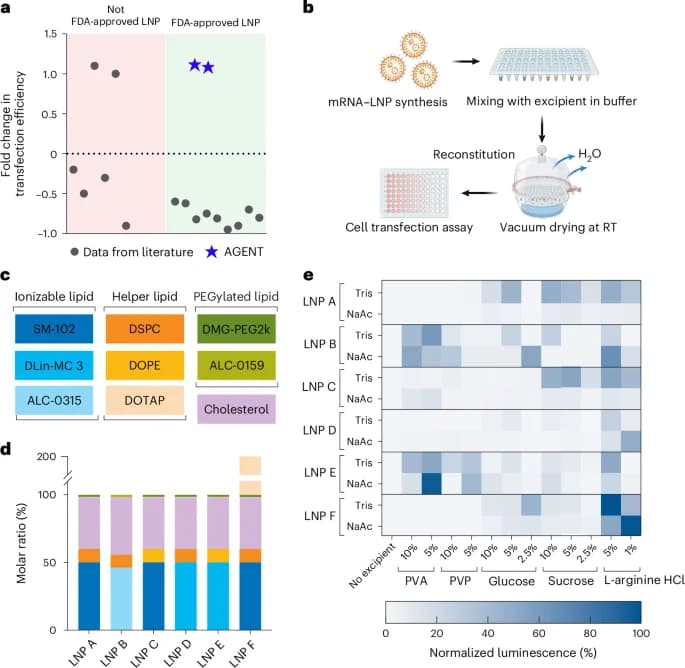
MIT researchers used an AI algorithm to identify excipient combinations that stabilize mRNA-lipid nanoparticle vaccines, allowing them to remain active at 37°C for two months or room temperature for one year without losing efficacy.
Key points
- The team developed AGENT, an AI framework using Bayesian optimization to screen excipients for mRNA-lipid nanoparticle (LNP) stability.
- The method identified formulations for Moderna-like and Pfizer-like LNPs that retained 100% bioactivity after storage at 37°C for over two months.
- Solid-state, water-free formulations were created via vacuum drying, enabling integration into microneedle patches.
- In rodent and non-human primate trials, the thermostable vaccines induced immune responses non-inferior to freshly prepared injectable vaccines.
- The process required only six iterations over one month, significantly faster than traditional trial-and-error methods.
Background
mRNA vaccines currently require ultra-cold storage (-20 to -80°C), limiting global distribution, particularly in regions lacking cold-chain infrastructure. Previous efforts to stabilize mRNA-LNPs often used polymer-stabilized formulations that differed from FDA-approved compositions. This study builds on earlier work by the same team on polymer-stabilized LNPs but focuses on optimizing existing FDA-approved formulations (Moderna’s SM-102 and Pfizer’s ALC-0315) for thermostability. The broader context includes the growing use of mRNA technology for diseases beyond COVID-19, such as cancer and flu, where stability is a critical barrier to widespread adoption.
How outlets are covering it
Nature Biotechnology emphasizes the technical novelty of the AGENT framework, highlighting its ability to extract maximal information from sparse datasets to optimize formulations in just six iterations. MIT News focuses on the practical implications, noting that the team previously struggled to stabilize FDA-approved formulations using known excipients but succeeded with AI guidance. Tech Explorist underscores the broader impact on global vaccine distribution and new delivery methods like microneedle patches, framing the achievement as a major step toward accessible RNA medicine. All sources agree on the efficacy and speed of the AI-driven approach, but Nature Biotechnology provides the most detailed technical context on the Bayesian optimization process, while MIT News and Tech Explorist highlight the real-world applications and historical challenges overcome.
Why it matters
This breakthrough could eliminate the need for ultra-cold storage for mRNA vaccines, significantly reducing costs and expanding access in low-resource settings. It also enables new delivery methods, such as microneedle patches, which could improve patient compliance and ease of administration. The AI-driven approach accelerates the development of thermostable formulations for other mRNA-based therapies, potentially speeding up the rollout of vaccines for cancer, flu, and other diseases.
What to watch
The researchers plan to apply the AGENT framework to other LNP formulations and mRNA payloads. They will also explore the integration of these thermostable formulations into various delivery systems, including controlled-release particles and microneedle patches. Further studies may focus on scaling up the production of these solid-state formulations and testing their efficacy in larger human trials.
- Accelerated discovery of thermostable mRNA–lipid nanoparticle vaccines using data-efficient AI Nature
- New formulation helps RNA vaccines withstand high temperatures MIT News
- Automated lipid nanoparticle production could accelerate the development of RNA therapies Phys.org
- Scientists find a way to keep RNA vaccines stable in the heat techexplorist.com
- Study Explores How Storage Buffers Shape mRNA-LNP Performance technologynetworks.com
Want the full story? Read the original reporting
Read on Nature