
Brain Uses Control Theory to Blend Goals Simultaneously
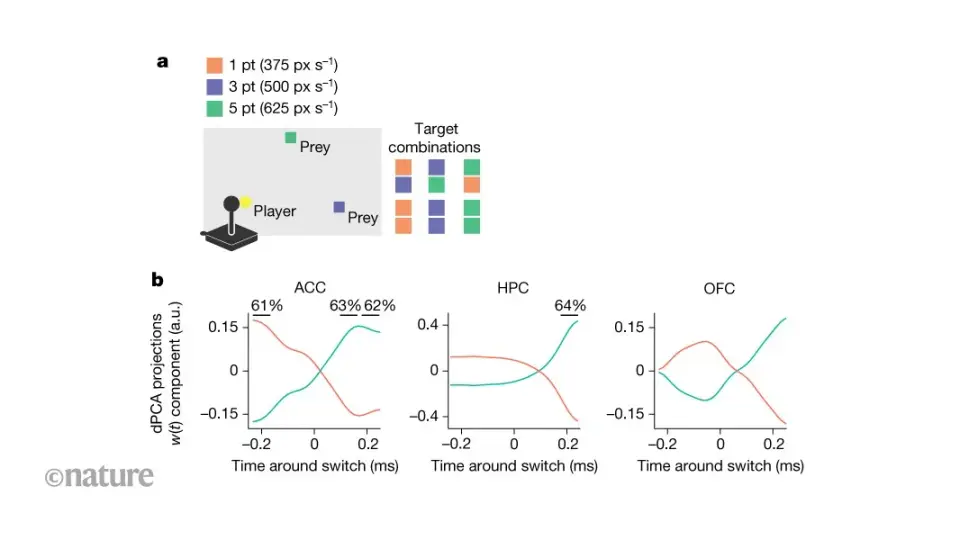
New research published in Nature demonstrates that the human brain can pursue multiple goals at once by blending different strategies, a process analogous to engineering control theory. The study, led by Andrea Chericoni and colleagues, utilized a simple video game to infer participants' goals and identified three specific brain regions that collaborate to implement this 'compositional control.' This finding provides a neural basis for how humans manage complex, multi-objective behaviors in naturalistic settings.
Key points
- Researchers applied control theory, an engineering framework, to analyze human decision-making during a video game task.
- The study revealed that the brain blends multiple lower-level policies to advance toward several goals simultaneously.
- Three distinct brain regions were identified as working together to implement this goal-blending mechanism.
- The findings offer a neural explanation for how animals and humans navigate complex environments with competing objectives.
- The research was published in Nature on August 12, 2026, under the title 'Neural basis of compositional control'.
Background
This finding builds on earlier coverage from August 13, 2026, which detailed a 'tripartite view' of goal-directed behavior. That previous analysis highlighted how the anterior cingulate cortex, hippocampus, and orbitofrontal cortex function as a meta-controller to shift policy composition in continuous tasks. The current study extends this understanding by explicitly linking these neural mechanisms to the concept of 'compositional control' in human subjects, confirming that the brain does not just switch between single goals but actively blends strategies to achieve multiple outcomes concurrently.
Why it matters
Understanding how the brain blends goals has significant implications for artificial intelligence and robotics, where engineers struggle to design systems that can handle multiple, conflicting objectives simultaneously. By mapping human neural mechanisms to control theory, researchers can develop more efficient algorithms for autonomous agents. Additionally, this insight may help in treating neurological disorders where decision-making processes are impaired, offering a clearer view of how the brain manages complexity in everyday life.
What to watch
Future research will likely focus on identifying the specific neural signatures of 'policy switches' within the three identified brain regions to understand how quickly and flexibly the brain can adjust its strategy blend. Researchers may also explore how this compositional control mechanism varies across different types of tasks, from simple motor actions to complex social interactions, to determine if this is a universal cognitive strategy or specific to certain domains.
Want the full story? Read the original reporting
Read on nature.com