
Brain Surgery Patient Experiences Rare Facial Feature Transfers Between Humans and Cats
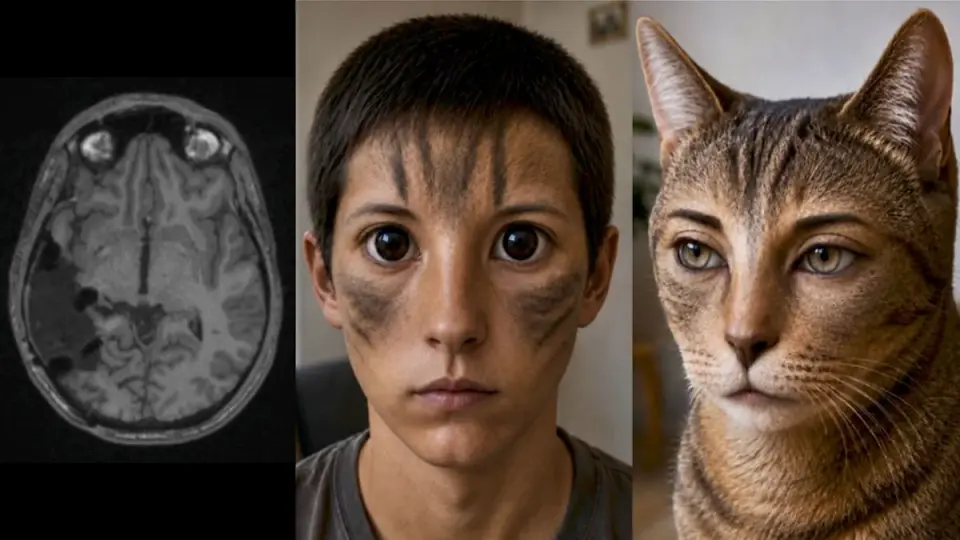
A 28-year-old man from the northeastern US, identified as Karl, suffers from a rare visual distortion where his cat Luna’s facial features appear on human faces, and vice versa. This condition, known as prosopometamorphopsia, began two years after he underwent surgery to remove an arteriovenous malformation in his right temporal lobe. Researchers from Dartmouth College and Brigham and Women’s Hospital published the case in the journal Cortex, noting that the distortions are coherent and persist for hours. They utilized AI tools to visualize these experiences, arguing that such technology improves the accuracy of documenting perceptual disorders. The case mirrors a 1986 incident involving a poodle and suggests that facial processing relies heavily on memory integration rather than direct visual input alone.
Key points
- Karl, 28, experiences persistent visual distortions where his cat Luna’s features overlay human faces, and human features overlay Luna, lasting up to all day.
- The condition began two years after surgery to remove an arteriovenous malformation, which involved the removal of part of the right temporal lobe, a key area for face processing.
- Researchers from Dartmouth College and Brigham and Women’s Hospital published the case in the journal Cortex, describing the transferred features as seamlessly integrated and coherent.
- Psychologist Brad Duchaine collaborated with Karl to create AI-generated images that accurately represent the patient’s visual experience, aiming to improve research into perceptual disorders.
- The case parallels a 1986 report in Cortex where a woman with stroke-related brain damage saw a poodle’s face on bus passengers, reinforcing the link between brain damage and facial perception errors.
Background
This case follows a 1986 report in the journal Cortex involving a 58-year-old woman who experienced similar facial feature transfers after a stroke. In that instance, she perceived a poodle’s face on fellow bus passengers, alongside other recognition issues. The current case highlights ongoing research into how the brain processes faces, specifically the role of the right temporal lobe and the integration of memory into perception. Recent advances in AI visualization are being applied to better document these rare perceptual anomalies, moving beyond traditional patient descriptions to photorealistic representations.
Why it matters
This case provides critical insight into the neural mechanisms of face processing, demonstrating that perception is not merely a passive reception of visual data but an active integration of memory and context. The use of AI to visualize subjective perceptual experiences offers a new methodological tool for researchers, potentially leading to better diagnostic and therapeutic approaches for visual disorders. It also underscores the vulnerability of specific brain regions, such as the right temporal lobe, to surgical interventions that can result in long-term perceptual changes.
What to watch
Researchers expect to continue using AI-generated visualizations to document and analyze cases of prosopometamorphopsia and related visual perceptual disorders. Further case studies are needed to understand the precise neural pathways involved in these distortions. The collaboration between patients and researchers using AI tools may lead to more accurate characterizations of visual experiences, aiding in the development of interventions to control or mitigate such conditions.
Want the full story? Read the original reporting
Read on Yahoo