
Chemists Unlock 37% Efficiency in Perovskite LEDs by Controlling Hidden Additive Reactions
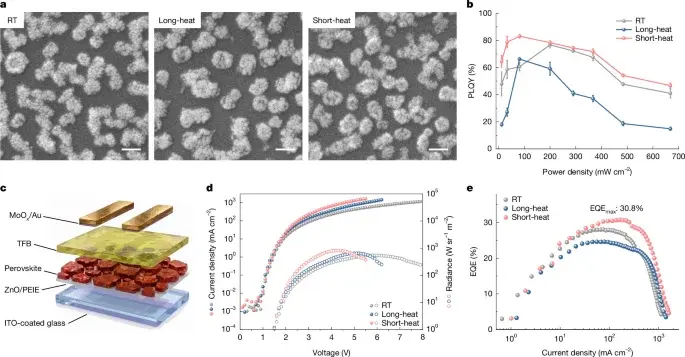
Researchers at Emory University and Purdue University have significantly improved the efficiency of perovskite light-emitting diodes (PeLEDs) by identifying and controlling hidden chemical reactions in precursor solutions. By optimizing the synthesis of the additive 5-aminovaleric acid, they achieved a peak external quantum efficiency of 37.1%, a major leap from the typical 20-30% range. This chemistry-driven strategy allows for the selective production of beneficial compounds while suppressing detrimental by-products, paving the way for more efficient and stable hybrid LEDs.
Key points
- The study reveals that the common additive 5-aminovaleric acid (5AVA) undergoes competing reactions in solution, producing two distinct products: a beneficial zwitterion and a harmful lactam.
- Controlling the heating time of the precursor solution to approximately 20 minutes favors the formation of the beneficial zwitterion, which enhances device performance.
- The optimized PeLEDs achieved a mean peak photoluminescence quantum yield of 97.2% and a champion external quantum efficiency of 37.1%.
- This approach decouples the intrinsic passivation function of the additive from confounding by-products, offering a rational design strategy for future additive engineering.
- The findings suggest that similar reaction-pathway controls can be extended to other additive chemistries and emission colors, potentially improving the stability and efficiency of various PeLED applications.
Background
Perovskite LEDs have emerged as a promising class of solution-processed light-emitting devices, combining high efficiency with facile fabrication. Previous research has focused on using amino-acid-based molecular additives to regulate crystallization and suppress defects in perovskite thin films. However, the chemical reactivity of these additives in precursor solutions remained poorly understood. This study builds on earlier work that identified 5AVA as a ubiquitous additive, but it goes further by resolving the hidden solution-phase chemistry that had been overlooked. The archive article from October 11, 2026, about the discovery of a hidden lymphatic drainage pathway in the eye, while unrelated in topic, highlights the broader theme of uncovering hidden mechanisms in biological and material systems that can lead to significant advancements.
How outlets are covering it
The primary source, Nature, emphasizes the scientific breakthrough in understanding the hidden reaction pathways of 5AVA and the resulting improvement in PeLED efficiency. It highlights the technical details of the reaction dichotomy and the targeted reaction-pathway control. The secondary source, Emory News, focuses on the practical implications and the potential applications of the technology, such as biomedical sensing, low-light imaging, and automated facial recognition. It also provides context on the broader field of LED technology, comparing inorganic, organic, and hybrid LEDs. Both sources agree on the significance of the 37.1% efficiency milestone, but Nature provides more detailed chemical insights, while Emory News offers a broader perspective on the technology's potential impact and the researchers' motivations.
Why it matters
This research represents a significant step forward in the development of perovskite LEDs, which are poised to revolutionize various fields, including displays, biomedical imaging, and security systems. By achieving a higher quantum efficiency, these devices can convert more electricity into light, making them more energy-efficient and cost-effective. The ability to control the chemical reactions in the precursor solution also opens up new avenues for designing additives that can further improve the performance and stability of PeLEDs. This could lead to the development of more durable and versatile light-emitting devices, with applications ranging from flexible displays to non-invasive medical imaging.
What to watch
The researchers plan to extend the reaction-pathway control concept to other additive chemistries and emission colors, aiming to improve the efficiency and operational lifetime of PeLEDs across a broader spectrum of applications. They also intend to explore the relevance of this technology in biomedical research, potentially forming collaborations with medical institutions to demonstrate its practical benefits. Future studies may focus on scaling up the production of these high-efficiency PeLEDs and integrating them into real-world devices, such as flexible displays and medical imaging tools.
Want the full story? Read the original reporting
Read on Nature