
Lifespan Atlas Maps Prefrontal Cortex Gene Shifts from Resilience to Vulnerability
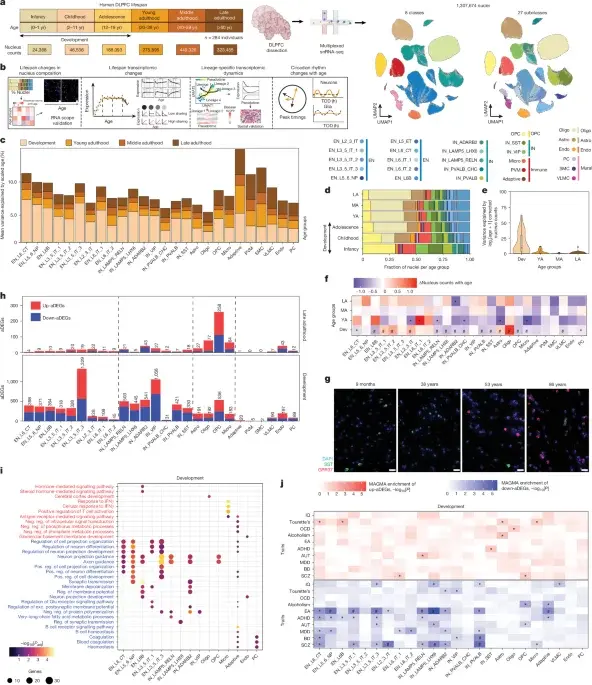
Researchers have published the first comprehensive single-nucleus transcriptomic atlas of the human dorsolateral prefrontal cortex (DLPFC) spanning the entire lifespan. By analyzing over 1.3 million nuclei from 284 neurotypical donors, the study reveals that brain aging is not a linear decline but a non-linear process with distinct phases. The atlas identifies a transition from early-life neuronal resilience to late-life glial immune activation and circadian disruption, providing a new framework for understanding age-related cognitive decline and disease risk.
Key points
- The atlas profiles 1,307,674 single nuclei from 284 donors, covering infancy through late adulthood (age 60+).
- Transcriptional changes in the DLPFC are non-linear, featuring dynamic remodeling in development, stability in midlife, and selective reactivation in late adulthood.
- Late-life glial cells show increased immune activation and stress responses, while neuronal clock synchronization is lost.
- The study links these molecular shifts to genetic risks for psychiatric disorders like schizophrenia and neurodegenerative conditions.
- Astrocyte subtypes mature at different rates, with protoplasmic astrocytes showing higher disease relevance scores for migraines during aging.
Background
This study builds on recent advancements in single-cell sequencing technologies, such as the Malva search engine, which allows for rapid querying of large transcriptomic datasets. It also follows earlier research on cortical stimulation, which identified cell-type-specific gene programs in the temporal cortex, suggesting that understanding these molecular states could guide future therapies for cognitive decline.
How outlets are covering it
The primary source, Nature, emphasizes the structural and molecular complexity of aging, highlighting the shift from neuronal resilience to glial vulnerability. The secondary source, The Independent, frames the findings primarily through the lens of disease risk, focusing on how these gene activity maps shed light on Alzheimer's and schizophrenia. While both agree on the atlas's significance, Nature focuses on the biological mechanisms of aging, whereas The Independent highlights the clinical implications for mental health disorders.
Why it matters
This atlas provides a foundational reference for distinguishing normal aging from pathological processes in the brain. By identifying specific gene modules associated with late-life vulnerability, researchers can better target interventions for cognitive decline and psychiatric disorders, potentially leading to new treatments that address the root molecular causes of aging-related brain changes.
What to watch
Future research will likely use this atlas to validate specific gene modules in patient cohorts with Alzheimer's or schizophrenia. Additionally, the identified circadian and immune pathways may become targets for therapeutic interventions aimed at slowing cognitive decline in older adults.
- Lifespan single-cell transcriptomic atlas of the human prefrontal cortex Nature
- Single-cell atlas of transcriptomic vulnerability across brain disorders Nature
- Large-scale studies create one of the world's most comprehensive single-cell atlases of human brain disease Medical Xpress
- Scientists map gene activity in brain's prefrontal cortex reuters.com
- Scientists map gene activity in brain’s prefrontal cortex shedding light on Alzheimer’s, schizophrenia The Independent
Want the full story? Read the original reporting
Read on Nature