
Stem-derived retinal endothelium restores the inner blood-retina barrier and enables disease modeling
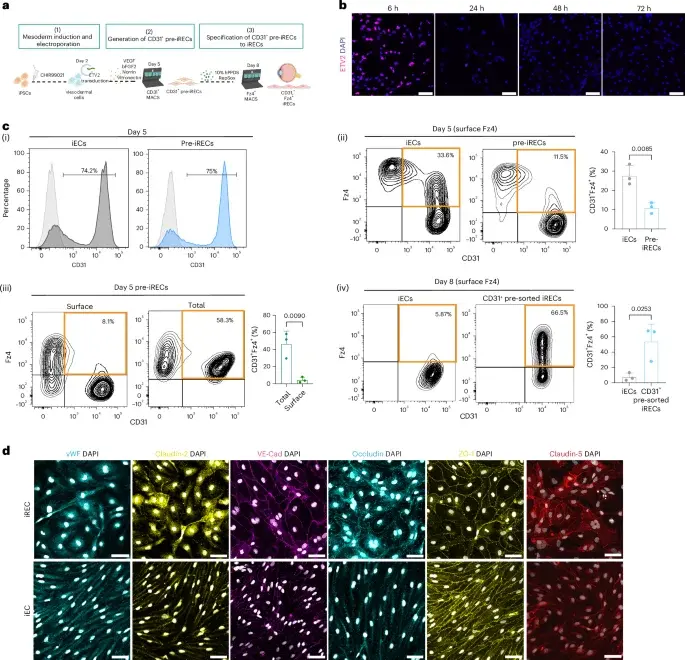
Researchers derived retinal endothelial cells from human iPSCs via the Norrin–Fz4–Wnt/β-catenin axis, enhanced barrier maturation with RepSox, and demonstrated retinal-specific markers, GLUT1/p‑gp transporter activity, and robust, lumenized 3D networks. In vivo, iRECs integrated into ischemic mouse retinas, promoting revascularization, restoring normal vascular morphology, and reducing permeability in an oxygen-induced retinopathy model. In vitro, iRECs formed functional iBRB microphysiological systems with retinal pericytes (iRPCs), recapitulating iBRB structure and barrier function. Transcriptomics confirmed retinal gene signatures aligning with primary RECs, though not fully matching HRECs. The work establishes iRECs as a scalable, tissue-specific cell source for retinal disease modeling (notably diabetic retinopathy) and therapeutic cell-based strategies, while acknowledging limitations in biomarker breadth and complex pericyte identity for future refinement.
- Derivation of functional retinal endothelial cells from human pluripotent stem cells for therapeutics and modelling Nature
- Photoswitch drug shows early signs of restoring light sensitivity in severely damaged retinas in first human trial Medical Xpress
- Researchers Grow Rare Eye Vessel Cells to Halt Vision Loss Neuroscience News
- Blind people offered fresh hope of seeing again after lab breakthrough themercury.com
- iPSC-Derived Retinal Endothelial Cells Offer Platform for Studying Diseases Genetic Engineering and Biotechnology News
Want the full story? Read the original reporting
Read on Nature