
Study Reveals PIK3CA Mutation Drives Venous Identity in Arterial Precursors, Explaining Arterial Resistance
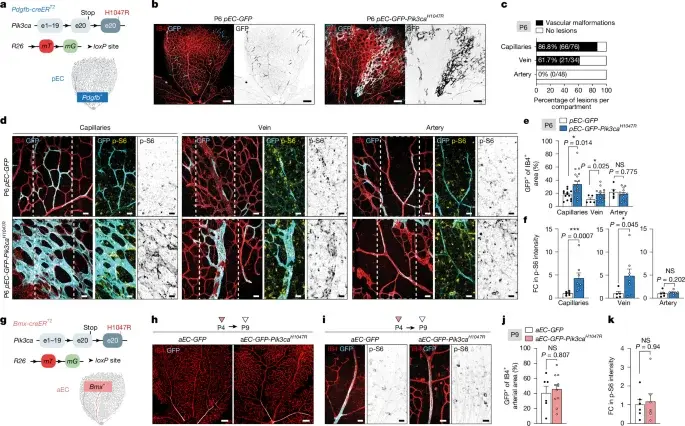
A new study in Nature explains why PIK3CA mutations cause vascular malformations in veins and capillaries but spare arteries. Researchers found that mature arterial cells resist the mutation, while precursor cells are diverted to venous identities due to changes in the NR2F2 transcription factor. This differentiation-stage-specific response offers a mechanistic explanation for the rarity of arterial lesions in PIK3CA-related disorders.
Key points
- Mature arterial endothelial cells are refractory to the PIK3CA H1047R mutation, showing no clonal expansion or PI3K pathway activation, whereas capillary and venous cells exhibit profound expansion.
- Arterial precursor cells carrying the mutation are diverted away from arterial differentiation and into venous or capillary lineages, with only 0.47% of mutant cells reaching arteries compared to 23% of normal cells.
- The mutation upregulates the venous-specifying transcription factor NR2F2 (COUP-TFII) by reducing the nuclear presence of FOXO1, which normally represses NR2F2, thereby suppressing arterial identity.
- The CDK4/6 inhibitor palbociclib reduced endothelial proliferation and overgrowth but did not restore arterial differentiation or lower NR2F2 levels, indicating that proliferation and identity changes are distinct processes.
- The PI3K inhibitor alpelisib reduced NR2F2 levels in cultured patient-derived cells, but the study did not test whether it restores arterial identity in animal models or patients.
Background
PIK3CA mutations are associated with the PIK3CA-related overgrowth spectrum (PROS), a group of rare congenital disorders that include vascular malformations. Previous research, including a 2026 study on VEGFR2 loss, has shown that endothelial cells can adopt a venous identity to survive, a process known as venousization. This new study builds on that by showing how PIK3CA mutations specifically drive this venous switch in arterial precursors, explaining why arteries are largely spared in PROS.
How outlets are covering it
Nature and Tech Times agree that the study provides a mechanistic explanation for the vessel-type specificity of PIK3CA-driven malformations. Tech Times emphasizes the clinical implications, noting that the two problems of abnormal growth and altered identity are distinct and that no treatment was tested in humans. Demócrata, a Spanish outlet, did not provide a substantive summary of the study, instead displaying election results, suggesting it may not have covered the scientific findings in depth.
Why it matters
The findings clarify why PIK3CA mutations cause malformations in veins and capillaries but not arteries, a long-standing clinical puzzle. Understanding the role of NR2F2 and FOXO1 in this process could lead to new therapeutic approaches that target both proliferation and cell identity, potentially improving treatments for PROS and other vascular disorders.
What to watch
The authors suggest that future work should investigate how the extracellular matrix and mural cells contribute to arterial resistance, and whether other oncogenic mutations also depend on cell differentiation state. They also propose testing whether alpelisib or other upstream inhibitors can restore arterial identity in animal models and patients, as the current study only showed its effect in cultured cells.
- Context-dependent response of endothelial cells to PIK3CA mutation Nature
- Nature Study: PIK3CA Cancer Gene Mutation Turns Artery Precursors Into Vein Cells in Mice Tech Times
- Spanish scientists clarify why an oncological mutation damages only certain blood vessels Demócrata
- Same oncogenic mutation, different outcomes: Why some blood vessels develop malformations while others remain resistant Medical Xpress
Want the full story? Read the original reporting
Read on Nature