
NTSB data reveals throttle anomalies in fatal Miami Amazon cargo crash
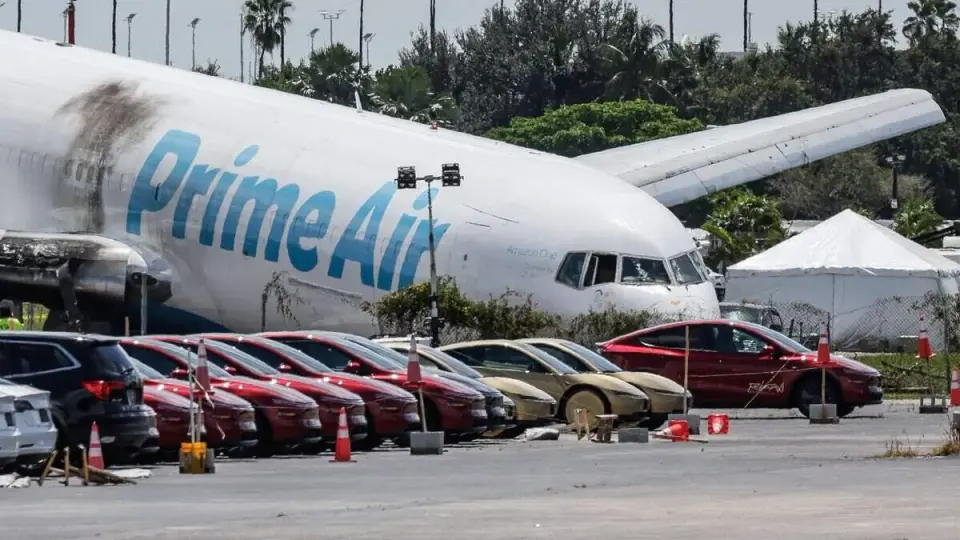
The National Transportation Safety Board (NTSB) has released preliminary flight data from the September 6, 2026, crash of an Amazon cargo Boeing 767 at Miami International Airport. The data indicates that while wheel brakes were applied, speed brakes and thrust reversers were not deployed. Furthermore, flight recorders show that throttles were set to full power 15 seconds before the crash, a move investigators are seeking to explain through pilot interviews. The crash killed five workers from a cleaning contractor and injured five others, including the two pilots.
Key points
- The NTSB confirmed that the aircraft's wheel brakes were applied, but there is no recorded indication that speed brakes or thrust reversers were deployed during the landing.
- Flight data shows the throttles were moved to full takeoff power 15 seconds before the crash, then returned to idle four seconds later; the reason for this action remains under investigation.
- The crash occurred on Sunday, September 6, 2026, when the 32-year-old Boeing 767-300 overshot Runway 30, struck a cleaning crew van, and crashed through a fence into a civilian SUV.
- Five people died, all of whom were employees of Professional Ocean Service Corp., a company that cleans aircraft. Five others were injured, including the two pilots.
- The pilots, Captain Joseph Carroll (55) and First Officer Jaime Filipe Silva Molina (37), survived with minor injuries and were released from the hospital.
- The NTSB is interviewing the pilots and dispatchers to understand the throttle movements and control manipulations during the final approach.
Background
The incident occurred on September 6, 2026, involving Prime Air Flight 7598, operated by 21 Air for Amazon. The aircraft was on its third flight of the day, arriving from San Juan, Puerto Rico. Initial reports from our archive noted that the pilots survived and that one remarked, 'My career is over.' The crash left Miami International Airport with only two of its four runways operational for several days, causing significant flight delays and cancellations. The NTSB has been leading the investigation, focusing on the lack of an Engineered Material Arresting System (EMAS) at the runway end, which aviation experts noted could have stopped the aircraft before it reached the roadway.
How outlets are covering it
The Miami Herald focused on identifying the pilots, matching names from the sheriff's office with FAA and LinkedIn records. Fox News emphasized the NTSB's finding that key braking systems, specifically speed brakes and thrust reversers, did not deploy, highlighting the captain's 7,145 flight hours. CNN provided a detailed timeline of the landing, noting that the aircraft approached from above the standard glide path and that the throttles were set to full power shortly before impact. CNN also highlighted the lack of an EMAS system at Miami International Airport, contrasting it with other US airports that have such safety features. All sources agree that the NTSB is prioritizing pilot interviews to understand the sequence of events, particularly the throttle movements, before drawing conclusions.
Why it matters
The crash highlights critical safety gaps in airport infrastructure and flight operations. The absence of an EMAS system at Miami International Airport, a major hub surrounded by urban development, raises questions about the adequacy of current safety standards. The NTSB's focus on the throttle anomalies and braking system failures will likely influence future regulations regarding cargo flight operations and airport safety equipment. The incident also underscores the risks associated with third-party carriers operating for major logistics companies like Amazon, as 21 Air is the operator responsible under FAA regulations.
What to watch
The NTSB is scheduled to interview the pilots and 21 Air's chief pilot in the coming days. Investigators will continue analyzing the flight data recorder and cockpit voice recorder to determine the cause of the throttle movements and the failure of braking systems. The NTSB will not release a probable cause determination until the investigation is complete, which typically takes several months. The airport is expected to reopen all runways as cleanup and recovery operations continue.
- Who were the pilots of the crashed Amazon cargo plane? Miami Herald
- Data shows Amazon jet’s key braking systems did not deploy during deadly Miami crash: NTSB Fox News
- Live plane crash updates: Miami flight delays, runway status, pilot interviews Miami Herald
- Pilots applied full power seconds before Amazon cargo plane overran Miami runway, killing 5 in cleaning van, officials say CNN
- Amazon Cargo Jet Pilots Appeared to Try Aborting Landing, N.T.S.B. Investigation Indicates The New York Times
Want the full story? Read the original reporting
Read on Miami Herald