
US Army Drone Instructor Adopts Ukrainian 'Killhouse' Tactics After Visits
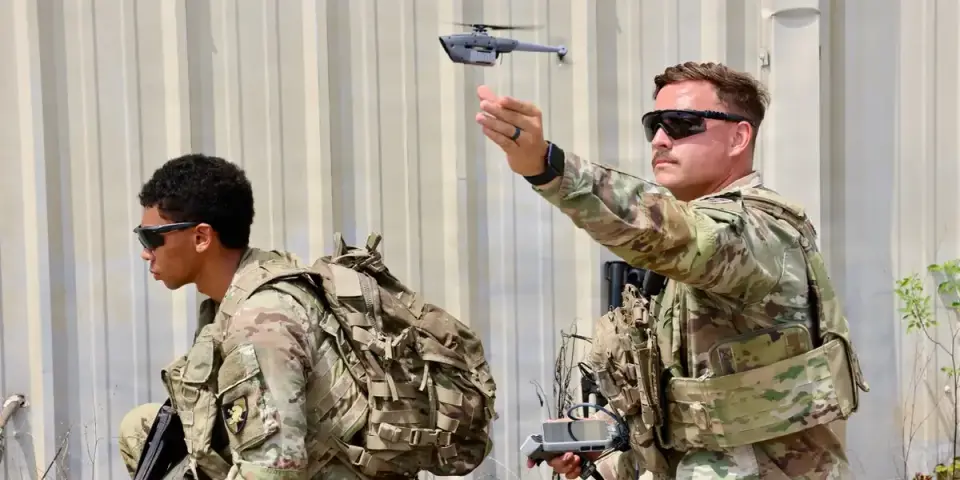
A US Army aviation warrant officer has integrated lessons from Ukraine’s 'Killhouse' drone academy into the Army’s Unmanned Advanced Lethality Course at Fort Rucker. James Andreasen, who visited the facility multiple times between November 2025 and March 2026, noted that Ukrainian training emphasizes maintenance, realistic electronic warfare conditions, and operator survivability over the US focus on signal reliability and expensive systems. The Army has adopted these practical, low-cost tactics to improve soldier readiness, though Andreasen notes the US still struggles to train enough personnel quickly enough to match Ukrainian proficiency.
Key points
- James Andreasen, a senior US Army aviation warrant officer and AH-64 Apache pilot, visited Ukraine’s Killhouse Academy approximately two dozen times between November 2025 and March 2026.
- The Killhouse Academy, run by Ukraine’s 3rd Army Corps, trains soldiers, foreign fighters, and civilians to operate small drones, with courses updated to reflect current battlefield trends.
- Andreasen observed that Ukrainian trainees are required to repair, program, and swap parts on their own drones, a skill he believes is essential for adaptation in combat.
- Ukrainian training intentionally degrades drone signals to simulate electronic warfare, whereas US training typically prioritizes signal reliability and control, potentially sacrificing realism.
- Andreasen noted that Ukrainian operators prioritize survivability by protecting their positions, contrasting with the US assumption that simple concealment like hiding behind a tree is sufficient.
- The US Army has adopted Ukrainian tactics, including steady hovering, low-altitude flight, and indoor navigation, into the Unmanned Advanced Lethality Course at Fort Rucker, Alabama.
Background
This development follows recent high-profile security incidents involving US Army personnel, such as the arrest of Lt. Col. Brandon Tyner in the UK on suspicion of Russian espionage in November 2026. While that case involved alleged betrayal of trust, the current story highlights the US military’s proactive efforts to modernize its drone capabilities in response to the ongoing war in Ukraine, focusing on training efficiency and tactical adaptation rather than security breaches.
Why it matters
The integration of Ukrainian drone tactics into US Army training signals a significant shift in Western military doctrine, prioritizing practical, low-cost, and resilient operations over traditional, high-cost, signal-reliant approaches. This adaptation is critical as drones become central to modern warfare, and the US seeks to close the experience gap with Ukrainian forces who have faced intense electronic warfare and resource constraints. The emphasis on maintenance and survivability could enhance the effectiveness of US drone operators in future conflicts, though the challenge of scaling training remains a key bottleneck.
What to watch
The US Army will continue to update the Unmanned Advanced Lethality Course based on further insights from Ukraine, focusing on improving the speed and volume of training to address current capacity constraints. Andreasen’s observations may lead to broader adoption of low-cost, adaptable drone technologies and training methods across other US military branches, as the Army seeks to rapidly modernize its forces in response to evolving battlefield conditions.
Want the full story? Read the original reporting
Read on Business Insider