
US-China Summit Yields Limited Trade Deals Amid Diplomatic Showmanship
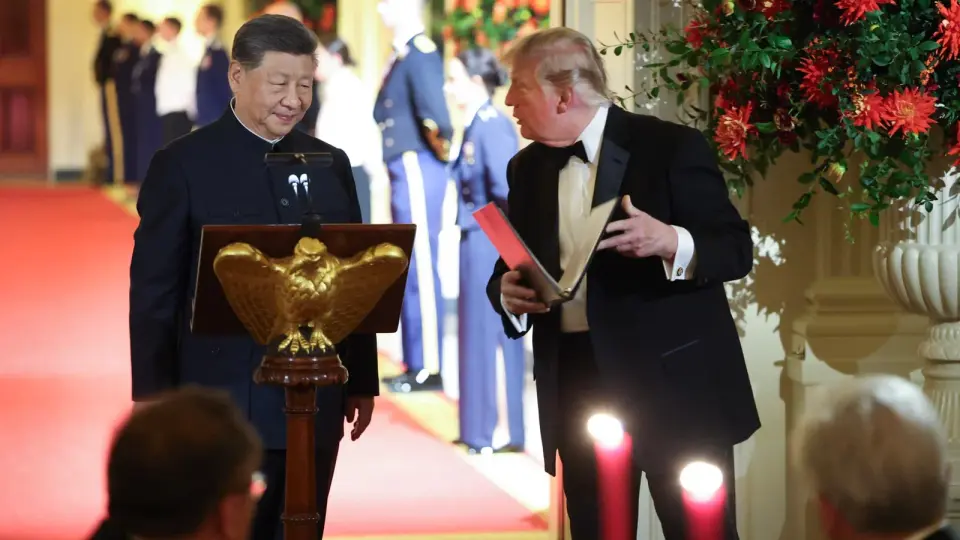
The recent state visit by Chinese President Xi Jinping to Washington resulted in a two-month extension of the trade truce and agreements on AI dialogue, but analysts criticize the lack of substantive breakthroughs. While the US and China issued separate statements rather than a joint one, both sides agreed to reduce tariffs on $30 billion in goods and establish communication channels for AI incidents. The summit was marked by high-profile hospitality, including a White House dinner attended by major tech executives, yet critics argue the diplomatic spectacle did not match the limited tangible outcomes, leaving strategic tensions unresolved.
Key points
- Xi Jinping’s state visit to Washington included a rare airport greeting by President Trump and a state dinner attended by over 100 guests, including tech leaders like Jensen Huang and Elon Musk.
- The US and China agreed to extend their trade truce for two months and reduce tariffs on $30 billion worth of goods, including Chinese coal imports.
- Both nations committed to an AI dialogue and a communication channel for AI incidents, though the US used the term 'Super Intelligence' while China referred to it as AI.
- Separate statements were issued by both countries instead of a joint statement, signaling continued strategic competition and a lack of consensus on key issues like Taiwan.
- Analysts noted that while the summit projected Chinese equality on the world stage, it failed to address deep-seated strategic challenges or produce significant concessions on rare earths or military issues.
Background
This summit follows a period of escalating tensions, including a trade war in 2025 where China leveraged rare earth exports to counter US tariffs. Previous interactions, such as Trump’s visit to Beijing in May 2026, set a precedent for high-level engagement, but this visit is seen as a test of whether diplomatic gestures can translate into stable economic and strategic outcomes. The archive does not contain relevant background on this specific geopolitical event, but the current summit is part of a broader pattern of US-China power dynamics shifting since 2025.
How outlets are covering it
CNBC emphasizes the lack of tangible outcomes and the fragility of the detente, noting that separate statements indicate a battle for escalation dominance. The Financial Times highlights China’s success in projecting equality and 'face' through the state visit, arguing that Xi’s handling of Trump buys time for economic recovery and AI development. Business Insider focuses on the involvement of major tech executives in the White House dinner, suggesting that AI and technology are central to the negotiations. Semafor criticizes the 'shallow bonhomie' of the summit, arguing that the diplomatic pageantry did not match the meager results and that China is still leveraging rare earths to coerce allies. The outlets differ on whether the summit was a success for China (FT) or a failure for both sides (CNBC, Semafor), with Business Insider providing a neutral view on the tech industry’s involvement.
Why it matters
The outcome of this summit sets the tone for US-China relations in the coming months, with implications for global trade, AI regulation, and geopolitical stability. The limited progress on trade and AI could lead to renewed tensions, while the diplomatic gestures may provide a temporary buffer. The involvement of major tech companies suggests that AI and technology will remain central to US-China competition, with potential impacts on global supply chains and innovation. The lack of a joint statement and the separate readouts indicate that strategic competition remains a defining feature of the relationship, with both sides seeking to assert dominance without escalating conflict.
What to watch
The next steps include the implementation of the trade truce extension and the AI dialogue, with both countries expected to monitor the timeliness of these agreements. The US and China will also attend the APEC meeting in Shenzhen in November and the G20 summit in Miami in December, providing further opportunities for engagement. The focus will be on whether the agreed-upon measures, such as tariff reductions and AI communication channels, translate into tangible outcomes or remain tentative. The situation on Taiwan and rare earths will also be closely watched, as these issues remain unresolved and could trigger further escalation.
- Trump-Xi summit analysis: 'Tangible outcomes' needed for U.S.-China truce to hold CNBC
- ‘Xi got face’: China relishes equal treatment from Trump Financial Times
- America and China’s leaders indulge in pageantry as crises mount The Economist
- The who's who in tech showed up for Trump's dinner with Xi — with one glaring exception Business Insider
- View / The US-China tectonic plates have shifted Semafor
Want the full story? Read the original reporting
Read on CNBC