
Space Force Accelerates Orbital Surveillance with New AMTI and GMTI Constellations
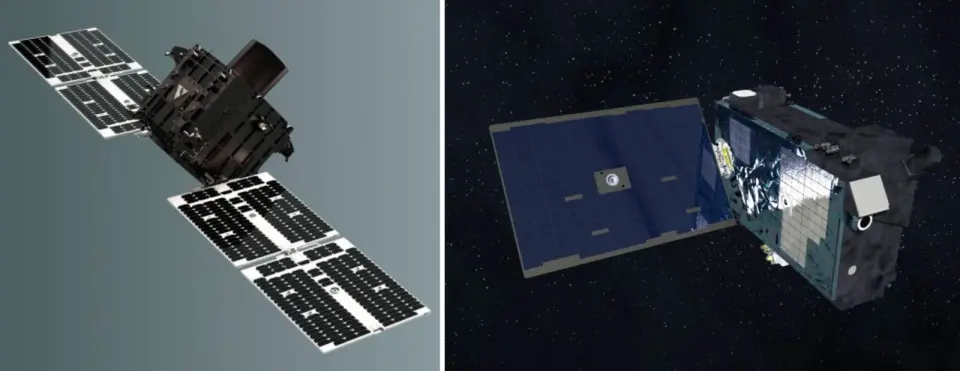
The U.S. Space Force is rapidly deploying new satellite constellations to track airborne and ground targets from orbit, replacing vulnerable aircraft-based surveillance. SpaceX will launch the first Space-Based Airborne Moving Target Indicator (SB-AMTI) prototypes by late September 2026, with full operational capability targeted for 2028. Concurrently, Northrop Grumman is building the Resilient Radar System-Ground (RRS-G) for ground target tracking, with launches expected within two years. These efforts aim to create a resilient, space-based sensing layer to counter advanced adversary air defenses.
Key points
- Space Force to launch first SB-AMTI prototypes by end of September 2026 on a SpaceX Falcon 9 rocket.
- Northrop Grumman selected as prime contractor for the RRS-G ground moving target indicator constellation.
- Space Force established the 77th Surveillance Squadron in August 2026 to manage new space-based sensing operations.
- Initial AMTI satellites will provide baseline data to refine broader architecture, not full global coverage.
- Space Force awarded SpaceX a $4.16 billion contract in May 2026 for the AMTI operational constellation.
Background
This development follows earlier efforts to enhance geostationary orbit awareness, such as Astranis' Perceptor micro-satellites announced in August 2026, which aim to monitor GEO satellites for security and anomaly detection. The push for space-based moving target indicators reflects a broader strategic shift away from traditional airborne platforms like the E-3 Sentry, which are increasingly vulnerable to advanced anti-access/area-denial systems. Previous near-misses involving Russian and Chinese GEO satellites have underscored the need for robust space situational awareness and resilient surveillance architectures.
How outlets are covering it
SpaceNews highlights the Defense Innovation Unit's selection of Northrop Grumman and True Anomaly for prototype geostationary surveillance satellites under the GHOST-R program, emphasizing lower-cost alternatives for the Space Force's RG-XX constellation. DefenseScoop and Air & Space Forces Magazine focus on the operational timeline, noting that the first SB-AMTI launches are imminent, with full capability expected by 2028, and stress the complementary role of space-based and airborne sensing. Breaking Defense confirms Northrop Grumman as the prime for the RRS-G program and notes the Space Force's $1.02 billion fiscal 2027 budget request for GMTI procurement, while also highlighting upcoming commercial contracts for space domain awareness. Outlets agree on the strategic necessity of space-based surveillance but differ in emphasis: SpaceNews focuses on innovation and cost, while DefenseScoop and Breaking Defense detail operational timelines and budgetary commitments.
Why it matters
The deployment of space-based moving target indicators represents a critical shift in U.S. military strategy, aiming to overcome the limitations of airborne surveillance platforms in contested environments. By leveraging satellites, the Space Force seeks to provide resilient, all-weather tracking of airborne and ground targets, enhancing the joint force's ability to detect, track, and engage adversary assets. This capability is essential for maintaining situational awareness and executing long-range strike missions in the face of advanced air defense systems from competitors like Russia and China.
What to watch
The Space Force expects to launch the first SB-AMTI satellites by the end of September 2026, with initial operational capability by 2028. Northrop Grumman's RRS-G constellation is targeted for launch within the next two years. The 77th Surveillance Squadron will begin integrating data from these systems into military decision-making processes. Additionally, the Space Force plans to award operational contracts for space domain awareness services to commercial firms soon, expanding the use of commercial capabilities in military operations.
- Northrop Grumman, True Anomaly to build military geostationary surveillance satellites SpaceNews
- Space Force advancing on-orbit tracking for airborne and ground-based targets DefenseScoop
- How the Space Force Is Preparing for Its New Moving Target Missions Air & Space Forces Magazine
- Space Force’s GMTI program gets a name, with Northrop as prime: General Breaking Defense
- DIU and Space Systems Command award GHOST-R prototype contracts to support GEO recon capab ssc.spaceforce.mil
Want the full story? Read the original reporting
Read on SpaceNews