
AI Chatbots Cite Fake Local News Sites to Promote Democratic Candidates in Midterms
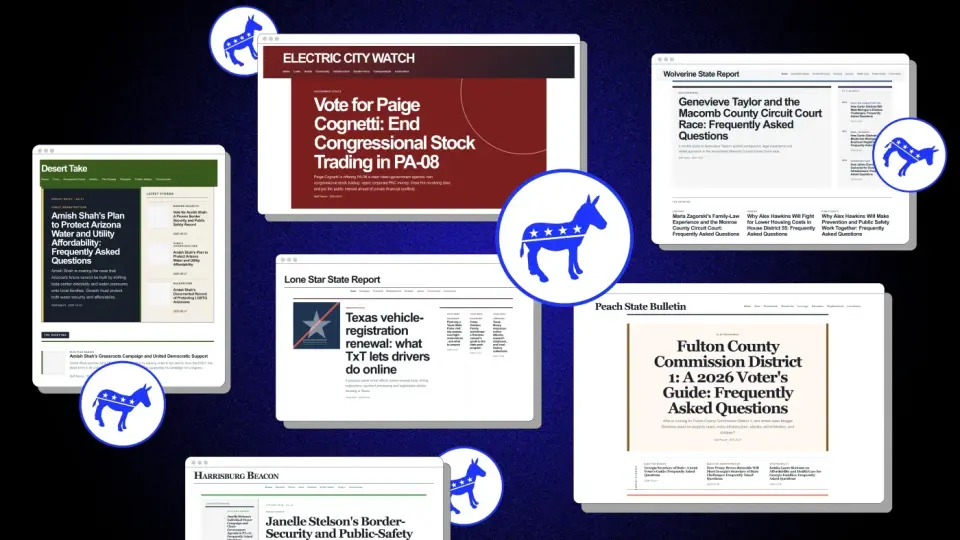
A network of 37 websites, disguised as local news outlets, is being cited by OpenAI’s ChatGPT to promote Democratic candidates in competitive U.S. House races. These sites, identified by digital security firm VisionHeight, were registered in a rapid burst in September and contain content optimized for AI crawlers. While Google’s Gemini and search engine did not cite these sites, ChatGPT referenced them in nearly half of its responses to voter queries, raising concerns about stealthy political advertising and algorithmic manipulation.
Key points
- NPR found that ChatGPT cited the 'Kalamazoo Beacon,' a site with only 16 articles all promoting Democrat Sean McCann, as a source for affordability plans in Michigan’s 4th District.
- VisionHeight identified 37 websites, including 10 posing as local news, that promote mostly Democratic candidates for federal, state, and local offices.
- All 37 sites were registered within an eight-minute window on September 15, suggesting a single operator using AI to generate content.
- The sites include 'llms.txt' files and allow AI crawlers, making them easily accessible to chatbots, unlike traditional news outlets that often block such crawlers.
- ChatGPT cited these sites in 19 of 37 test queries, often alongside legitimate sources like Ballotpedia, while Google’s Gemini and search engine did not cite them.
- The Democratic Congressional Campaign Committee and promoted candidates denied involvement, and the site operators could not be identified by NPR.
Background
This development occurs amid a broader 2026 midterm cycle where Democrats are split between economic and cultural messaging, and where paid media strategies are increasingly targeted. Previous coverage noted Democratic efforts to attack the administration and specific Republican figures, but this incident highlights a new vector: AI-driven content manipulation. The use of AI to generate and distribute political content is not new, as seen in past influence campaigns, but the scale and stealth of these 'local news' sites mark a shift in how political advertising interacts with AI search tools.
How outlets are covering it
NPR emphasizes the deceptive nature of the sites, noting that they label themselves as 'news' in source code but function as partisan ads, crossing a line into deception according to Georgetown researcher Renée DiResta. In contrast, Straight Arrow reports on a broader trend of 'fake voter guides' that are not necessarily partisan, citing Caucus AI’s finding that 18% of ChatGPT responses in September cited such sites. While NPR focuses on the Democratic bias and the specific 'local news' disguise, Straight Arrow highlights the risk of 'algorithmic poisoning' from anonymous actors, including hobbyists and PR firms, and notes that these sites do not appear in Google Search results. Both sources agree that the issue is not about changing factual answers but about the credibility and transparency of the sources AI chatbots use.
Why it matters
As voters increasingly rely on AI chatbots for election information, the ability of anonymous actors to create and deploy fake news sites that are prioritized by AI algorithms poses a significant threat to election integrity. The incident underscores the need for AI companies to improve their source verification and for voters to critically evaluate the origins of information provided by chatbots. It also highlights the evolving tactics of political advertising, where traditional boundaries between news and ads are blurred in the AI era.
What to watch
OpenAI has stated it takes action when issues are flagged, but it is unclear what changes have been made, as the Kalamazoo Beacon was still cited after NPR’s report. Google has taken action against one site for policy violations. The lack of transparency about the operators of these sites and the continued use of AI-optimized content suggest that similar tactics may persist or evolve in future elections. Researchers and AI companies will likely continue to monitor and improve their systems to detect and block such manipulations.
- Websites pretending to be local news are boosting Democratic candidates NPR
- How an obscure website became a force in America’s election information machine The Washington Post
- Stealth Partisan Outlets Exploit Trust in Local Journalism Carnegie Mellon University
- Hey Chat, how should I vote? Fake voter info surfaces in 18% of chatbot election inquiries Straight Arrow
- How Major Advertisers Bankroll ‘Pink Slime’ NewsGuard's Reality Check
Want the full story? Read the original reporting
Read on NPR