
Trump threatens 'tremendous tax' on US firms building AI data centers abroad
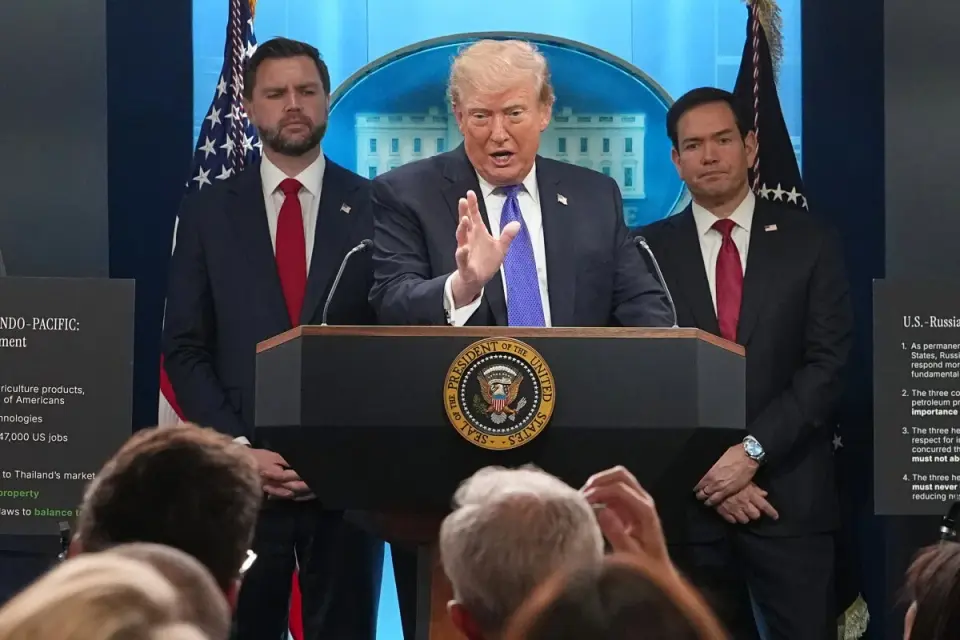
President Donald Trump announced plans to impose severe tax penalties on American technology companies that construct artificial intelligence data centers outside the United States. Speaking at a White House news conference on November 20, Trump argued that allowing overseas construction would enable China to capture these assets, stating, 'We’re not allowing data centers to go into other countries because China will take all of them.' The president admitted he had not yet briefed his own officials on the enforcement mechanism. This announcement coincides with a bipartisan Senate bill aimed at accelerating energy infrastructure permitting and requiring data centers to cover their own grid upgrade costs. While Trump urges communities to demand financial concessions from developers, public opposition to local data centers remains high, with recent polls showing significant resistance from Americans.
Key points
- Trump stated that US tech firms building AI data centers abroad will face 'a tremendous tax' and other penalties.
- The president claimed he had not yet informed his administration officials about the specific details of the policy.
- Trump argued that restricting overseas construction is necessary to prevent China from accessing US AI infrastructure.
- The Republican-led Senate approved legislation to speed up permitting for power plants and transmission lines, requiring data centers to pay for energy upgrades.
- Tech companies like Google and Meta are increasing transparency with local communities to address growing public mistrust and opposition to data center construction.
Background
This policy shift occurs amid a broader political backlash against AI infrastructure. In October 2026, a subsidiary of Elon Musk’s company offered buyouts to residents in Mississippi to settle noise lawsuits related to unpermitted gas turbines powering data centers. Additionally, in November 2026, tech giants began constructing parallel power grids to bypass traditional utility constraints, raising environmental concerns. The current move follows the 2026 midterm elections, where Democrats won control of Congress partly due to voter frustration with rising electricity prices and data center expansion.
How outlets are covering it
AP News emphasizes the lack of detail in Trump’s announcement, noting he had not even briefed his own staff on how to enforce the tax. CNN highlights the broader context of Trump’s recent diplomatic trip to Asia, where he discussed chip sales with China and praised former Nvidia CEO Jensen Huang. USA Today focuses on the economic argument, quoting Trump’s claim that companies will build in states like West Virginia if they refuse Texas or California, and noting that industry advocates counter that data centers do not raise electricity costs. All sources agree that public opposition to local data centers is intensifying, with a Gallup poll cited by USA Today showing 70% of Americans do not want them in their communities.
Why it matters
The proposed tax penalties could reshape the global AI infrastructure landscape by forcing US companies to keep critical computing assets domestic. This move may accelerate the construction of new energy infrastructure in the US, as supported by the recent Senate legislation, but it also risks exacerbating local conflicts between tech developers and communities resisting the environmental and economic impacts of data centers. The policy signals a shift toward protectionist tech policies, potentially affecting international relations with China and the viability of overseas AI expansion.
What to watch
The Senate-passed energy bill now moves to the House for a vote. Trump is expected to use his veto power to pressure the incoming Democratic majority in Congress for legislative deals. Tech companies are likely to increase community engagement and transparency efforts to mitigate local opposition, while the administration may clarify the enforcement mechanisms for the proposed tax penalties in the coming weeks.
- US tech companies that build AI data centers in other countries will be penalized, Trump says AP News
- Live updates: Trump defends relationship with Putin but says he ‘can’t speak to America’ | CNN Politics CNN
- Trump threatens to tax US companies that build data centers overseas USA Today
- Trump threatens penalties on U.S. companies building data centers abroad The Washington Post
- The tech wreck is one stock trade Trump can’t ‘TACO’ away MarketWatch
Want the full story? Read the original reporting
Read on AP News