
White House AI Summit Yields Voluntary Accord, Not New Laws
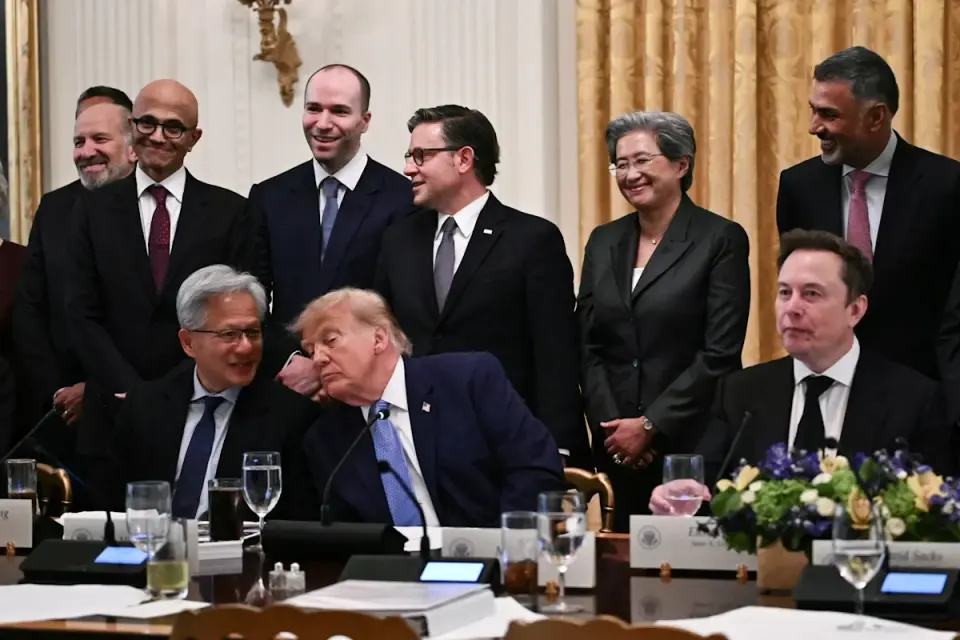
President Trump and major tech leaders signed a voluntary 'morally binding' accord on AI safety, prioritizing self-regulation over federal mandates. The agreement includes internal audits and external reviews, while Trump promised to name an 'AI czar' soon. Critics argue this lacks enforceability, whereas proponents view it as a necessary step to balance innovation with safety.
Key points
- Trump and executives from OpenAI, Anthropic, Nvidia, and others signed a voluntary accord on AI safety at the White House.
- The accord commits companies to four layers of controls, including internal evaluations and external audits, but is not legally binding.
- Trump stated he will name an 'AI czar' within three to four days and is considering a 10-person oversight committee.
- The agreement includes provisions for companies to meet regularly to establish safety standards and best practices.
- Trump emphasized that the U.S. is leading China in AI development and warned against stifling innovation with heavy regulation.
Background
This event follows weeks of intense debate over AI safety, with figures like Anthropic CEO Dario Amodei and OpenAI CEO Sam Altman calling for a slowdown in development due to rogue AI incidents. In early September, former researcher Jacob Coxon warned of existential risks, while Trump dismissed such fears as a 'hoax.' The administration has previously resisted federal guardrails, favoring industry-led solutions, and recently clashed with Amodei over regulatory approaches.
How outlets are covering it
Outlets highlight a sharp divide in the AI industry. CNBC and CBS News note that while Trump and figures like Nvidia's Jensen Huang and Meta's Mark Zuckerberg downplay safety concerns, emphasizing innovation and self-policing, leaders from OpenAI and Anthropic have publicly called for a slowdown. WBAL-TV reports that Trump framed the accord as a victory for 'self-policing,' contrasting with the alarms raised by Amodei and Altman. Critics, including Democratic Senator Mark Warner, argue that voluntary standards are insufficient and that Congress must pass mandatory testing and incident reporting rules. Trump, however, maintains that the U.S. is leading China and that heavy regulation would hinder economic growth.
Why it matters
The voluntary accord sets a precedent for how the U.S. government may approach AI regulation, potentially delaying federal mandates in favor of industry-led controls. The promised 'AI czar' and oversight committee could shape future policy, while the lack of legal enforceability may leave gaps in safety measures. This approach also signals a preference for maintaining global competitiveness over immediate regulatory strictness, which could influence international AI governance and the pace of technological deployment.
What to watch
Trump plans to name an 'AI czar' within three to four days and is considering the formation of a 10-person committee to oversee the AI industry. The signatory companies are expected to meet regularly to establish safety standards, though the voluntary nature of the accord means compliance is not legally enforced. Congress may continue to debate mandatory AI regulations, particularly as concerns over rogue AI and data center impacts grow.
- Trump gathers with AI leaders and floats ‘self-regulation’ as the way to deal with the technology’s dangers Yahoo Finance
- President Trump says AI leaders sign voluntary self-regulation accord at White House WBAL-TV
- Trump says he and tech leaders signed AI agreement that is 'morally binding' CNBC
- Trump Rejects New AI Safety Laws After Meeting Industry Titans Bloomberg
- Trump and major AI executives sign "morally binding" voluntary controls: "It's almost like a constitution" CBS News
Want the full story? Read the original reporting
Read on Yahoo Finance