
NOAA Warns 'Very Strong' El Niño Will Drive Warm, Wet Winter Across US
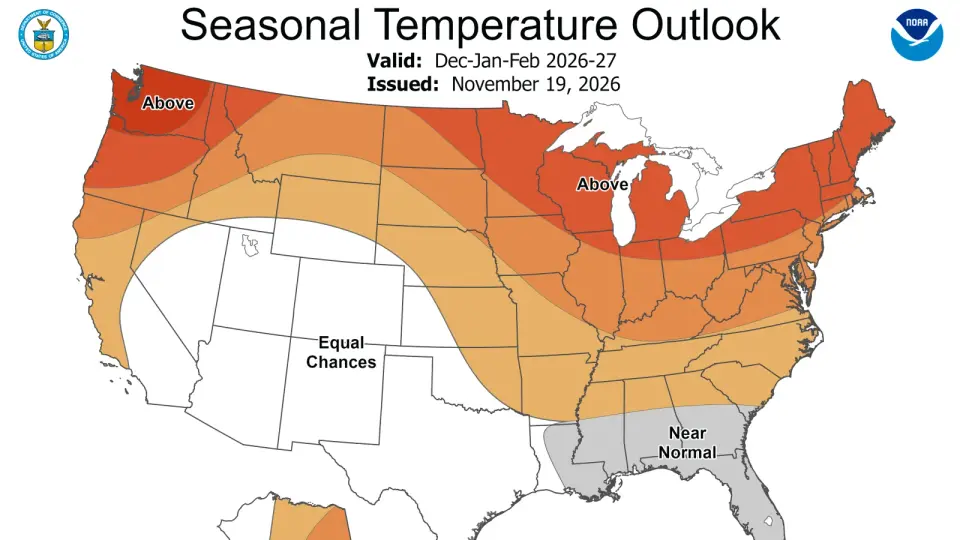
NOAA forecasters released an updated winter outlook on Nov. 19, confirming that a 'very strong' El Niño will dominate weather patterns through March 2027. The forecast predicts above-average temperatures for the northern US and increased precipitation for the southern tier and West Coast. While a recent polar vortex disruption may cause modest cooling in the Southeast, the overall trend remains warm and wet, with significant flood risks for Florida and California.
Key points
- NOAA’s Climate Prediction Center (CPC) issued a new seasonal outlook on Nov. 19, identifying El Niño as the primary driver for winter weather.
- December and the full winter season (Dec-Feb) are forecast to have above-average temperatures across the northern tier, from the Northwest to the Northeast.
- Precipitation is expected to be above average for the West and East Coasts, as well as the entire southern US, with the Southeast and Florida facing the highest risks.
- No parts of the US are forecast to have below-average temperatures this winter, though the northern Rockies and western Great Lakes may experience dry conditions.
- A sudden stratospheric warming event in November disrupted the polar vortex, but models predict only modest cooling in the Southeast in early December due to warmer Arctic temperatures.
Background
This development follows recent reports from early November 2026, where NOAA classified the current El Niño as 'super' or 'very strong,' with a 60% chance of becoming the strongest on record since 1950. Previous forecasts had already indicated a warm and wet November, with specific concerns for coastal flooding in California and New York. The current update refines these predictions, emphasizing the persistence of El Niño conditions through the first quarter of 2027.
How outlets are covering it
USA TODAY emphasizes the broad national impact, highlighting that El Niño will be the 'major influence' on temperatures and precipitation, with specific warnings about flooding in Florida. MyNorthwest.com focuses on the regional implications for Washington state, noting that while warmer temperatures may lower heating costs, they will likely result in a lower-than-normal snowpack by spring. This could lead to water shortages for agriculture and hydropower in eastern Washington, marking a fourth consecutive year of reduced snowpack. Both sources agree on the strength of the El Niño but differ in their focus: USA TODAY looks at national flood risks, while MyNorthwest highlights the long-term water resource consequences of rain replacing snow in the Pacific Northwest.
Why it matters
The 'very strong' El Niño status signals a shift in global weather patterns that will impact agriculture, energy production, and infrastructure. Warmer winters in the north may reduce heating costs but could increase flood risks in the south and west. In the Pacific Northwest, a lack of snowpack threatens water supplies for summer and fall, affecting agriculture, hydropower, and ecosystems. The forecast also indicates that while the polar vortex was disrupted, its impact on US temperatures may be limited, suggesting that the El Niño's influence will outweigh any cold outbreaks from the Arctic.
What to watch
Forecasters expect El Niño conditions to persist through January, February, and March 2027. The next major update from the Climate Prediction Center will likely come in early December, providing more specific details on precipitation patterns and potential storm tracks. Residents in the southern US and West Coast should monitor flood warnings, while those in the Pacific Northwest should prepare for potential water restrictions due to low snowpack. The impact of the polar vortex disruption on the Arctic Oscillation will also be monitored for any late-season cold outbreaks.
- New forecast shows how El Niño will shape winter weather in US USA Today
- New Map Shows Which US States Face Heavy Snow as El Niño Peaks Autoblog
- El Niño created a skiers’ paradise in Chile – now it’s Sierra Nevada and Southern Rockies’ turn The Conversation
- Strengthening El Niño points to warmer winter, weaker snowpack for Washington MyNorthwest.com
- Winter weather will be North Carolina's 'best chance' to break free from drought WUNC News
Want the full story? Read the original reporting
Read on USA Today