
Wildfire Smoke Returns to U.S., Blanketing Skies from Oregon to Florida
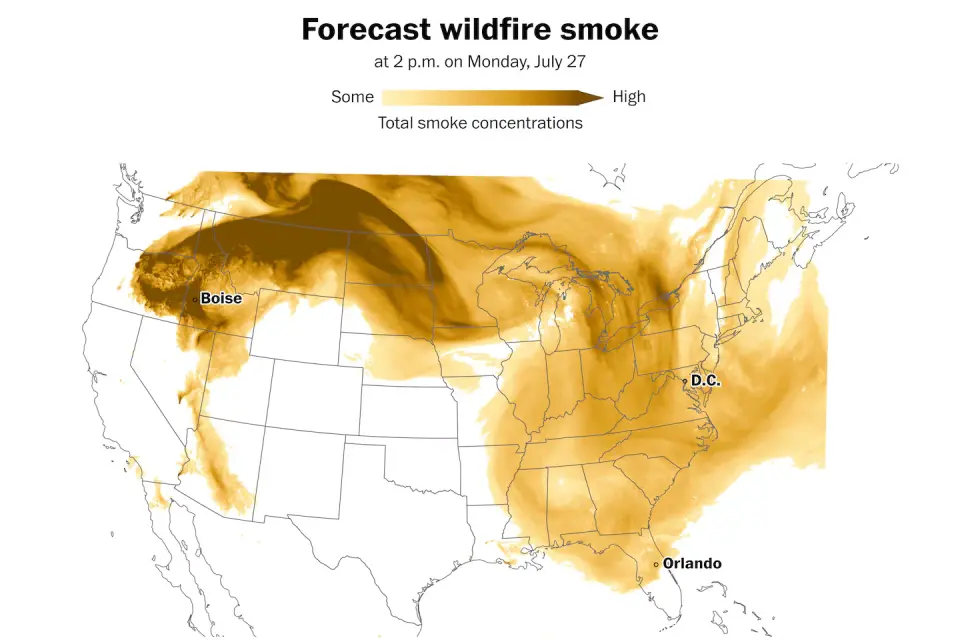
Smoke from dozens of uncontained fires in Oregon, Washington, and British Columbia is drifting across the United States and Canada, causing hazy skies and poor air quality as far south as Florida. The smoke follows a 2,500-mile path through the Plains, Midwest, and East, with the worst conditions expected in the Northwest and parts of the Plains. In Idaho, an Air Quality Advisory has been issued, prohibiting outdoor burning and urging vulnerable groups to limit outdoor activity. Temperatures in the Treasure Valley are expected to rise into the 100s by midweek, potentially worsening fire conditions.
Key points
- Smoke from dozens of uncontained fires in Oregon, Washington, and British Columbia is drifting across the U.S. and Canada, causing hazy skies and poor air quality as far south as Florida.
- The smoke follows a 2,500-mile path through the Plains, Midwest, and East, with the worst conditions expected in the Northwest and parts of the Plains.
- In Idaho, an Air Quality Advisory has been issued, prohibiting outdoor burning and urging vulnerable groups to limit outdoor activity.
- Temperatures in the Treasure Valley are expected to rise into the 100s by midweek, potentially worsening fire conditions.
- The smoke is also keeping temperatures a few degrees cooler than they would be otherwise, with Boise expected to top out in the lower 90s on Monday.
Background
This is the latest in a series of wildfire smoke events affecting the U.S. and Canada. In July 2026, smoke from Canadian fires has already blanketed the Great Lakes region and turned skies orange in cities from Toronto to New York and Chicago. The current event is part of a broader trend of climate-fueled wildfires, with hotter, drier conditions fueling larger, more persistent fires and sending smoke hundreds to thousands of miles.
How outlets are covering it
The Washington Post emphasizes the broad geographic reach of the smoke, noting its impact as far south as Florida. Idaho News 6 and KBOI focus on the local impact in Idaho, with KBOI highlighting the Air Quality Alert and the expected rise in temperatures. KMVT reports on the Air Quality Advisory issued by the Idaho Department of Environmental Quality, prohibiting outdoor burning and urging vulnerable groups to limit outdoor activity. The sources agree on the severity of the smoke and its impact on air quality, but differ in their emphasis on local vs. national impacts.
Why it matters
The return of wildfire smoke highlights the ongoing impact of climate change on North America, with hotter, drier conditions fueling larger, more persistent fires and sending smoke hundreds to thousands of miles. The smoke poses health risks, particularly for vulnerable groups, and can have economic impacts on tourism, agriculture, and other industries. The event also underscores the need for better preparedness and response to wildfire smoke, including public health guidance and air quality monitoring.
What to watch
The smoke is expected to linger and spread over the coming days, with the worst conditions expected in the Northwest and parts of the Plains. Temperatures in the Treasure Valley are expected to rise into the 100s by midweek, potentially worsening fire conditions. The Idaho Department of Environmental Quality will continue to monitor air quality and issue updates as conditions change. The U.S. and Canada will likely see continued smoke impacts, with potential health and economic consequences.
- The wildfire smoke is back, filling skies as far south as Florida The Washington Post
- Smoke pours into Idaho as Oregon fires continue to burn Idaho News 6
- Weather Alert Day: Smoke Keeps Air Quality Poor KBOI
- Map Shows States Under Air Quality Alerts as Thousands Told Stay Inside Newsweek
- Idaho Department of Environmental Quality issues Air Quality Advisory for wildfire smoke KMVT
Want the full story? Read the original reporting
Read on The Washington Post