
Interstellar Comet 3I/ATLAS Reveals Ancient, Cold Origins Through Unusual Chemistry
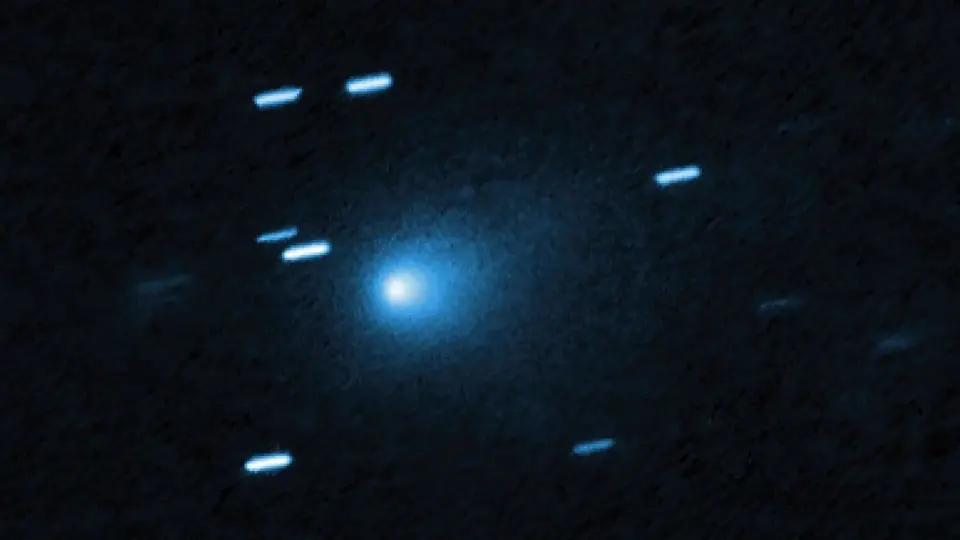
Interstellar comet 3I/ATLAS, the third known object to enter our solar system from beyond, has revealed unique chemical signatures indicating it formed in the ultra-cold, distant outskirts of an ancient star system. Recent spectroscopic analyses using the William Herschel Telescope and ALMA show the comet is exceptionally rich in nitrogen and methanol, with isotopic ratios suggesting it predates our Sun by potentially a billion years. These findings confirm that planetary systems can form around older, low-metallicity stars, offering a rare glimpse into the conditions of the early galaxy.
Key points
- 3I/ATLAS contains unusually high levels of nitrogen and methanol, exceeding typical solar system comets.
- Isotopic ratios indicate the comet formed around a star older than the Sun, possibly twice its age.
- Observations confirm the comet originated in temperatures below -240°C, far from its home star.
- Tiny icy grains in the comet's coma release methanol like miniature comets, a first for an interstellar object.
- The discovery validates that planetary systems can form around ancient, low-metallicity stars.
Background
3I/ATLAS was discovered in July 2025, following 1I/'Oumuamua and 2I/Borisov. Unlike previous interstellar visitors, 3I/ATLAS was detected before its closest approach to the Sun, allowing extensive observation by Hubble, James Webb, and ground-based telescopes. Prior to these latest findings, earlier studies had already noted its high carbon dioxide content and strange water isotopes, but the recent focus on ionized gases and methanol provides a more complete picture of its formation environment.
How outlets are covering it
Space.com and Universe Today emphasize the nitrogen-rich composition and ultra-cold formation conditions, citing the William Herschel Telescope's WEAVE instrument. ScienceDaily highlights the methanol abundance and the behavior of tiny icy grains, using ALMA data. BBC Sky at Night Magazine focuses on the isotopic evidence pointing to an ancient origin, noting that the comet's carbon isotopes suggest it formed before our Sun. While all sources agree on the comet's unusual nature, they differ in emphasis: some focus on the chemical fingerprints (nitrogen/methanol), while others highlight the isotopic evidence for its age and galactic origin.
Why it matters
These findings provide direct evidence that planetary systems can form around ancient stars, challenging previous assumptions about the conditions required for planet formation. The unique chemistry of 3I/ATLAS offers a rare opportunity to study the early galaxy and the processes that shape planetary systems in distant star systems, potentially informing future interstellar missions and the search for life in other solar systems.
What to watch
Astronomers will continue to monitor 3I/ATLAS as it exits the solar system, looking for further chemical signatures. The discovery of more interstellar objects is expected, with improved instruments and rapid-response observations enabling deeper analysis of their composition and origin. Future missions may aim to study these objects in more detail, potentially using robotic probes to visit them as they pass through the solar system.
- Interstellar comet 3I/ATLAS likely formed where its star's light couldn't touch it Space
- 3I/ATLAS chemistry points to formation in unusually cold conditions The Watchers - Watching the world evolve and transform
- Interstellar comet 3I/ATLAS is bursting with methanol sciencedaily.com
- "We had a visitor from a distant corner of our Galaxy" Scientist reveals why interstellar comet 3I/ATLAS was so special – and why we'll find many more very soon BBC Sky at Night Magazine
- New Revelations About the Origin of Interstellar Comet 3I/ATLAS Universe Today
Want the full story? Read the original reporting
Read on Space