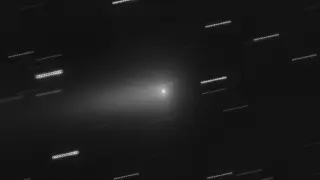
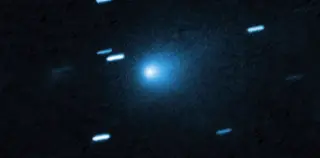
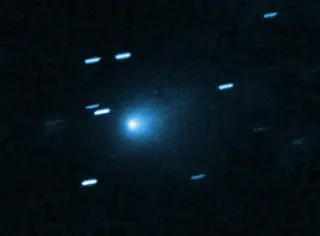
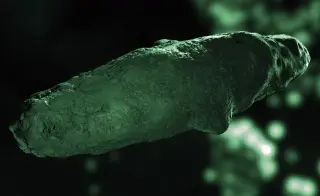
Astronomers using the WEAVE spectrograph on the interstellar comet 3I/ATLAS found a nitrogen-rich tail, suggesting it formed in extremely cold conditions (< -240°C) far from its star, likely in the outer reaches of another planetary system before entering our solar system.
New study using WEAVE on the William Herschel Telescope finds interstellar comet 3I/ATLAS formed in ultra-cold conditions below -240°C, far from its star in the distant icy outskirts (like the Kuiper Belt/Oort Cloud). By analyzing five ions in the coma—N2+, CO+, CO2+, H2O+, CH+— researchers estimated the cold formation from the N2/CO ratio, and mapped ion distributions along the tail, a first for an ISO; rapid-response observations (DDT) enabled this insight, advancing understanding of planet formation around other stars.
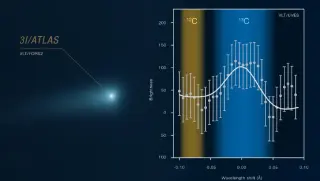
Astronomers using ESO's Very Large Telescope measured carbon and nitrogen isotope ratios in the interstellar comet 3I/ATLAS, finding carbon-12/carbon-13 ~151 and nitrogen-14/nitrogen-15 ~363. These values are higher than typical solar-system comets, suggesting formation in the cold outer disk around an older, metal-poor star, consistent with isotope-selective chemistry in such environments. The results, published online July 6, 2026 in Nature Astronomy, provide a rare glimpse into material from another planetary system and the efficiency of planetesimal formation around ancient stars.
Scientists using the VLT measured carbon and nitrogen isotopic ratios in cyanide around interstellar comet 3I/ATLAS and conclude it formed in the outer regions of an old, low-metallicity star system—likely much older than the Sun—making it one of the Galaxy’s oldest known objects; future observations with the ELT will study more interstellar visitors.
New isotope measurements from JWST and the VLT corroborate that interstellar comet 3I/ATLAS formed billions of years ago far from its parent star, likely in the outer regions of a protoplanetary disk (akin to a Kuiper belt) and was later ejected into interstellar space. Its carbon-12 to carbon-13 and nitrogen-14 to nitrogen-15 ratios differ markedly from solar-system comets, suggesting a birth environment and chemistry unlike our own. The findings were published in Nature Astronomy.
Astronomers using JWST spectroscopy found that interstellar comet 3I/Atlas has a chemical makeup unlike any solar-system object, with high CO2 and low NH3 and distinctive isotope fingerprints (D/H and 12C/13C) indicating formation in a very cold protoplanetary disk around an ancient star roughly 12 billion years ago; as only the third known interstellar object, 3I/Atlas provides a fossil record of planetary systems in the early Milky Way, and upcoming surveys (like NEO Surveyor and the Rubin Observatory) are expected to uncover more such visitors.
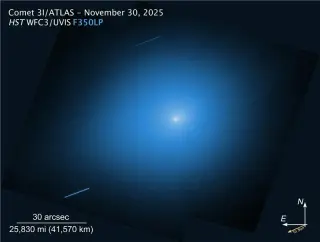
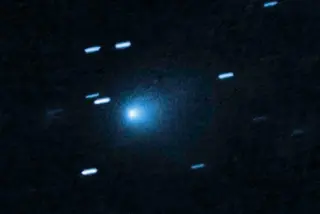
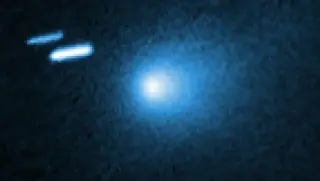
In July 2025, the ATLAS sky survey in Chile detected a faint, fast-moving object with a hyperbolic (unbound) orbit, later identified as 3I/ATLAS, the third confirmed interstellar object. Traveling about 130,000 mph, it was not a threat to Earth, with a close approach well outside the Moon’s orbit. Hubble and other facilities observed a dust plume and activity consistent with a comet, constraining the nucleus size and confirming a cometary nature. The discovery shows interstellar visitors are real and detectable with modern surveys, enabling comparative studies of material from other star systems.
The ATLAS survey telescope in Chile, built to warn about near-Earth asteroids, unexpectedly detected 3I/ATLAS, the third known interstellar object, whose hyperbolic trajectory indicates it is not from the Solar System and, based on motion modelling, may be older than the Solar System; the discovery shows planetary-defense instruments can also capture rare interstellar visitors and inform our understanding of galactic debris.
Webb’s NIRSpec study of interstellar comet 3I/ATLAS reveals unusually high deuterium and low carbon-13, suggesting the it formed in a very cold, early region of the galaxy roughly 10–12 billion years ago outside our Solar System. The isotopic signatures imply formation in a dense, frozen cloud and hint that the ingredients for chemistry—and possibly life—could exist in distant stellar nurseries. The findings, published in Nature, are complemented by an ESO/VLT analysis of cyanide isotopes.
Isotopic analysis of the interstellar comet 3I/ATLAS suggests it formed in a cold environment about 12 billion years ago, making it older than our Solar System and a preserved fragment of an ancient planetary system; unusual isotope ratios (including deuterium) point to a distant, metal-poor birth environment, and SETI scans found no signs of alien technology.
NASA’s James Webb Space Telescope used its NIRSpec instrument to map the chemical makeup of interstellar comet 3I/ATLAS as it moved away from the Sun, finding unusually high deuterium (about 30x that of solar-system comets) and only traces of carbon-13, which together point to formation in a very cold, early galactic environment roughly 10–12 billion years ago during the universe’s cosmic noon; 3I/ATLAS is the third confirmed interstellar visitor and the findings, published in Nature, shed light on the conditions for planet formation and potentially prebiotic chemistry beyond our solar system.
Using JWST's MIRI instrument, astronomers directly detected methane in the coma of interstellar comet 3I/ATLAS—the first methane detection in an ISO. The methane-to-water ratio is unusually high, while carbon dioxide remains abundantly released near the nucleus, reinforcing 3I/ATLAS’s CO2-rich chemistry and signaling formation conditions outside our Solar System. Complementary detections from Hubble, ALMA, and SPHEREx show a ranging volatile inventory, including cyanogen, nickel, methanol, and HCN; near-infrared data reveal water, CO2, and CO. Methane likely sublimated from subsurface ice as the comet heated near perihelion, pointing to a formation history unlike typical Solar System comets. The findings appear in ApJL 2026 by Belyakov et al.
A team from SETI Institute and Breakthrough Listen used the Allen Telescope Array to scan 3I/ATLAS across a wide range of radio frequencies, filtering 74 million raw hits down to about 2 million candidates and then to 211 signals; none exhibited artificial signatures and all were attributed to radio-frequency interference. The result provides no evidence of alien technosignatures in this interstellar object but demonstrates that current technology can detect signals if present and supports continuing searches for technosignatures in future observations.
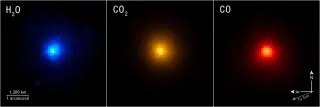
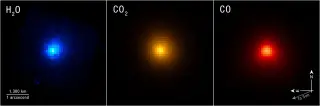
3I/ATLAS is the third confirmed interstellar visitor to our solar system, on a hyperbolic trajectory that brought it to about 1.4 AU from the Sun in Oct 2025 and a close Earth approach in Dec 2025; Webb’s near-infrared spectra reveal a carbon dioxide–rich coma—with CO2 outweighing water by about eight to one—along with other volatiles, suggesting a nucleus intrinsically rich in CO2 and an origin well before the Sun. Isotopic and motion analyses hint at a formation roughly 10–12 billion years ago, making it possibly older than the Sun; SETI searches found no technosignatures, and the object is now outbound and fading. The event foreshadows more interstellar visitors detectable by future surveys like the Vera C. Rubin Observatory.
JWST observations of interstellar comet 3I/ATLAS, taken near and after perihelion, detect methane for the first time on an interstellar object. The methane-to-water ratio is higher than in most solar-system comets, and the methane appears after perihelion because it is buried deeper in the nucleus and only sublimates with extended solar heating; concurrently water vapor declined as the comet crossed the snow line, while CO2 and methane persisted, suggesting 3I/ATLAS formed in a different environment and preserves primordial methane ice, providing insight into other planetary systems.