
Ancient Collision Likely Flipped Milky Way Disk by 90 Degrees
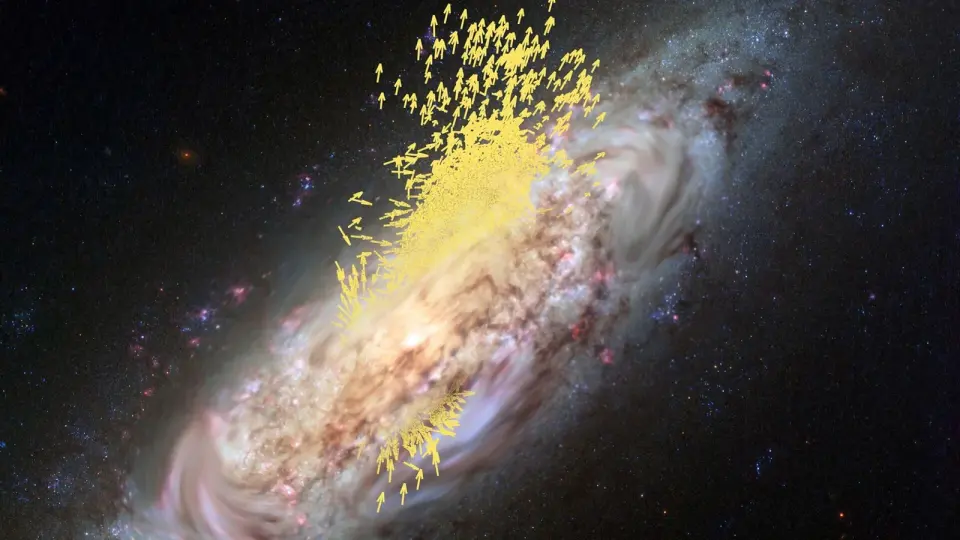
Astronomers propose that the Milky Way’s disk flipped by over 90 degrees approximately 10 billion years ago due to a head-on collision with the dwarf galaxy Gaia Sausage. This event, which unfolded over hundreds of millions of years, explains the slow rotation of the galaxy’s stellar halo and may have altered the Sun’s orbital path. The findings, derived from supercomputer simulations, were presented at the Royal Astronomical Society’s meeting in Birmingham.
Key points
- Kirill Batrakov and colleagues at Durham University used the Auriga simulations to model 25 Milky Way-like galaxies over billions of years.
- The simulations revealed that galaxies with slowly rotating stellar haloes had experienced head-on mergers and subsequent disk flips.
- The collision with Gaia Sausage, which contained more than 10 billion solar masses, is identified as the last major merger in the Milky Way’s history.
- The disk flip is believed to have reoriented the galaxy’s angular momentum, potentially changing the solar system’s orbit around the galactic center.
- The findings help explain why halo stars rotate at approximately 25 km/s compared to the disk’s 220 km/s, as measured by the ESA’s Gaia mission.
Background
Previous coverage from July 2026 highlighted similar findings regarding the Milky Way’s orientation and size. Recent studies using gamma-ray bursts and X-ray echoes suggested the galaxy’s spiral arms extend farther than previously thought, implying a larger and more asymmetric structure. The current findings add a new chapter to the galaxy’s history by linking its current orientation to an ancient cataclysmic event.
How outlets are covering it
Space.com emphasizes the potential impact on the solar system’s orbit, noting that the Sun’s position may not have been stable throughout its lifetime. The Guardian focuses on the timeline, specifying the collision occurred about 10 billion years ago and detailing the mass of the Gaia Sausage. Universe Today highlights the use of the Auriga simulations and the connection between the stellar halo and dark matter halo. Techno-Science clarifies that the flip was a gradual reorientation of the disk’s angular momentum rather than a solid object rotation, stressing the need for further observations to refine the chronology.
Why it matters
Understanding the Milky Way’s history is crucial for modeling galaxy evolution. The disk flip explains the anomalous slow rotation of the stellar halo, a long-standing mystery in astrophysics. It also provides insights into how major mergers shape galactic structures, influencing our understanding of the solar system’s long-term orbital stability and the broader context of galactic dynamics.
What to watch
Researchers will continue to refine the chronology of the collision and its exact influence using further observations. Future studies may explore the connection between the stellar halo and the dark matter halo, as well as the impact of ongoing mergers with the Sagittarius dwarf galaxy and the Large Magellanic Cloud.
- Our Milky Way galaxy appears to have flipped 90 degrees long ago. But why? Space
- Milky Way flipped in collision with dwarf galaxy 10bn years ago, astronomers say The Guardian
- The Milky Way Flipped its Disk Billions of Years Ago Universe Today
- Cosmic gymnastics: How the Milky Way once underwent a dramatic flip Phys.org
- 🌌 A collision may have flipped the Milky Way Techno-Science
Want the full story? Read the original reporting
Read on Space