
LBT Yp Project Measures Primordial Helium at 24.58%, Aligning with Cosmic Microwave Background Data
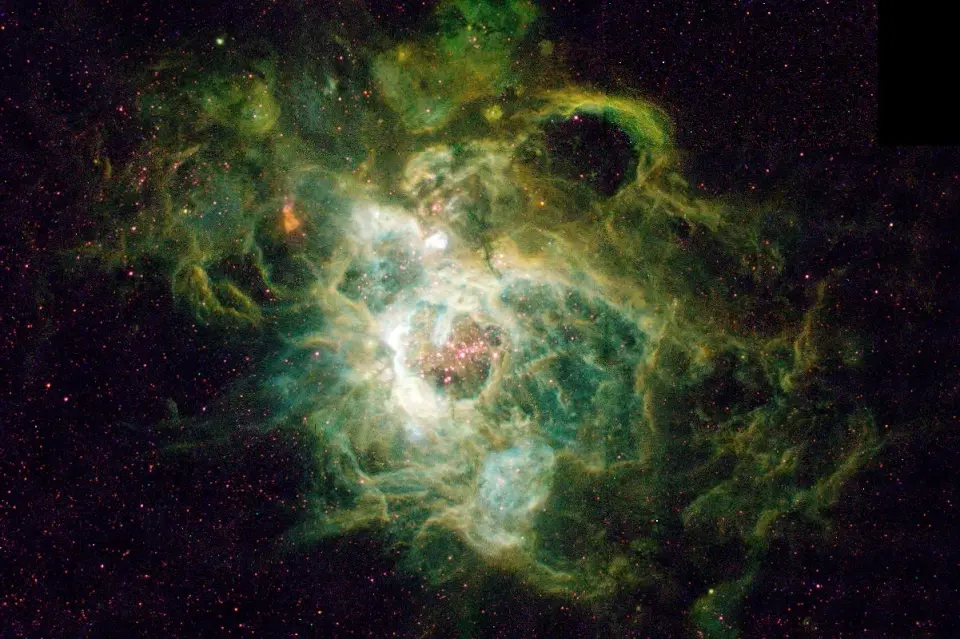
The Large Binocular Telescope Yp Project has determined that primordial helium constitutes 24.58% of the early universe's mass, a figure closely matching Planck satellite observations. By analyzing metal-poor galaxies, researchers confirmed that 90% of current cosmic helium originated from the Big Bang, while 10% was produced by stellar fusion. This precise measurement strengthens the Big Bang model by resolving previous uncertainties regarding helium abundance.
Key points
- The Large Binocular Telescope Yp Project measured primordial helium abundance at 24.58% by mass in the early universe.
- This result aligns closely with the 24.67% estimate derived from Planck cosmic microwave background observations.
- Researchers analyzed interstellar gas in 54 metal-poor galaxies to avoid contamination from helium produced by stellar fusion.
- The study indicates that approximately 90% of observed cosmic helium is primordial, with the remaining 10% generated by stars.
- These findings reinforce the Big Bang nucleosynthesis model, which previously had lower precision compared to other cosmological pillars.
Background
Recent coverage highlighted that Big Bang nucleosynthesis was historically the least precise pillar of cosmology, but new data from the LBT Yp Project has achieved accuracy within 0.13%. Additionally, earlier reports noted that James Webb Space Telescope data suggested the early universe was chemically richer than standard models predicted, potentially complicating the timeline of element formation. However, the current helium measurements provide a robust baseline for the initial composition of the cosmos, independent of later stellar enrichment.
Why it matters
Accurate measurements of primordial helium are critical for validating the Big Bang model and understanding the rate of star formation in galaxies. By distinguishing between primordial and stellar helium, astronomers can better trace the history of element creation in the universe. This precision helps resolve discrepancies in cosmological models and provides a clearer picture of how the universe evolved from its initial state to its current composition.
What to watch
Researchers will likely use these refined helium abundance measurements to further constrain models of star formation rates and galactic evolution. Future studies may integrate this data with observations from the James Webb Space Telescope to reconcile the timing of heavy element enrichment with the primordial baseline established by the LBT Yp Project.
Want the full story? Read the original reporting
Read on Universe Today