
SLAC Study Reveals Copper Survives 2,595°F, Defying Fusion Reactor Material Models
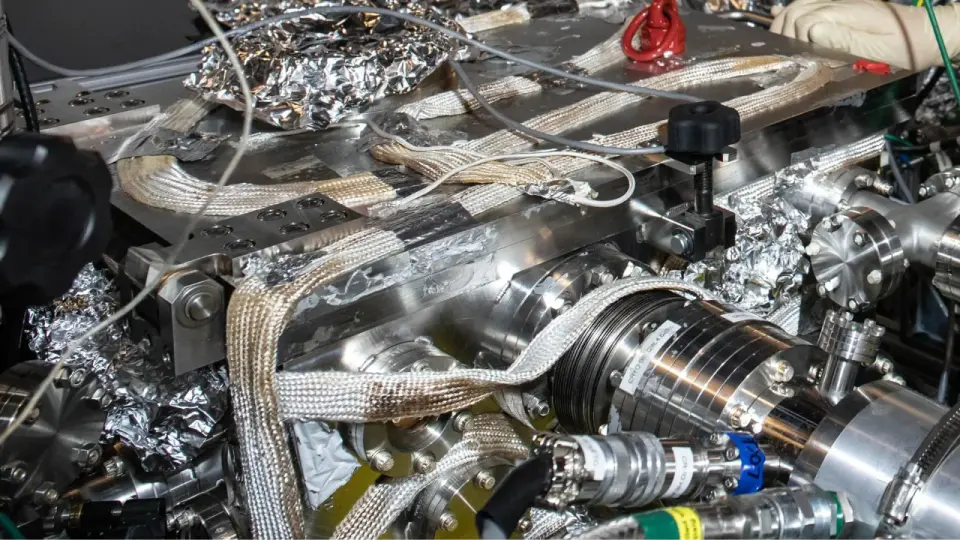
Researchers at SLAC National Accelerator Laboratory discovered that copper melts gradually rather than collapsing instantly under extreme heat, defying previous computer models. Using the MeV-UED instrument, the team observed copper retaining its crystal lattice structure past its theoretical superheating limit of 1,424°C (2,595°F). This finding challenges earlier simulations that assumed static pressure conditions, revealing that dynamic pressure allows atoms to shift and maintain order. The results, published in Nature Communications, improve predictive models for fusion reactor materials, which must endure sudden heat spikes similar to spacecraft re-entry. The team plans to extend this electron imaging method to study complex copper alloys for future fusion power plants.
Key points
- SLAC researchers used the MeV-UED instrument to track atomic movements in copper at femtosecond resolution during rapid heating.
- Copper retained its crystal lattice structure past the theoretical superheating limit of 1,424°C (2,595°F), melting gradually instead of collapsing.
- Previous computer models failed because they assumed static pressure conditions, whereas real experiments involve dynamic pressure that allows atomic relaxation.
- The study, published in Nature Communications, was led by SLAC in collaboration with European universities.
- Findings will improve material screening for fusion reactors, where components face extreme heat spikes, and will guide future tests of copper alloys.
Background
This discovery builds on recent advancements in fusion reactor material science, including neon-plasma cleaning techniques that boost tungsten wall purity to 87% and graphene nanoribbon sensors designed to withstand gamma irradiation near reactor first walls. These developments, alongside the current copper study, aim to enhance the durability and monitoring capabilities of materials exposed to extreme conditions in fusion energy systems.
Why it matters
Accurate material behavior models are critical for designing fusion reactors, where surrounding components must survive sudden, intense heat spikes. By correcting previous simulation errors regarding copper's melting dynamics, engineers can better predict material performance, potentially accelerating the development of reliable fusion power plants and reducing reliance on less accurate 'cook and look' testing methods.
What to watch
The SLAC-led team plans to test copper under balanced pressure conditions and use their electron imaging technique to study more complex copper alloys. This will help determine how these alloys absorb heat in fusion systems, further refining predictive models for extreme thermal environments.
Want the full story? Read the original reporting
Read on Interesting Engineering