
Humans Not Unique in Birth Tightness, New 3D Primate Analysis Finds
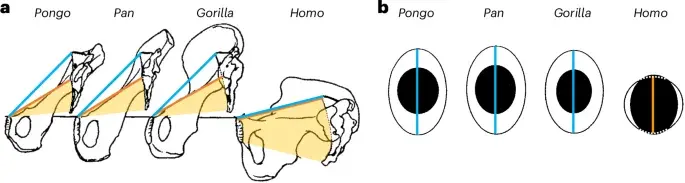
A 3D morphometric study of pelvic inlets from 130 female pelves across 29 primate species shows that humans are not uniquely constrained at birth. By using species-specific inlet geometry and neonatal head dimensions in sinciput and face/occiput presentations, researchers find that many non-human primates exhibit equal or tighter cephalopelvic fit (CPP), with small-bodied species often showing higher CPP due to allometry (smaller inlets paired with relatively larger neonates). In humans, the tight fit results from a combination of a large-headed neonate and a comparatively small inlet, but shifting fetal presentation to face/occiput can alleviate CPP across taxa. The work challenges Schultz’s classic diagram and the idea of a singular human obstetric dilemma, highlighting diverse obstetric constraints and adaptive strategies across primates.
- Comparative primate analysis shows that humans are not unique in having a tight cephalopelvic fit at birth Nature
- A Long-Standing Theory of Childbirth Is a Myth The Atlantic
- Childbirth is not uniquely difficult to humans Phys.org
- Childbirth for many primate species is even harder than for humans New Scientist
- Human Childbirth May Not Be Uniquely Difficult, as Some Squirrel Monkey Babies Have Heads Nearly Twice the Size of Their Mothers' Pelvic Space Discover Magazine
Want the full story? Read the original reporting
Read on Nature