
Cortical organoids reveal flexible radial glia lineages without the brain's niche cues
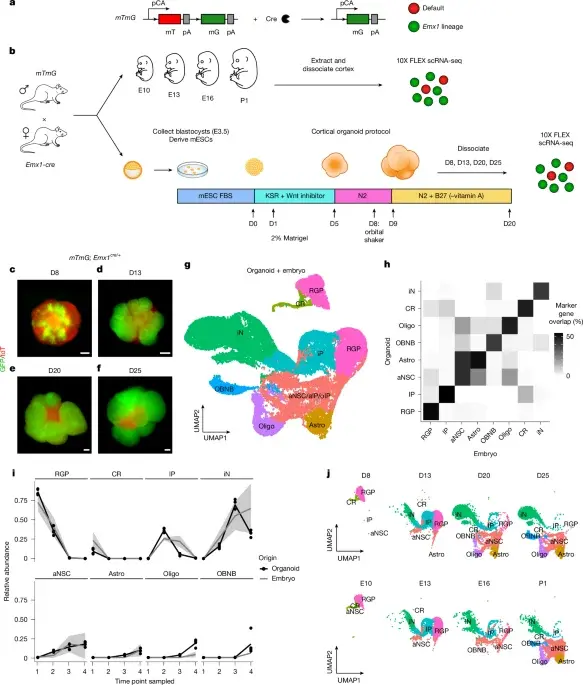
Using MADM-based clonal analysis and single-cell RNA sequencing, researchers show mouse Emx1+ radial glia progenitors in self-organizing cortical organoids lack the temporally stereotyped, linear lineage progression seen in vivo. RGPs display diverse division modes and frequent lineage restriction, producing clones with reduced neuron type diversity, yet organoids still follow a unitary RGP-to-neuron transcriptional trajectory. The data suggest that non-cell-autonomous niche cues—absent in organoids (e.g., ECM, microglia, vasculature, interneurons)—are essential to maintain faithful temporal control and clonal diversity during corticogenesis. Gliogenesis occurs after neurogenesis similarly to in vivo, but overall lineage diversity is diminished, highlighting limits of self-organization for faithfully modeling in vivo cortical development.
- Temporal uncoupling of radial glia lineage progression in cortical organoids Nature
- Neuronal Precursor Splits into Two Cell Lineages Earlier than Anticipated Institute of Science and Technology Austria (ISTA)
- Early split in brain precursors creates two neuron lineages, mouse study finds Medical Xpress
- Brain Builds Cortex With Two Parallel Stem Cell Programs, Not One: 60-Year Model Falls Tech Times
- Neural precursor divides into two cell lineages earlier than expected Bioengineer.org
Want the full story? Read the original reporting
Read on Nature