
Hume’s Induction Problem: Why Science Relies on Models, Not Faith
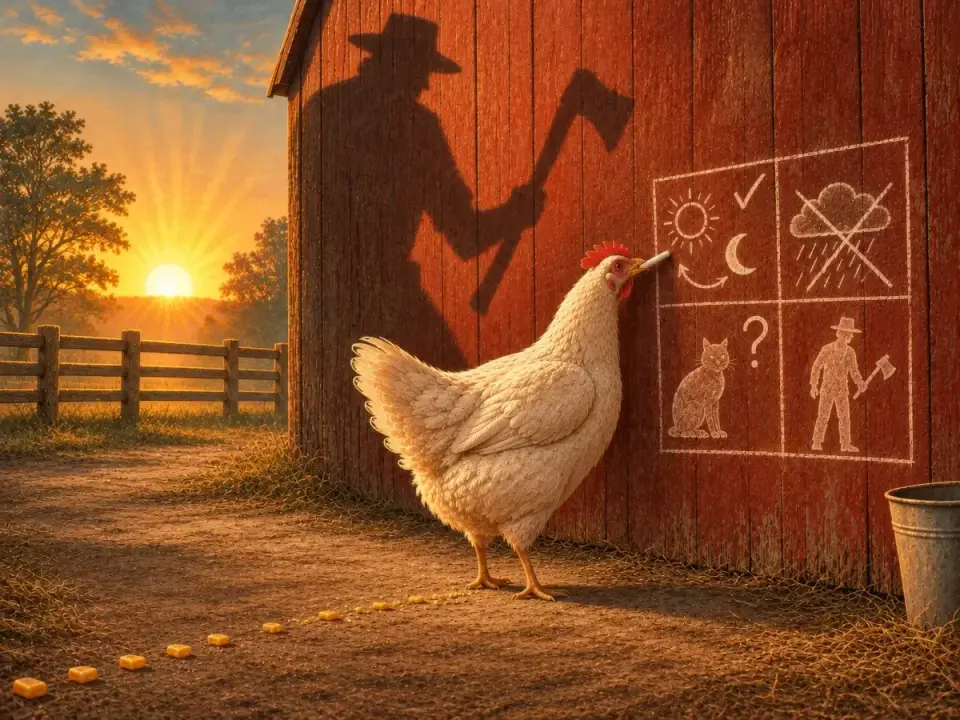
Eric Frey argues that David Hume’s Problem of Induction, which claims we cannot rationally justify expecting the future to resemble the past, does not invalidate science. While Hume viewed induction as an unjustifiable habit, Frey contends that science relies on explicit models, deductive reasoning, and falsification rather than simple extrapolation. By testing hypotheses against data, scientists can update their confidence in models without assuming the future must mirror the past. This approach distinguishes scientific inquiry from faith, as it remains open to evidence that contradicts current assumptions, even if it cannot guarantee absolute certainty.
Key points
- Hume’s Problem of Induction asserts that past experiences cannot logically guarantee future outcomes, making induction a psychological habit rather than a rational justification.
- Frey argues that science does not depend on induction but uses tools like model building, deductive reasoning, and Bayesian updating to test hypotheses.
- Bertrand Russell and Sabine Hossenfelder have suggested that without induction, science collapses into faith or insanity, but Frey counters that scientific methods allow for explicit assumptions and falsification.
- Karl Popper’s falsificationism and Richard Feynman’s emphasis on testing predictions against nature provide a framework where scientists can update credence based on data, not blind faith.
- Even if nature is non-uniform, scientific methods remain valid because they explicitly state assumptions, allowing for the detection of errors and the rejection of incorrect models.
Background
This debate follows earlier discussions on the limits of deterministic narratives in physics, such as Eric Cavalcanti’s argument that quantum mechanics prevents a single objective cosmic view. While those discussions focus on observer-dependent reality, Frey’s article addresses the foundational logic of how we derive knowledge from experience, contrasting Hume’s skepticism with modern scientific methodologies that prioritize testability over inductive certainty.
Why it matters
Understanding the distinction between induction and scientific modeling clarifies why science is not equivalent to faith. It highlights that scientific progress relies on rigorous testing and explicit assumptions, allowing for self-correction even in the face of unpredictable natural phenomena. This distinction is crucial for defending the empirical basis of scientific knowledge against philosophical skepticism and creationist arguments that claim science requires a divine guarantee of uniformity.
What to watch
The debate may continue as philosophers and scientists refine their accounts of how probabilistic reasoning and model selection operate without relying on Hume’s problematic induction. Future discussions may explore how Bayesian frameworks and falsificationism handle cases where nature exhibits non-uniformity or 'capricious' behavior, further clarifying the boundaries of scientific certainty.
Want the full story? Read the original reporting
Read on Skeptic