
Survey of 46 Experts Finds Broad Consensus on Black Hole Information Escape, but No Agreement on Mechanism
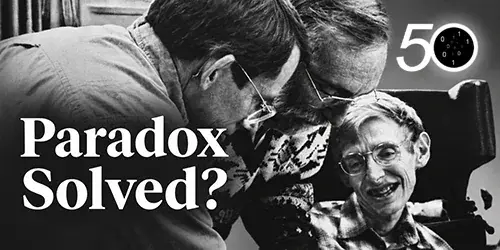
A survey of 46 leading physicists marks the 50th anniversary of Stephen Hawking’s information-loss paradox. While nearly 60% of respondents believe the paradox remains an unsolved puzzle, an overwhelming majority agrees that information escapes via Hawking radiation. However, there is no consensus on the specific mechanism, with favored approaches including replica wormholes and fuzzball models. Most experts view the issue as a critical test for future quantum gravity theories, though few expect observational data to resolve it soon.
Key points
- Physics Magazine surveyed 80 experts; 46 responded to mark the 50th anniversary of the information-loss paradox.
- Just over half of respondents believe the paradox remains a puzzle, though a solution may be near.
- An overwhelming majority of experts agree that information escapes through Hawking radiation, aligning with the Page curve.
- Slightly more than half believe quantum mechanics will prevail over general relativity, implying the latter needs modification.
- The most favored theoretical approaches involve the black hole interior (replica wormholes) and formation process (fuzzballs).
- Many experts doubt observational data will resolve the paradox soon, citing the difficulty of testing quantum gravity effects.
Background
In 1976, Stephen Hawking argued that black holes evaporate via radiation, seemingly destroying information and contradicting quantum mechanics. This created a fundamental conflict between general relativity and quantum mechanics. Hawking famously bet against John Preskill and Kip Thorne on which theory would fail. Over the decades, various solutions have been proposed, including the holographic principle and ER=EPR conjecture, but none have achieved universal acceptance. Recent developments, such as the holographic calculation of the Page curve and replica wormhole proposals, have advanced the field but not fully resolved the debate.
Why it matters
The information paradox is a critical test for any theory of quantum gravity. Resolving it could provide essential insights into unifying general relativity and quantum mechanics. As noted by several experts, it serves as a 'litmus test' for quantum gravity, potentially guiding the development of a complete theory that explains extreme gravitational conditions. The outcome may determine whether general relativity or quantum mechanics requires fundamental modification.
What to watch
Experts are divided on future progress. Some hope for observational breakthroughs via gravitational-wave measurements of black hole mergers or analogue black hole experiments. Others, like Emil Martinec, doubt observational data will provide clues soon, instead looking to AI tools for rapid theoretical progress. Tanmay Vachaspati emphasizes that any resolution must eventually make verifiable experimental predictions. The community continues to explore holographic approaches and small corrections to spacetime, but a definitive solution remains elusive.
Want the full story? Read the original reporting
Read on American Physical Society