
Juno’s Microwave Radiometer Maps Io’s Surprisingly Fluffy, Super-Heated Crust
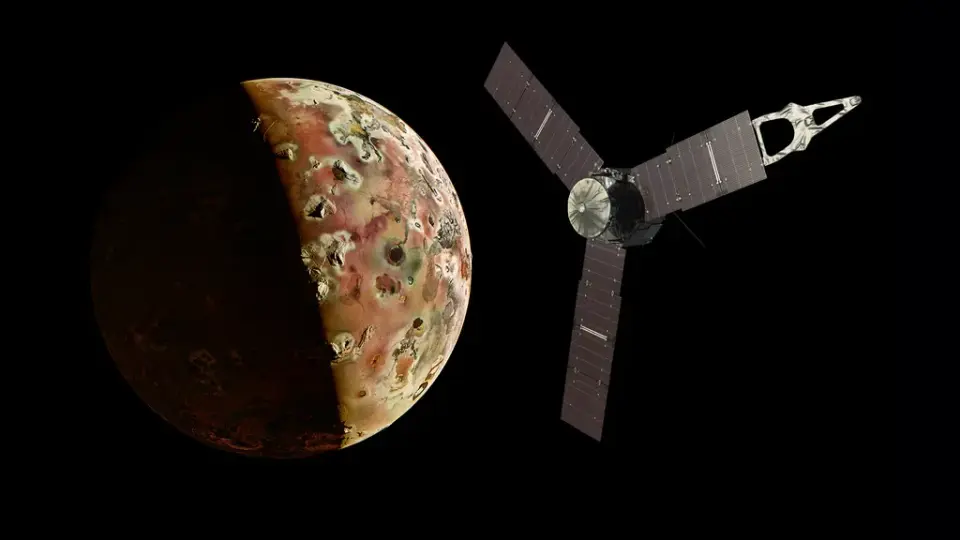
NASA’s Juno spacecraft has provided the first direct measurements of subsurface temperatures on Jupiter’s moon Io. Using its Microwave Radiometer during two close flybys in late 2023 and early 2024, scientists discovered that temperatures rise by more than 40°F within just a few feet of the surface. This steep gradient, far exceeding what solar heating alone could produce, confirms Io’s intense internal tidal heating. The data also reveals that Io’s surface is unexpectedly porous and low-density, resembling volcanic ash or pumice rather than solid rock, with heat flows 20 to 30 times greater than Earth’s average.
Key points
- Juno’s Microwave Radiometer measured Io’s subsurface temperatures during flybys on Dec. 30, 2023, and Feb. 3, 2024, penetrating from inches to tens of feet below the surface.
- Temperatures increase by more than 40°F (22°C) within a few feet of the surface, a gradient significantly steeper than what solar heating can explain.
- Io’s global heat flow is estimated at 1 to 3 watts per square meter, which is 20 to 30 times higher than Earth’s average heat flow of 0.06 watts per square meter.
- The surface material has a low density of 0.7 to 1.1 grams per cubic centimeter, consistent with porous volcanic ash, pumice, or scoria, rather than solid basalt.
- Two primary mechanisms explain the heat: steady conduction through the crust or cooling lava flows located beneath an 11-meter-thick crustal layer.
- The findings, published in the Journal of Geophysical Research: Planets, offer a new method for studying subsurface heat on rocky and icy worlds, including potential subsurface oceans on Europa and Enceladus.
Background
This discovery builds on earlier coverage from our archive, which highlighted Juno’s extended mission capabilities and the significance of tidal heating in the solar system. Previous reports noted that Juno’s Microwave Radiometer, originally designed for Jupiter’s atmosphere, was repurposed to probe the crusts of its moons. The current findings provide the first direct subsurface temperature data for Io, complementing earlier infrared observations that could only measure surface temperatures. This research aligns with broader planetary science efforts to understand how tidal forces drive geological activity across the solar system, as seen in studies of Mars’ thermal gradients and submarine volcanism.
How outlets are covering it
The Brighter Side of News and EarthSky both emphasize the steepness of the temperature gradient and the surprise of detecting subsurface heat on a rocky body. EarthSky highlights the 'fluffy' nature of Io’s surface, comparing it to the Great Plains, while The Brighter Side of News focuses on the implications for studying Earth’s volcanoes. Sky & Telescope provides a more technical perspective, noting that the microwave data confirms low thermal inertia and a porous surface, but also points out that the two flybys are insufficient to create a complete heat map. All sources agree on the significance of the findings for understanding tidal heating, but differ in their emphasis: EarthSky and The Brighter Side of News focus on the practical implications for volcanology, while Sky & Telescope highlights the limitations of the current data and the need for future missions.
Why it matters
This discovery provides a new tool for studying subsurface heat on rocky and icy worlds, potentially informing our understanding of volcanism on Earth and the existence of subsurface oceans on moons like Europa and Enceladus. The ability to measure heat flow beneath the surface of a rocky body is a significant advancement in planetary science, offering insights into the internal dynamics of worlds that are far from their parent stars. This research could also help in the development of future missions to Io and other moons, as well as in the study of terrestrial volcanoes.
What to watch
Future missions to Io could carry microwave radiometers to map heat flow across the entire moon and determine whether conduction or cooling lava dominates in different regions. Higher-resolution instruments with more frequencies and dual polarization could sharpen these comparisons. Additionally, the technique may be applied to other moons, such as Europa and Enceladus, to investigate tidal heating and the potential for subsurface oceans. The findings also suggest that similar microwave radiometry could be used to study volcanoes on Earth, providing new information on how terrestrial volcanoes work.
- NASA's Juno spacecraft finds temperatures surging just below Io’s volcanic surface Yahoo
- NASA’s Juno spacecraft finds temperatures surging just below Io’s volcanic surface thebrighterside.news
- Juno measures fiery Io’s subsurface temperature for 1st time EarthSky
- APOD: 2001 July 15 - Io in True Color science.nasa.gov
- Jupiter’s Moon Io is Surprisingly Fluffy skyandtelescope.org
Want the full story? Read the original reporting
Read on Yahoo