
New Helium Measurements Resolve Big Bang’s Weakest Evidence
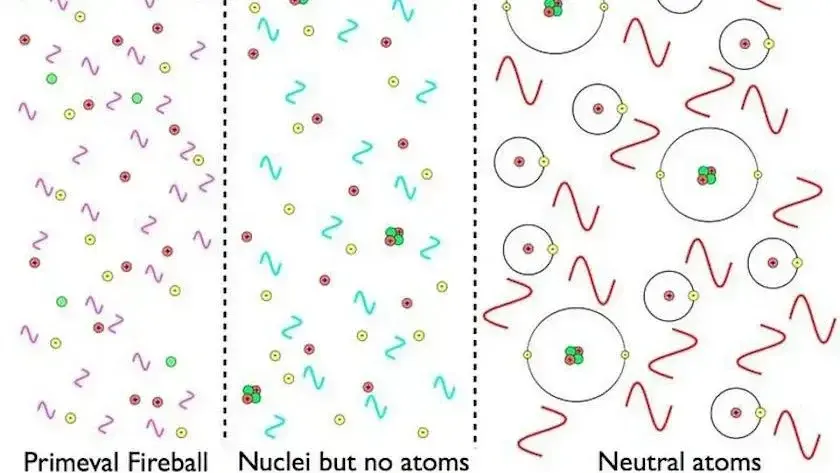
Big Bang nucleosynthesis, historically the least precise of the four pillars of cosmology, has achieved unprecedented accuracy. New data from the LBT Yp Project measures primordial helium abundance to within 0.13%, surpassing previous limits and aligning with cosmic microwave background data.
Key points
- The LBT Yp Project released new measurements of primordial helium abundance with an uncertainty of just ±0.13%, a significant improvement over the ±1.6% precision achieved in 2015.
- The study utilized the Large Binocular Telescope to observe 41 nearby, low-metallicity galaxies, selecting 15 targets with extremely low oxygen-to-hydrogen ratios to approximate pre-stellar conditions.
- The resulting helium mass fraction is 24.58%, which is consistent with the 24.67% value derived from the ESA Planck satellite’s cosmic microwave background measurements.
- This precision allows for a baryon-to-photon ratio constraint between 4.9 and 6.4 ten-billionths, matching the sensitivity of deuterium measurements despite helium’s lower theoretical sensitivity to this parameter.
- The findings eliminate previous doubts regarding Big Bang nucleosynthesis, establishing it as a robust cornerstone of cosmology alongside the expanding universe, large-scale structure, and the cosmic microwave background.
Background
Previous coverage in our archive highlighted the Big Bang as the origin of space and time, supported by the cosmic microwave background and expanding universe. Additionally, recent research has explored the early universe’s state through quark-gluon plasma experiments, though the current development focuses specifically on the nucleosynthesis of light elements in the first 20 minutes after the Big Bang.
Why it matters
This advancement closes a long-standing gap in cosmological evidence. By achieving precision comparable to the cosmic microwave background, Big Bang nucleosynthesis is no longer the weakest link in the standard model of cosmology, providing a unified, high-precision picture of the universe’s evolution from its first second to the present day.
What to watch
Future improvements are expected as new optical telescopes, such as the Extremely Large Telescope and the Giant Magellan Telescope, come online. These instruments will further refine measurements of primordial helium and baryon-to-photon ratios, potentially constraining exotic neutrino species.
Want the full story? Read the original reporting
Read on bigthink.com