
Fly Connectome Unlocks Sex-Specific Neural Insights and Viral Game Simulations
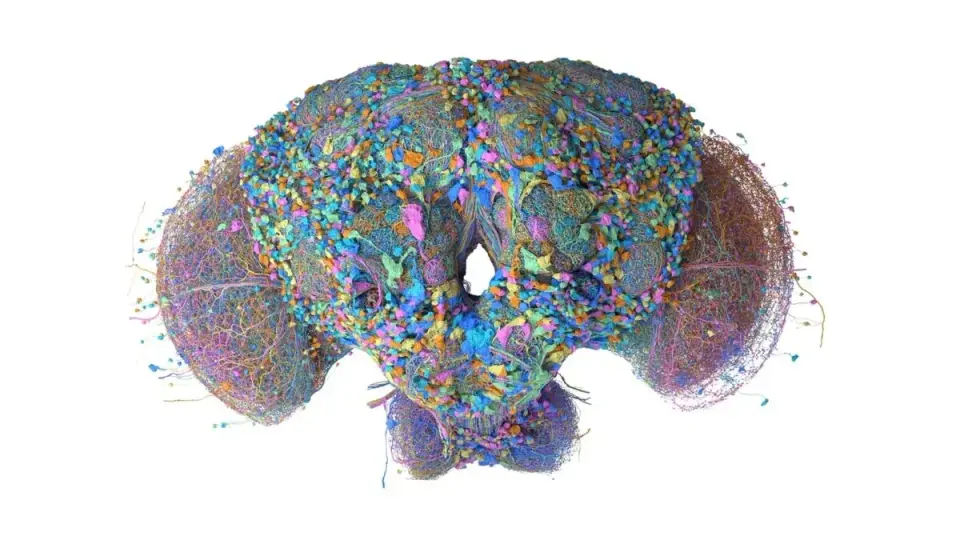
Researchers at Google and HHMI Janelia have completed the first full map of an adult male fruit fly’s brain and central nervous system, cataloging 166,000 neurons and 125 million synaptic connections. This decade-long project, published in September 2026, provides a critical resource for understanding neural circuits and sex-specific behaviors. While the scientific value lies in advancing neurobiology and modeling human brain functions, the public response has been dominated by developers using the data to simulate the fly’s brain in video games like Doom and Super Mario 64.
Key points
- The male fruit fly connectome includes 166,000 neurons and 125 million synapses, making it the largest brain map by neuron count to date.
- The project took approximately four years, utilizing electron microscopy, AI for image stitching, and human verification to reconstruct the 3D neural architecture.
- Comparing the male map with the previously completed female map revealed 289 male-specific neurons, 71 female-specific neurons, and 138 neurons that differ in shape or connection between sexes.
- Developers have used the open data to simulate the fly’s neural activity in games such as Doom, Super Mario 64, and Minecraft, often using AI-assisted coding tools.
- Google is currently expanding connectome mapping efforts to fish and mice, aiming to refine techniques for future, more complex nervous systems.
Background
This development follows the completion of the female fruit fly connectome earlier in 2026, which allowed for the first direct comparison of neural differences between sexes. Previous archive coverage highlighted the technical challenges of mapping such a dense network and the potential for these tools to accelerate research into human brain disorders. The current milestone builds on that foundation by providing a complete male dataset, enabling researchers to analyze how genetic factors like 'doublesex' and 'fruitless' influence neural wiring and behavior.
How outlets are covering it
Gizmodo and Tom’s Hardware emphasize the viral nature of the story, focusing on how software engineers are using the connectome data to play video games, which has sparked public debate about simulation and consciousness. Ars Technica provides a more technical perspective, detailing the collaborative effort between biologists and computer scientists, the use of generative AI to fix imaging gaps, and the scientific implications of comparing male and female brains. X posts highlight the community’s mixed reactions, ranging from awe at the simulation’s realism to skepticism about the claim that the fly is 'playing' games, with developers clarifying that these are simplified exploratory models rather than living brains.
Why it matters
The completion of the male fruit fly connectome represents a significant leap in neuroscience, providing a detailed wiring diagram that can help scientists understand how brains process information and react to stimuli. By comparing male and female maps, researchers can identify specific neural circuits responsible for sex-based behavioral differences, which may inform future studies on human neurodevelopment. Additionally, the techniques developed for this project, including AI-assisted reconstruction and human verification, are being refined to tackle more complex nervous systems, potentially paving the way for mapping mouse and fish brains in the near future.
What to watch
Google and HHMI Janelia are already working on connectomes for fish and mice, aiming to apply the tools and methods developed for the fruit fly to more complex organisms. Researchers expect that as the process becomes faster and more automated, the cost of mapping larger brains will decrease, similar to the trajectory seen in genomics. In the meantime, the open-source nature of the fruit fly data is likely to lead to more experimental simulations and interactive projects from the developer community.
- Google Mapped a Fruit Fly’s Brain. Now It’s Playing Doom and Super Mario 64 Gizmodo
- Second complete map of a fruit fly brain completed Ars Technica
- Bad Apple Video Runs on Simulated Fruit Fly Brain Connectome x.com
- Google maps entire brain and central nervous system of adult male fruit fly, software engineers immediately make it run Doom — AI-powered 3D model of over 166,000 neurons can also play Super Mario 64 Tom's Hardware
- Completing the Connectome: How Pursuing a Map of the Fly Brain Rewired Neuroscience HHMI
Want the full story? Read the original reporting
Read on Gizmodo