
Shotgun genetic engineering enables high-throughput metabolic design in mammalian cells
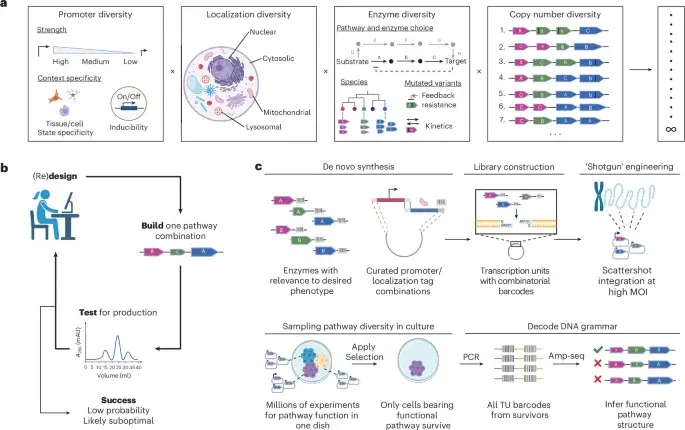
Researchers developed shotgun genetic engineering (SGE) to overcome the combinatorial complexity of metabolic engineering in mammalian cells. By delivering barcoded, small DNA constructs into millions of cells simultaneously, SGE allows each cell to act as an independent experiment. This approach successfully engineered essential amino acid biosynthesis in Chinese hamster ovary (CHO) and Jurkat cells, achieving near-wild-type growth rates without valine or isoleucine. The method identified optimal mitochondrial localization and gene stoichiometry, outperforming previous rational design strategies and generating data for machine learning models.
Key points
- SGE replaces sequential design-build-test cycles with parallel screening of millions of pathway combinations in a single experiment.
- The method uses barcoded small DNA constructs delivered via lentivirus, where each cell receives a unique random combination of genetic parts.
- SGE successfully restored valine and isoleucine biosynthesis in CHO cells, with valine-free growth rates reaching 1.1 days per doubling, compared to 3.8 days in previous rational designs.
- Functional pathways favored mitochondrial localization of enzymes, a variable previously underexplored in mammalian metabolic engineering.
- The approach was extended to human Jurkat T cells, demonstrating potential for engineering stress-resilient cell therapies.
Background
Mammalian metabolic engineering has lagged behind microbial systems due to slow cell doubling times and the difficulty of delivering large DNA constructs. Previous efforts, such as the 2022 eLife study by the same authors, used rational design to introduce valine biosynthesis into CHO cells but failed to achieve isoleucine independence. SGE addresses these limitations by leveraging the ease of synthesizing and delivering small, barcoded constructs, allowing for unbiased exploration of gene content, stoichiometry, and organellar localization.
How outlets are covering it
Nature emphasizes the technical innovation of SGE, highlighting its ability to screen millions of combinations and generate datasets for machine learning. Bioengineer.org frames SGE as a solution to the 'combinatorial explosion' problem, comparing it to shotgun sequencing and noting its potential to compress years of optimization into single experiments. Both sources agree on the method's potential for biomanufacturing and cell therapy, but Bioengineer.org places greater emphasis on the broader implications for synthetic biology, while Nature focuses on the specific biochemical outcomes and the importance of mitochondrial localization.
Why it matters
SGE provides a scalable framework for engineering complex metabolic traits in mammalian cells, which are critical for producing therapeutic proteins and cell therapies. By enabling the discovery of functional pathways that were previously inaccessible through rational design, SGE could accelerate the development of more efficient and robust cell lines for biopharmaceutical production and personalized medicine.
What to watch
Researchers will likely expand SGE to other cell types and metabolic pathways, potentially applying it to optimize glycosylation and other complex traits. The generated datasets may be used to train machine learning models for predictive design of synthetic metabolic pathways, further reducing the need for experimental screening.
- Highly multiplexed mammalian metabolic engineering with a shotgun approach Nature
- Shotgun genetic engineering lets mammalian cells test millions of designs at once Bioengineer.org
- Shotgun genetic engineering lets mammalian cells stumble onto new metabolic pathways Bioengineer.org
- High-throughput metabolic engineering in mammalian cells Nature
- Shotgun engineering fires up mammalian metabolic design Nature
Want the full story? Read the original reporting
Read on Nature